Mexican exports rebound in May, supporting a trade surplus, with manufacturing leading the way
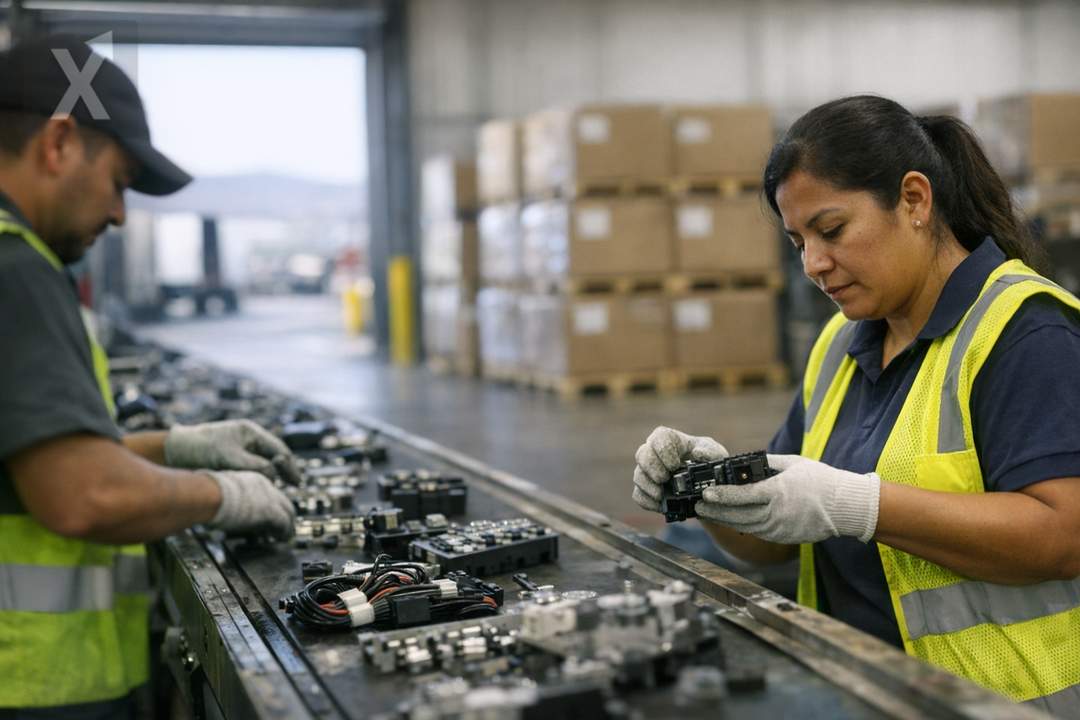
Mexico sharply increased its overseas sales in May, supported by manufacturing and a larger flow of imported inputs used for production.
Mexico’s exports picked up speed in May, posting one of their strongest readings of the year—a sign that the external sector continues to act as a buffer amid uneven domestic growth across industries. According to the latest figures, the country exported $69.544 billion, a 25.4% year-over-year increase, driven by manufacturing performance and by strong non-auto shipments, which offset weakness in the auto segment.
At the same time, imports totaled $67.285 billion, 24% higher than in May of the previous year. The result was a trade surplus of $2.259 billion, smaller than April’s but still positive, in an environment where industrial activity and supply chains continue to set the pace for Mexico’s foreign trade.
Growth was led by the non-oil component: non-oil exports rose 25.6% year over year, while oil exports increased 18%. Within non-oil exports, shipments to the United States climbed 27.2%, and exports to the rest of the world grew 17.7%—performance that suggests broad-based momentum, although the U.S. market remains the main destination given the degree of production integration between the two countries.
Strong manufacturing, but the auto sector still lags
Manufacturing once again accounted for most of the momentum. Manufactured exports reached $62.990 billion, up 25.1% year over year. Within that category, a standout was the surge in machinery and equipment for a range of industries (98.1%), along with gains in mining-metallurgy, electrical and electronic equipment, plastics and rubber, and the food, beverages, and tobacco category—reflecting a mix of external demand and a reshuffling of orders within regional supply chains.
The contrast showed up in the auto sector, where exports fell 2.2% year over year. The decline was tied to a 3.5% drop in sales to the United States, although shipments to other markets grew 5.7%. In practice, auto performance tends to be more sensitive to inventory adjustments, temporary shutdowns, platform changes, and the consumer cycle in the U.S. market; that’s why its weakness doesn’t necessarily negate the broader strength of manufacturing, but it does create a key watch item for the coming months.
On the primary front, agricultural and livestock exports increased 2.2%, with gains in grapes and raisins, tomatoes, fresh legumes and vegetables, citrus, and cucumbers; by contrast, green coffee and avocados declined. Extractive exports, for their part, jumped 88.7%—a category that often shows large swings due to base effects and the lumpy nature of shipments.
Imports rise: more inputs for production and mixed signals on investment
Import growth was led by intermediate goods—inputs used to manufacture other products—which totaled $54.314 billion and rose 29.8% year over year. This is typically interpreted as a sign consistent with heavier manufacturing workloads and the export cycle, especially in industries closely integrated with the United States.
By contrast, consumer goods imports rose 6.5%, and capital goods imports increased just 1.6%. The economic takeaway from that last figure is important: modest growth in capital goods may suggest that investment in machinery and equipment is still moving forward, but without the same momentum as inputs trade, in a context where investment decisions depend on financing costs, energy and infrastructure availability, and regulatory certainty.
The surplus holds, but the composition is shifting
May’s $2.259 billion surplus came in below April’s balance ($4.520 billion) due to a smaller non-oil surplus, while the oil deficit was virtually unchanged. This nuance matters because in Mexico, the oil balance is often shaped both by the production platform and by the need to import fuels, which limits the energy sector’s net contribution to the trade balance.
For January through May, exports totaled $317.172 billion, a 22.6% year-over-year increase. Over the same period, imports reached $311.405 billion, up 20.8%. As a result, the country reported a trade surplus of $5.767 billion, well above the $918 million recorded in the same period a year earlier—performance that underscores the importance of the external sector in 2026.
Looking to the second half of the year, the main support will continue to be manufacturing, as long as U.S. demand remains steady and regional supply chains keep favoring Mexican suppliers due to costs, logistics, and rules of origin. Still, the auto sector’s performance, the pace of productive investment, and costs tied to imported inputs will continue to determine whether this momentum translates into a broader expansion of the productive base.
In short, May showed vigorous foreign trade: exports at relatively high levels, rising imports of inputs, and a still-solid surplus. The challenge will be sustaining the manufacturing push and reducing vulnerabilities in specific areas—such as autos and energy—so that the strong external backdrop translates more clearly into domestic growth.






