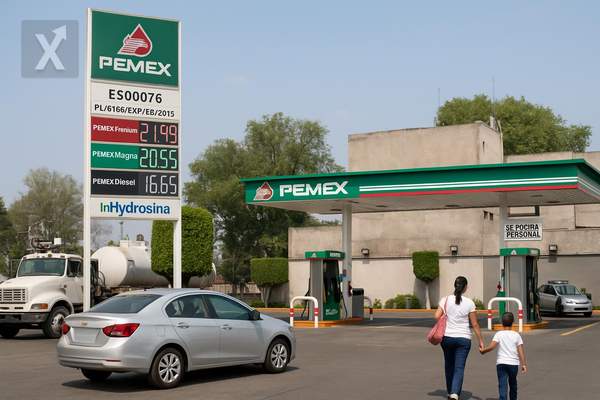
Finance Ministry reinstates Premium gasoline tax break amid oil rebound and mounting pressure on fuel prices
The rise in oil prices triggered by the conflict between the United States and Iran led the Finance Ministry to increase IEPS tax breaks, including for Premium gasoline.
Mexico’s Ministry of Finance and Public Credit (SHCP) reinstated the tax stimulus for Premium gasoline for the week of July 18–24, 2026, after a period in which this fuel received no support. The move responds to a rebound in international oil prices, which has once again made fuels more expensive in global markets amid renewed clashes between the United States and Iran.
According to what was published in the Official Gazette of the Federation (DOF), Premium gasoline will receive a stimulus of 8.23% applied to the Special Tax on Production and Services (IEPS) per‑liter rate, equivalent to 0.4655 pesos per liter. As a result, the IEPS amount consumers will pay will be 5.1924 pesos per liter during the period in question.
The adjustment also increased support for Magna gasoline, with a 22.20% stimulus (1.4877 pesos per liter), placing the IEPS rate at 5.2124 pesos per liter. For diesel, the increase was more pronounced: the stimulus rose to 50.64% (3.7291 pesos per liter), reducing the IEPS rate to 3.6343 pesos per liter. Compared with the prior week, the change implies a greater fiscal effort, since Magna was at 15.95%, Premium still had no stimulus, and diesel stood at 26.26%.
The move comes alongside a notable rebound in Mexico’s crude oil export blend, which reached $77.67 per barrel—nearly 20% above the level seen before the conflict resumed. While crude prices do not automatically translate into pump prices, higher oil prices raise costs throughout the supply chain, especially in a country that still depends on imports of fuels and components to cover a significant share of domestic consumption.
Finance also reported that no supplemental stimuli will be granted for any of the three fuels during the week in question, limiting the room for additional relief if international prices continue trending upward or if exchange-rate volatility emerges.
IEPS, inflation, and the exchange rate: the balancing act behind prices at the pump
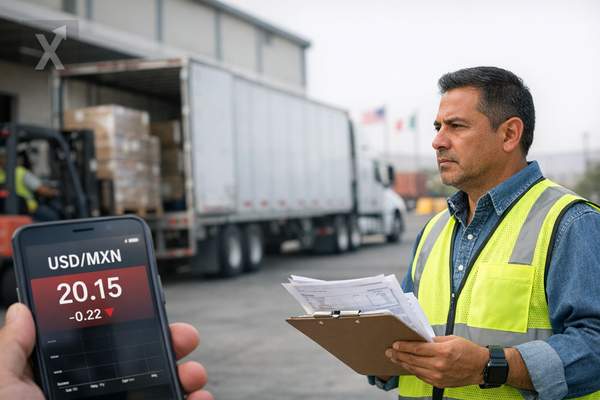
In Mexico, the final price of gasoline depends on several factors beyond crude oil: the IEPS, the exchange rate, refining, logistics and distribution costs, and international benchmarks for finished fuels. As a result, a geopolitical shock can translate into indirect inflationary pressures even when a smoothing mechanism exists through tax stimuli. For public finances, the challenge is twofold: to contain sharp increases that hurt purchasing power and inflation—particularly in transportation and goods—without excessively compromising revenue collection or raising the fiscal cost of the stimuli. The performance of the U.S. dollar against the peso often acts as an amplifier: if the exchange rate weakens at the same time oil rises, the peso cost of importing fuels can increase, raising pressure to extend or deepen the stimuli.
From a macroeconomic perspective, IEPS stimuli function as a short-term buffer, but their repeated use also reflects Mexico’s exposure to global energy volatility. During episodes of rapid price increases, the stimuli can help moderate pass-through to prices, although the effect is not always uniform across regions due to differences in transportation costs and market conditions. For mobility- and logistics-intensive businesses, diesel is usually the most sensitive point, so the larger stimulus for this fuel aims to contain second-round effects on consumer prices.
Looking ahead, the trajectory of the conflict in the Middle East and its impact on supply and oil risk premiums will be decisive for stimulus policy. If volatility persists, Finance could face pressure to maintain support for longer, while the central bank continues monitoring core inflation and supply shocks. At the same time, domestic refining capacity and logistical efficiency remain structural factors that shape the country’s vulnerability to episodes of externally driven price increases.
In sum, the return of the Premium stimulus and the increased support for Magna and diesel show an effort to contain the impact of higher crude prices on household budgets and inflation, in a context where geopolitics and the exchange rate may continue moving fuel costs.