Cetes Slip While Inflation Tightens: The Challenge of Keeping Real Returns in Mexico
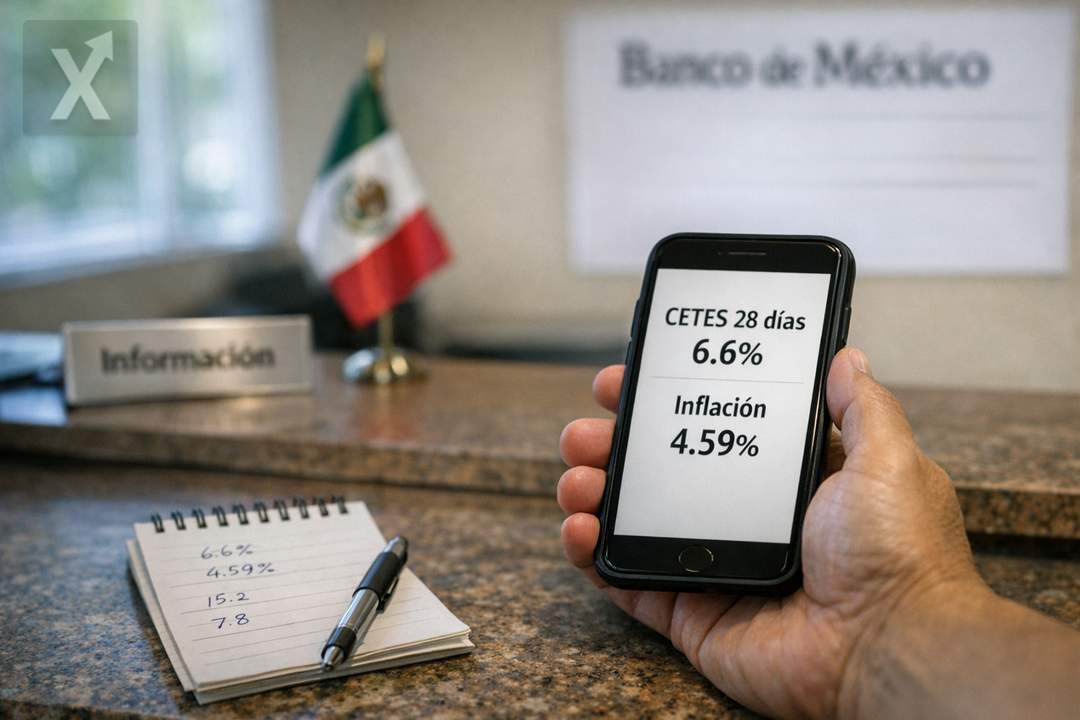
Falling Cetes rates and a pickup in inflation are shrinking the real profit margin for savers, even though returns still outpace price increases.
Yields on Mexico’s Treasury Certificates (Cetes) extended their downward trend into the second half of April, at a time when inflation moved back above the central bank’s target range. This clash of forces—declining rates and rising inflation—is reducing the relative appeal of the most popular instrument among retail investors, especially those looking to preserve purchasing power with low risk.
In the latest available reading, headline inflation came in at 4.59% year over year in March, reflecting pressure in consumption-sensitive components such as food and energy. Against that backdrop, Cetes still offer a nominal return above the overall rise in prices; however, the real “cushion” has narrowed as auctions post lower rates and the market prices in a longer monetary policy easing cycle.
Across the most actively traded tenors, the 28-day Cete held at 6.6%, while the 91-day fell to 6.7%. The 182-day came in at 6.98% and the one-year Cete at 7.16%, both also down from prior auctions. The path is consistent with an environment where the cost of money is normalizing after the period of elevated rates that prevailed since 2022, when the Bank of Mexico (Banxico) tightened policy to confront the most intense inflation episode in decades.
For investors, the central question isn’t only “what does the Cete pay,” but how much it yields after factoring in inflation and taxes. In simplified terms, subtracting annual inflation from the nominal yield helps approximate the real return. With inflation at 4.59% annually, a 6.6% Cete implies a spread of about 2 percentage points. Still, if inflation remains high or accelerates again, that spread shrinks and savings lose purchasing power faster than expected.
In addition, annual inflation doesn’t always line up with the instrument’s horizon: anyone investing for 28 or 91 days faces reinvestment risk—meaning that when the Cete matures, the new yield may be lower just as prices could remain under pressure from external shocks or seasonal effects in certain food items.
Banxico, Expectations, and the “Floor” for Rates in the Economy
Cetes performance is closely tied to the path of Banxico’s policy rate and to market expectations for inflation, growth, and the exchange rate. In Mexico, when the central bank begins or deepens rate cuts, the adjustment typically feeds into short-term government instruments, which serve as benchmarks for bank lending, corporate financing, and portfolio valuation. However, the speed and size of cuts depend on the “battle” against inflation: if price pressures remain above target, Banxico tends to be more cautious to avoid unanchoring expectations and raising the risk premium.
In this context, investors are watching both domestic and external factors. At home, consumer demand, wage adjustments, services momentum, and the trajectory of agricultural prices often determine how persistent inflation is. Abroad, bouts of energy volatility or geopolitical tensions can move import costs and the fuel component, with second-round effects on transportation and food. If those risks materialize, rates could find a higher-than-expected “floor,” or at least decline more slowly.
For households, Cetes remain a relevant option because of their low risk and ease of access, particularly through investment platforms that allow small amounts. Their role as a capital-preservation tool matters in a country where a significant share of savings is still held in cash or in accounts with yields below inflation. Even so, falling rates make it necessary to compare alternatives: other government instruments with longer maturities or strategies that combine liquidity and term can improve the balance between return and availability, though with different sensitivities to market moves.
In practice, the real return a saver ultimately receives depends on several factors: actual inflation during the investment period, the reinvestment rate at maturity, tax withholding, and the timing of entry. In a declining-rate environment, an investor who “locks in” a longer term can secure a nominal yield for more time, though they face an opportunity cost if rates were to rise due to an unexpected inflation shock.
Looking ahead, the market takeaway is mixed: if inflation gradually converges and growth holds without overheating, Cetes could continue adjusting lower, reducing real returns. If, instead, inflation proves sticky—because of food, energy, or services—Banxico would have less room to cut and yields could stabilize, though at the cost of tighter financial conditions for businesses and consumers.
In short, lower Cetes rates don’t eliminate their usefulness as a low-risk refuge, but they do narrow the margin over inflation and force savers to pay closer attention to real returns, their investment horizon, and the price backdrop the Mexican economy will face in the coming months.






