Carlos Torres Rosas Set to Lead Nafin and Bancomext at a Pivotal Moment for Credit and Exports
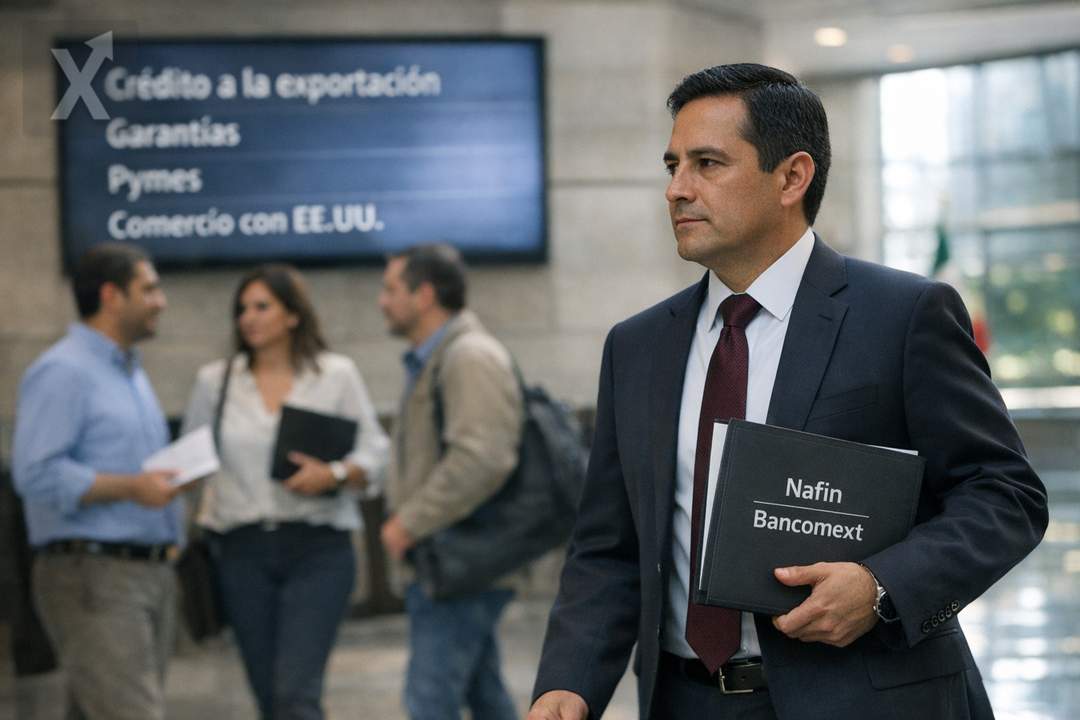
The leadership change at Mexico’s development banks comes as the country seeks to sustain investment, jobs, and foreign trade by expanding financing for businesses.
Carlos Torres Rosas is expected to be appointed next week as the new head of Nacional Financiera (Nafin) and the National Bank for Foreign Trade (Bancomext), two cornerstone institutions in Mexico’s development banking system, according to sources familiar with the process. The move follows the departure of Roberto Lazzeri, who was recently put forward to represent Mexico as ambassador to the United States.
The transition comes as Mexico’s economy navigates a mix of opportunities and pressures: on the one hand, the reshuffling of supply chains toward North America and strong export momentum; on the other, still-elevated borrowing costs, private investment that demands regulatory certainty, and an infrastructure and energy agenda that will shape the pace of industrial expansion. In that landscape, Nafin and Bancomext become key levers to expand credit, support project financing, and reduce funding barriers for businesses with productive potential.
Torres Rosas, who holds a degree in Business Administration from the University of Bath in the United Kingdom, currently serves as general coordinator of the Welfare Programs. He also has experience in the private sector and in government, including work at the Office of the Presidency during Andrés Manuel López Obrador’s administration. His arrival puts the spotlight on coordination between the new government’s social policy agenda and the state’s growth-oriented financial tools—especially for small and medium-sized businesses.
Bancomext’s mandate is to promote and finance foreign trade and companies that generate foreign-currency earnings, while Nafin operates as a second-tier development bank and a provider of guarantees and funding, with an emphasis on micro, small, and medium-sized enterprises (MSMEs). In practice, both institutions often serve as complements to traditional bank lending, particularly when private-sector risk appetite declines.
What’s at Stake for Development Banking: Borrowing Costs, MSMEs, and Supply Chains
With policy rates still at restrictive levels and a credit market moving cautiously, the challenge for Nafin and Bancomext will be to broaden access to financing without weakening portfolio quality. For MSMEs—which account for a significant share of formal employment and serve as suppliers within industrial value chains—the difference between having or not having guarantees, factoring, or working-capital lines can determine both survival and the ability to plug into export-driven projects.
At the same time, the opportunity lies in strengthening financing tied to supplier networks, logistics, advanced manufacturing, and import substitution in sectors where Mexico already has export traction. Bancomext, in particular, can make an impact by offering credit on competitive terms and supporting transactions linked to foreign trade, while Nafin can accelerate guarantee programs and financial training initiatives to increase business access to banking services and boost formalization.
This moment also calls for improved coordination with commercial banks and state governments to structure viable, bankable projects—especially in regions experiencing industrial expansion and mounting pressure on urban services. If development banking can catalyze private investment—without crowding it out—it can help ensure growth extends beyond the export cycle and translates into higher productivity.
Looking ahead, Torres Rosas’s performance will be watched for his ability to translate public goals into measurable financial tools: effective loan and credit placement, support for businesses with job-creation potential, and risk-mitigation mechanisms that expand coverage without making credit more expensive. In an environment where competition for capital is intense and certainty is an asset, clarity of priorities and institutional execution will matter as much as the appointment itself.
In short, the leadership change at Nafin and Bancomext is shaping up to be a decision with direct implications for productive financing and foreign trade. The challenge will be to turn development banking into an efficient bridge between investment opportunities and the businesses that need credit to grow and export.






