ENIGH 2024: Average Income Rises, but the “Mexico of Deciles” Still Defines Social Class
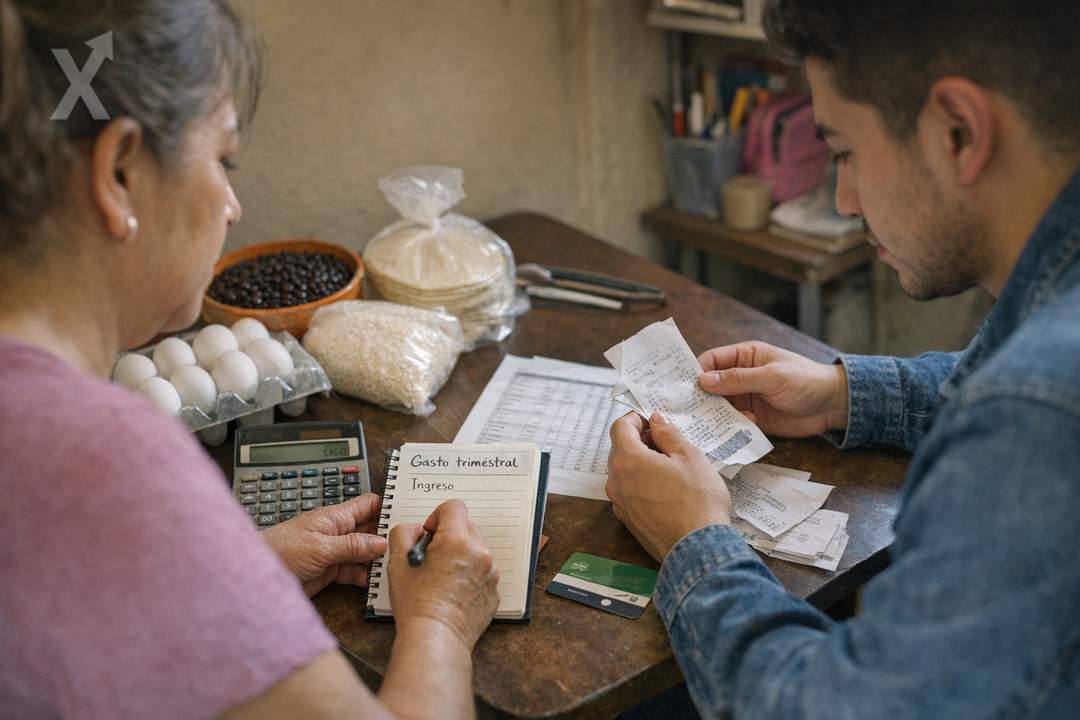
The income gap narrowed in the statistics, but the cost of living and informality keep pressure on most households.
In Mexico, the conversation about “social class” is often settled by intuition: whether there’s enough for groceries, rent, and transportation, or whether there’s room to save, rely less on debt, and plan ahead. Still, the numbers help ground that perception. INEGI’s 2024 National Household Income and Expenditure Survey (ENIGH) once again draws a clear map: average income is rising, inequality as measured by aggregate indicators is falling, but the distance between lower- and higher-income households remains wide—and decisive for well-being.
According to ENIGH 2024, the average quarterly current income per household came in at 77,864 pesos. By itself, that figure says little without looking at the dispersion: in urban areas, average income was 85,550 pesos per quarter, while in rural areas it dropped to 48,004. That gap reflects not only unequal productive opportunities, but also uneven access to formal jobs, services, infrastructure, and markets.
A practical way to look at economic stratification is income distribution by deciles. At the bottom end, Decile I reported 16,795 pesos per household per quarter, versus 236,095 pesos for Decile X. Between those extremes is the day-to-day reality of millions of families who, even while working, operate on tight budgets with little room to handle a medical emergency, a home repair, or a job loss.
Inequality, measured by the Gini coefficient, continued to decline, reaching 0.391 in 2024, down from 0.402 in 2022 and 0.449 in 2016. But the same survey shows an important nuance: without transfers, benefits, and social programs, the Gini would have climbed back to around 0.450. In other words, a meaningful share of the statistical improvement is tied to redistributive policy rather than a structural closing of gaps in productivity, job quality, or skills.
Household Spending: Essentials Eat Up the Budget and Limit Mobility
ENIGH 2024 also puts the spotlight on the most tangible side of household economics: where the money goes. Average quarterly current monetary spending reached 47,674 pesos per household. The largest share went to food, beverages, and tobacco (17,982 pesos), followed by transportation and communications (9,319 pesos). Education and recreation (4,593) and housing and utilities (4,346) round out the core categories that, together, shape quality of life. When most income is devoted to basic consumption, the ability to save, invest in training, or start a business shrinks—making it harder to “move up” from one economic tier to another.
This spending pattern takes on additional meaning in Mexico’s recent context: after the inflation episode of 2021–2023, headline inflation has moderated, but households still feel the squeeze in sensitive categories like food and services. At the same time, rising rents in certain cities, pressure on transportation costs, and the cost of consumer credit—shaped by interest rates that remain high by historical standards—tend to compress disposable income, especially for those without access to cheaper financing or formal savings vehicles.
On the income side, work remains the central pillar: 65.6% of total quarterly current income came from labor. Transfers contributed 17.7%, and the imputed rental value of owner-occupied housing 11.6%, while income from property rentals accounted for 4.9%. The picture is clear: for most households, the economy depends on job and wage stability, in a labor market where informality remains a structural feature and where access to Social Security, pensions, and risk protection is far from uniform.
In that environment, minimum-wage increases in recent years have lifted incomes at the lower end of the distribution and helped narrow some gaps, but they don’t, by themselves, solve the underlying challenge: boosting productivity, transitioning to greater formality, and expanding access to better-paying jobs. Investment tied to North American supply chains—a phenomenon associated with nearshoring—creates opportunities, though its impact varies by region and depends on local conditions: availability of energy and water, security, logistics, and human capital.
The “class” labels used in reference documents—from lower-lower to upper-upper—work as a descriptive framework, but ENIGH suggests a more practical interpretation: the country is organized into income steps with very different realities. For lower deciles, the priority is sustaining basic consumption; for middle deciles, stabilizing finances and managing housing, education, and transportation costs; and for upper deciles, the capacity to save, invest, and diversify wealth is clearly greater.
Looking ahead, the question for economic policy isn’t just whether inequality can keep falling, but how to do it without relying exclusively on transfers: by consolidating more inclusive growth, expanding the base of formal taxpayers, strengthening competition in key markets, and improving public services that reduce out-of-pocket spending (health, caregiving, transportation). In practice, that package determines how “expensive” it is to be middle class in Mexico—and how feasible it is to sustain that status over time.
In sum, ENIGH 2024 confirms an improvement in inequality indicators, but it also shows that the structure of income and spending continues to put most households under pressure. Progress is visible in the aggregate; the challenge remains on the ground: higher-quality jobs, less vulnerability to shocks, and a cost of living that doesn’t swallow up any gains.






