Mexico Finds a New Export Niche in the Pet Food Boom
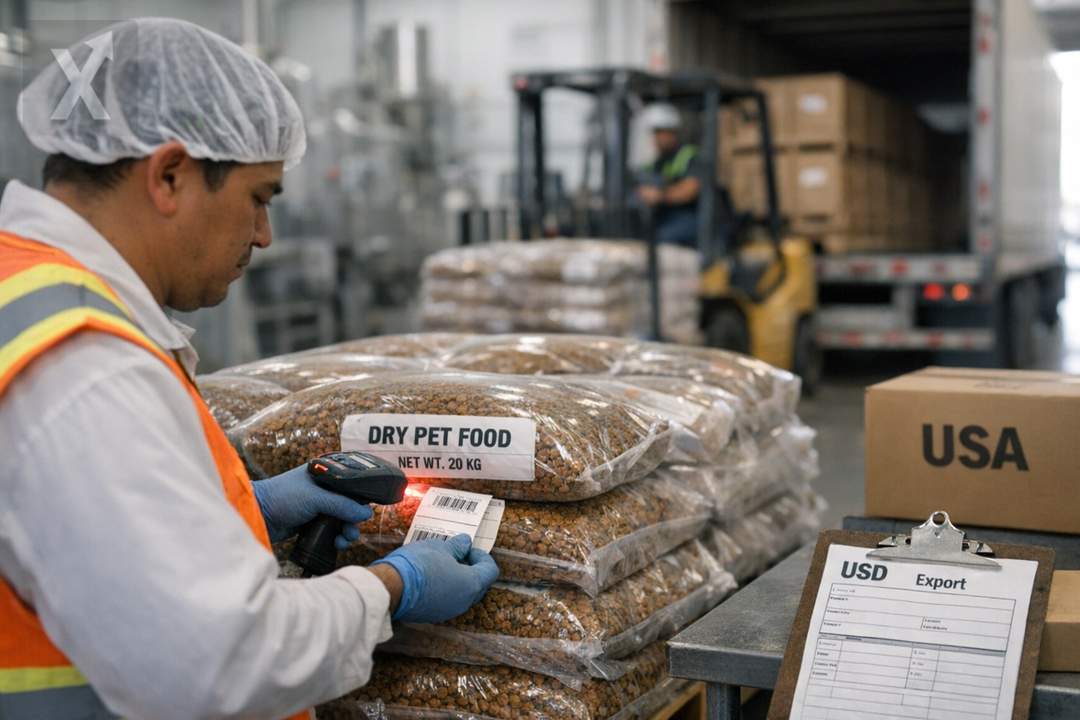
Mexican exports of dog and cat food have multiplied over the past decade, driven by premium demand and integration with the U.S.
Mexico’s economy is adding a low-profile—but increasingly important—player to its export mix: pet food. What began as a shift in household consumption habits—more pets and more spending on their well-being—is scaling into an industrial opportunity with regional reach, as Mexico looks to position itself as a manufacturing platform for North America and Latin America.
According to trade figures reported by the Bank of Mexico (Banxico), Mexican exports of dog and cat food aimed at the retail channel rose from $28.3 million in 2015 to $214.2 million in 2025—a 7.5x jump. Over the same period, imports also climbed, from $84.3 million to $311.3 million, reflecting a strong expansion in the domestic market and the fact that the country continues to buy product from abroad, even as export momentum accelerated faster.
By destination, the United States (U.S.) accounts for about 30% of Mexican shipments, but the pattern shows diversification toward Central and South America, with a growing presence in economies such as Costa Rica, Guatemala, Colombia, and El Salvador. That spread aligns with Mexico’s logistics advantage: geographic proximity to the region’s largest market and competitive routes to the rest of the continent.
The trend comes at a time when Mexico is trying to deepen its role as a regional producer of higher value-added goods, supported by USMCA, the reshuffling of supply chains (nearshoring), and a manufacturing base that has continued to attract investment despite bouts of global volatility. In this case, the edge comes not only from the food industry itself, but from the entire agribusiness chain: grains, proteins, oils, packaging, logistics, and sanitary standards that make it possible to compete in more demanding segments.
Growth is already visible on the corporate map. Large multinationals with local operations have expanded capacity, while Mexican brands are increasing scale and upgrading their product portfolios to capture a consumer who now demands specialized formulas, “premium” options, functional products, and ingredient traceability—categories that typically deliver better margins than standard pet food.
Investment, Standards, and the Challenge of Competing in a “Premium” Market
The export surge isn’t explained by volume alone; it’s also tied to a shift toward higher-value products. In the pet food business, differentiation comes down to consistent quality, certifications, sanitary compliance, and the ability to develop specific formulas (by age, size, digestive sensitivity, or clinical needs). For Mexico, that means investing in extrusion technology, quality-control labs, traceability, and logistics with tighter standards—along with a stable supply base for raw materials. In an environment where agricultural input costs can be volatile and where energy and transportation continue to pressure margins across industries, competitiveness will hinge more on efficiency, scale, and reliable access to inputs than on competing on price alone.
On the external front, selling into the U.S. is attractive because of market size and purchasing power, but it also requires regulatory discipline and consistency. The opportunity is amplified by USMCA trade integration, although the sector is not insulated from the trade uncertainty that at times affects Mexico’s export industries. In that sense, companies tend to pursue two strategies: cement long-term relationships with North American customers while also diversifying across Latin America to reduce dependence.
The international backdrop also works in Mexico’s favor. Market research firms estimate that the global pet food industry continues to expand, driven by urbanization, smaller households, and a greater willingness to spend on animal well-being. In North America, where pet ownership is high, spending on specialized products tends to be less sensitive to the economic cycle than other discretionary categories, making it attractive to produce close to the end consumer.
For Mexico, the potential of this niche lies in how it combines existing strengths—agribusiness, manufacturing, and exports—with demand that is shifting toward higher-value products. If it consolidates, pet food could become a supply chain that attracts more investment, industrial jobs, and technological content, though with clear challenges: securing inputs, raising quality standards, and maintaining competitive access to the U.S. market during a period of trade and regulatory adjustments.
In perspective, recent performance suggests that the “pet economy” has moved beyond a domestic consumption story and is becoming an emerging export component. The key will be sustaining the pace through productivity, innovation, and market diversification—avoiding progress that depends on a single destination or short-term advantages.






