U.S. Tariff Reshuffles the Tomato Market: Mexico Loses Share and Domestic Prices Rise
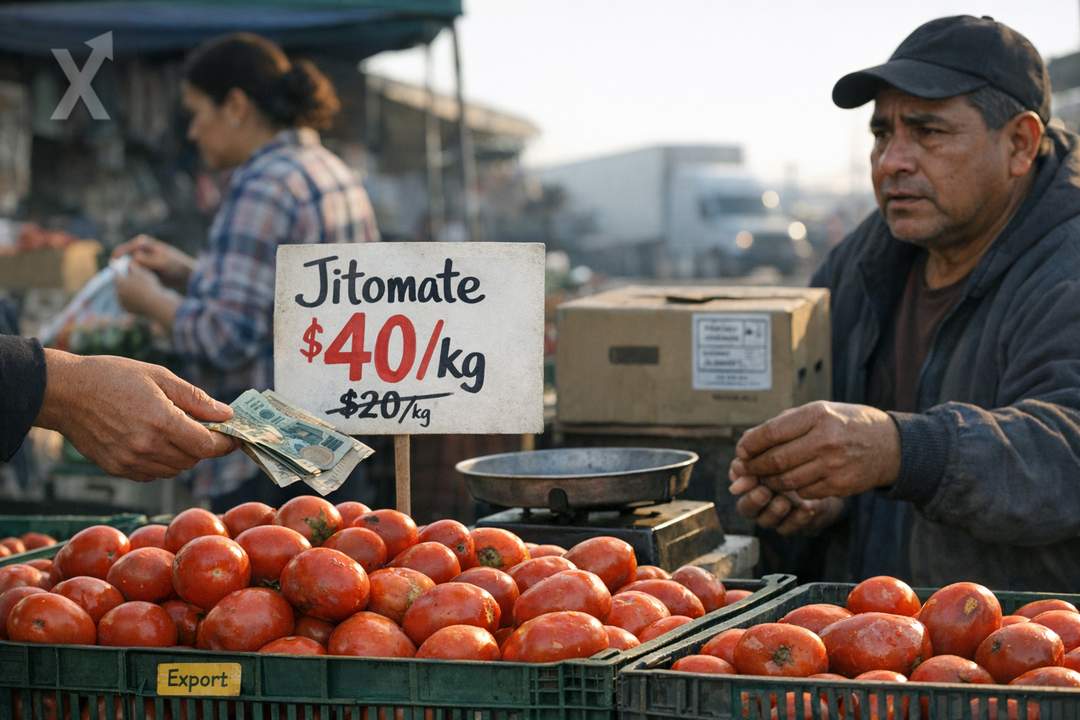
The antidumping tariff in the United States is already translating into fewer exports, less planting, and more expensive tomatoes in Mexico, while Canada gains ground.
Mexico’s tomato supply chain has entered a phase of forced adjustment: the 17.09% antidumping tariff imposed by the United States is reducing the product’s competitiveness, squeezing margins, and triggering a mix of effects ranging from lost export-market share to price increases at home. What began as a trade dispute in the main export destination is now rippling through growers, packers, carriers, and consumers—at a time when the agrifood sector is also dealing with climate volatility and higher operating costs.
The dependency is clear. More than 90% of Mexico’s tomato exports go to the United States, so any trade friction gets magnified in producers’ income and planting decisions. Projections from the U.S. Department of Agriculture (USDA) suggest Mexican shipments would fall to about 1.8 million metric tons in 2026—roughly 7% less than the prior year—following a trend that was already visible in 2025.
At the same time, the U.S. market has started to reshuffle suppliers. Business estimates point to Mexico losing between 10% and 12% of its share of the U.S. tomato market, while Canada may have increased its exports by about 25%. The shift is significant: for a high-turnover product, switching suppliers tends to lock in through contracts, logistics, and supply chains that aren’t easily reversed from one season to the next.
There is a partial outlet in Canada, but it doesn’t make up the difference. Data from Banco de México show Mexico’s tomato exports to Canada multiplied in 2025 versus the previous year and remained strong in the first quarter of 2026. Even so, given market size and the proximity of U.S. demand, Canada’s growth functions more like a pressure valve than a structural substitute.
On the supply side, the USDA also estimates Mexico’s production would drop 9% in 2026, from 2.8 to 2.5 million metric tons, while planted acreage would decline by about 11% compared with 2025. The combination of thinner margins, trade risk, and climate impacts is pushing some producers to scale back or shift into crops with profitability profiles less exposed to trade disputes.
Another factor has been the exchange rate. A stronger Mexican peso reduces local-currency income for each export dollar received, effectively making domestic costs relatively more expensive versus sales abroad. In an industry intensive in labor, energy, and cold-chain logistics, that effect becomes more pronounced when there’s also a tariff limiting the final competitive shelf price in the U.S.
Food Inflation and Consumer Pressure: The Hit Reaches the Table
The export adjustment has not translated into cheaper supply in Mexico. On the contrary: with less acreage planted and tighter supply in certain seasonal windows, prices have posted sharp increases across multiple states. According to estimates cited by the USDA, through April 2026 a significant share of states reported increases above 100%, while the rest also saw sizable gains. In a country where food accounts for a meaningful share of household spending, higher prices for staples tend to hit lower-income households the hardest.
Tomatoes are a cross-cutting input in the Mexican diet and in the day-to-day operations of restaurants, neighborhood eateries, and food services. When prices spike, it doesn’t just raise at-home consumption costs; it also pushes up costs in the service sector and can show up in menu prices, weakening demand. From a macro perspective, Mexico has sought to cement a gradual disinflation trend, but episodes of food supply shocks—whether driven by weather, logistics, or trade—often add volatility to both core and non-core inflation, complicating month-to-month readings of consumer inflation.
The USDA also forecasts a drop in domestic tomato consumption in 2026. That demand adjustment, rather than an immediate switch to other products, typically reflects lost purchasing power in the face of elevated prices—illustrating how an external trade measure can ultimately affect welfare in the domestic market.
On the political and trade front, tomatoes are shaping up to be part of the conversation in the review of the United States–Mexico–Canada Agreement (USMCA), alongside other sensitive agricultural goods. For the private sector, the goal is to reduce uncertainty and seek more predictable competitive conditions—particularly in a context where compliance with sanitary rules, traceability, and labor standards has also become part of North America’s trade discussion.
In Mexico, the federal government has tried to bring more order to the domestic market through voluntary mechanisms among producers, marketers, and supermarket chains, aiming to improve supply coordination and reduce distortions in price formation. How effective these agreements are will depend on the ability to align incentives across the chain—from farms and packing houses to transport and points of sale—and on their compatibility with a reality shaped by rising costs, water stress in agricultural regions, and a higher frequency of extreme weather events.
Looking ahead, the outlook for Mexican tomatoes will play out on three fronts: the legal and political path of the U.S. tariff, the crop’s productivity and climate resilience (investment in protected agriculture, modernized irrigation, and logistics), and market diversification—which reduces vulnerability but takes time, standards, and workable trade agreements. Meanwhile, Mexican consumers will remain an immediate barometer of any mismatch among production, intermediation, and distribution.
In sum, the U.S. tariff is reshaping the tomato map: Mexico faces lower competitiveness and a production adjustment, Canada gains ground, and the domestic market feels the impact through higher prices. The resolution of the dispute and the sector’s ability to adapt will be decisive in stabilizing exports and prices in the coming agricultural cycles.






