U.S. floats “interim USMCA deals” and delays rules of origin: what’s at stake for Mexico
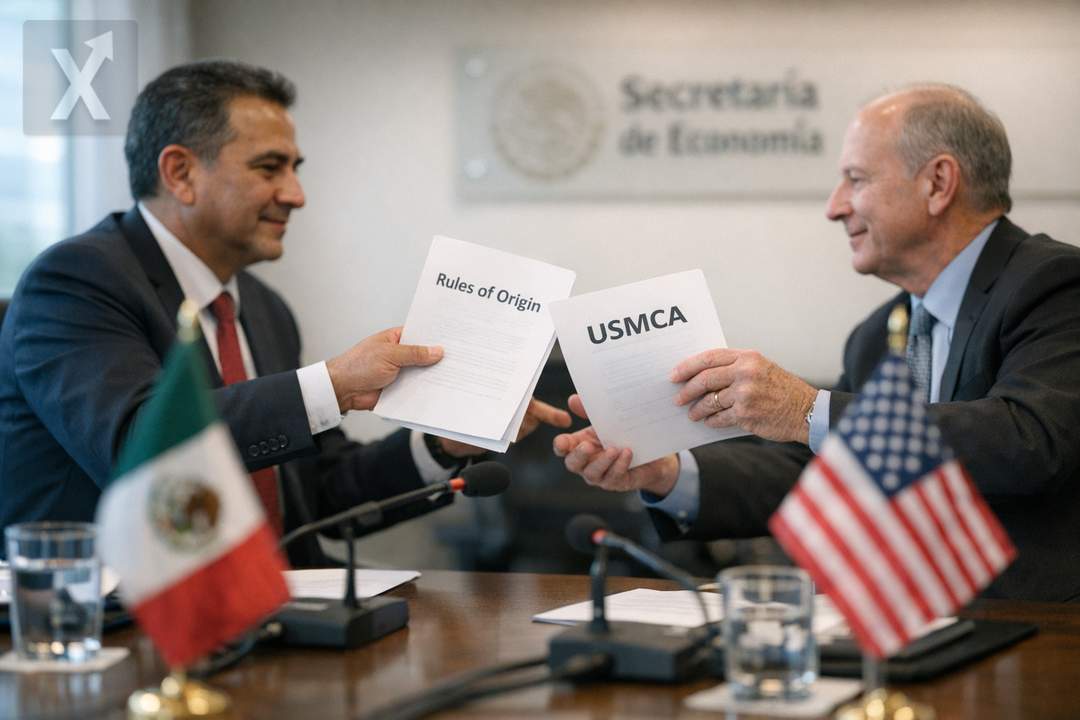
Washington aims to lock in preliminary USMCA understandings before 2026 and push the most sensitive changes to 2027, forcing key investment and trade decisions in Mexico.
The United States is outlining a two-step USMCA review: move forward with provisional agreements with Mexico and Canada before the end of 2026, and postpone the most complex chapters until 2027—such as tightening rules of origin and strengthening labor and environmental commitments. The approach was described by U.S. Trade Representative Jamieson Greer during testimony before the Senate Finance Committee, where he said he will present options for interim arrangements to President Donald Trump before year-end.
In practice, the push for temporary deals is meant to avoid a prolonged period of uncertainty in North American trade relations, while “taking the pressure off” the issues that typically require lengthy technical negotiations, industry lobbying, and legislative involvement. Greer confirmed talks will continue with the Mexican government, including a trip to Mexico City to meet with President Claudia Sheinbaum and Economy Secretary Marcelo Ebrard, as technical work between both teams moves forward.
For Mexico, the message lands at a time when export performance remains the main anchor of growth, with U.S.-oriented manufacturing serving as a key driver of formal employment in industrial states across the Bajío, the north, and the border region. Mexico’s economy has shown resilience, but it faces a mixed backdrop: on one hand, supply-chain relocation (nearshoring) and deeper regional integration; on the other, still-high real financing costs, infrastructure constraints (energy and water in certain regions), and business caution amid regulatory changes. In that context, the USMCA timeline serves as a compass for multi-year investment decisions.
Greer flagged rules of origin as a central unresolved issue, which Washington wants to tighten to raise regional content and reduce reliance on inputs from economies with industrial overcapacity or practices it views as unfair. While the proposal aligns with the U.S. push to reindustrialize and “bring back” production, the change has direct implications for Mexico: higher North American content requirements could benefit suppliers located in the region, but they could also raise transition costs for industries that depend on global components—such as auto parts, electronics, medical devices, and machinery.
The official also indicated that negotiations will continue in 2027 to strengthen labor and environmental enforcement mechanisms—an area where U.S. lawmakers have pushed for greater verification and sanctioning capacity. For Mexico, that debate intersects with its domestic agenda on formalizing employment, inspections, and union compliance, as well as the need for certainty for exporting companies operating under increasingly strict standards.
Rules of origin and nearshoring: the opening—and the risk—for Mexican manufacturing
If rules of origin become stricter, Mexico could attract more regional supplier investment—provided conditions exist to scale production with reliable energy, competitive logistics, and specialized human capital. Part of nearshoring depends on that equation: that producing in North America is not only geopolitically convenient but also economically viable. However, the shift is not automatic: a tighter rule can squeeze margins in highly integrated supply chains and force contract renegotiations, supplier redesigns, and content certification—processes that take time and can create temporary friction in exports. In addition, the U.S. approach could intensify sector-specific reviews—especially in autos—where compliance becomes an operational and legal issue, not just a trade one.
In his testimony, Greer argued that although the USMCA improved on NAFTA, problems remain in the trade relationship. Among the concerns he listed were the U.S. trade deficit with Mexico, cases tied to expropriation, insufficient enforcement of labor laws, and non-tariff barriers in agricultural trade. In parallel, the posture toward Canada was more combative, citing retaliation against Trump’s tariff policy and a lack of progress—according to Washington—in addressing trade complaints.
For Mexico, the U.S. focus on deficits and non-tariff barriers typically translates into a negotiating agenda that blends industrial objectives, domestic political sensitivity, and sector-specific demands (agriculture, energy, manufacturing). In the near term, interim agreements could provide continuity and signals of stability for markets and investors, but they could also leave core issues unresolved—only to return with greater force in 2027, when structural changes and enforcement mechanisms are debated with heavier involvement from the U.S. Congress.
In the coming months, the key will be how broad the provisional agreements are and whether they include operational definitions on rules of origin, labor verification, and treatment of sensitive sectors. An early political understanding could sustain Mexico’s export momentum and nearshoring appeal; but pushing the hard issues back keeps the risk of regulatory volatility and fresh trade pressure alive in the middle of the region’s investment cycle.
In short, the United States’ phased negotiating strategy aims to preserve USMCA continuity while redrawing the terms of productive integration; for Mexico, the challenge will be turning that transition into an opportunity without losing competitiveness or certainty for its export base.






