When the Tax Authority Collects Too: Art as “Payment” and the Challenge of Managing Public Assets in Mexico
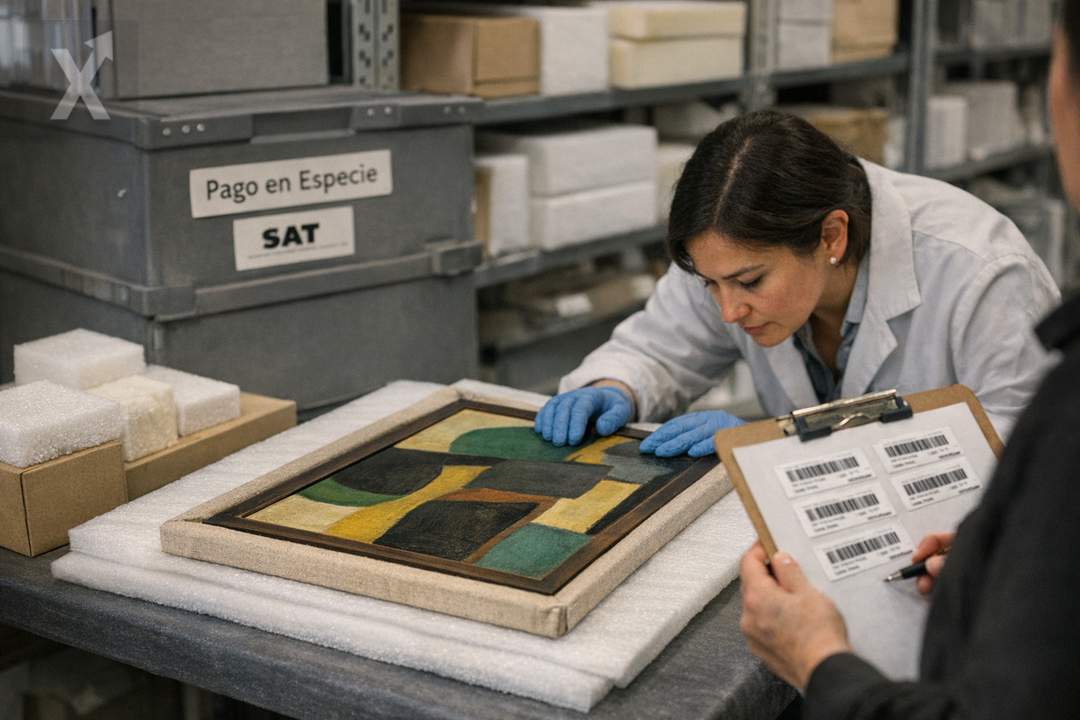
The Payment in Kind program turned tax liabilities into a cultural collection—but today it demands transparency, preservation, and modern public management.
Mexico’s Ministry of Finance and Public Credit (SHCP) is usually associated with budgets, revenue collection, and debt; however, for decades it has also managed an unusual asset for a financial authority: one of the country’s largest public collections of modern and contemporary art, along with historic furniture and other heritage objects. It began with a unique tax mechanism—the “Payment in Kind” program—that allows artists to cover part of their taxes by transferring artwork. Over time, that steady inflow has produced a federal collection of more than 17,000 pieces and created a public-policy challenge: how to safeguard, record, insure, and—most importantly—circulate that heritage so it doesn’t become a static inventory.
The institutional relationship between the Finance Ministry and the arts dates back to the late 1950s, when a group of creators advanced the idea of substituting artwork for cash to meet tax obligations. The proposal combined two incentives: making compliance easier for a sector with often variable income and, at the same time, strengthening the state’s cultural patrimony. Nearly seven decades later, the arrangement remains in place, and the bulk of the Finance Ministry’s collection comes precisely from that constant stream of works added year after year.
Today, the program’s mechanics rest on the receipt of pieces by the Tax Administration Service (SAT) and their subsequent distribution across different levels of government. Some works are assigned to municipalities, others to state governments, and the rest remain with the federal government—where SHCP consolidates its holdings. The result is a collection that, by its scale and diversity of techniques, has become a reference point for museums, curators, and institutions seeking to tell the story of contemporary Mexican art from a public-sector perspective.
But SHCP doesn’t only safeguard paintings and prints. It also preserves antique furniture, historic office equipment from public agencies—such as adding machines, typewriters, and safes—along with donations and objects with heritage value. In the past, part of the collection also incorporated seized assets. Taken together, this patrimony shows how public administration accumulates nonfinancial assets that, while not reflected in traditional fiscal-balance accounts, do carry ongoing maintenance costs and custodial responsibilities.
In an environment where economic debate tends to focus on the deficit, debt, and borrowing costs, SHCP’s art collection highlights another side of public spending: sustained investment in conservation, insurance, cataloging, and outreach. Even without an official monetary valuation—common for public collections given their complexity and heritage-protection criteria—safeguarding thousands of pieces requires technical capacity, infrastructure, and protocols comparable to those of any large-scale museum institution.
Day-to-day operations include specialized storage for two-dimensional and three-dimensional works, temperature and handling controls, and “nail-to-nail” insurance that covers storage, transportation, and exhibition. These policies, standard in the art world, underscore a key public-finance point: cultural patrimony is not “free” to manage, and public display depends on the state’s ability to cover risks and meet museum-grade conditions.
Transparency, Digitization, and the Public Value of a Collection That Isn’t Measured in Pesos
Modernizing records through digital systems—such as relaunching cataloging and public-access platforms—has implications that extend beyond cultural management. In an economy where institutional trust is a scarce asset, transparency about what exists, its condition, and where it is exhibited helps close gaps of opacity, reduces the risk of loss or deterioration, and strengthens accountability. It also makes coordination easier with museums, embassies, and government venues that request loans, expanding public access to heritage without requiring SHCP to build new exhibition spaces of its own.
This digitization also aligns with a broader trend in Mexican public administration: pressure to raise efficiency with constrained budgets. In recent years, the fiscal debate has moved between the need to sustain social programs, finance infrastructure, and maintain balance-sheet discipline, in a context of moderate growth, borrowing costs sensitive to interest rates, and limited fiscal space. In that setting, professionalizing the management of cultural assets with technological tools aims to do “more with less”—avoiding duplication, correcting inventory errors, and enabling evidence-based decisions.
Outreach for the collection—through traveling exhibitions, loan agreements, and audiovisual content—also serves an indirect economic function: it boosts local cultural circuits, strengthens tourism offerings in mid-sized cities, and contributes to the creative economy, a sector that in Mexico has positioned itself as a job generator in services, publishing, visual arts, and related activities. While it is not a substitute for industrial or innovation policy, it does help stimulate cultural demand and activate value chains around museums, heritage management, specialized transport, and restoration.
At the same time, the Payment in Kind program keeps an ongoing conversation open about equity and tax design: how to facilitate compliance in sectors with high informality or irregular income without eroding the revenue base. Mexico’s tax intake remains relatively low compared with peer economies, so every tax incentive is typically scrutinized closely. The program’s persistence suggests the state sees it as compatible with its compliance strategy, even though its real reach is limited to a specific segment of taxpayers and its main return is cultural, not fiscal.
Looking ahead, the challenge will be sustaining professionalization: ensuring sufficient budgets for conservation, strengthening restoration capacity, and updating storage standards. It will also be crucial for loan mechanisms to maintain strict controls to prevent damage, and for public access to catalogs to become firmly established as a tool for citizen oversight and democratic access to heritage.
In short, SHCP’s art holdings show that the state’s economic management is not limited to pesos and cents: it also administers cultural capital that requires governance, transparency, and resources—and whose public value depends on its ability to circulate and be known by society.






