Cetes Snap Their Downtrend: March Inflation and Banxico Caution Push Yields Higher
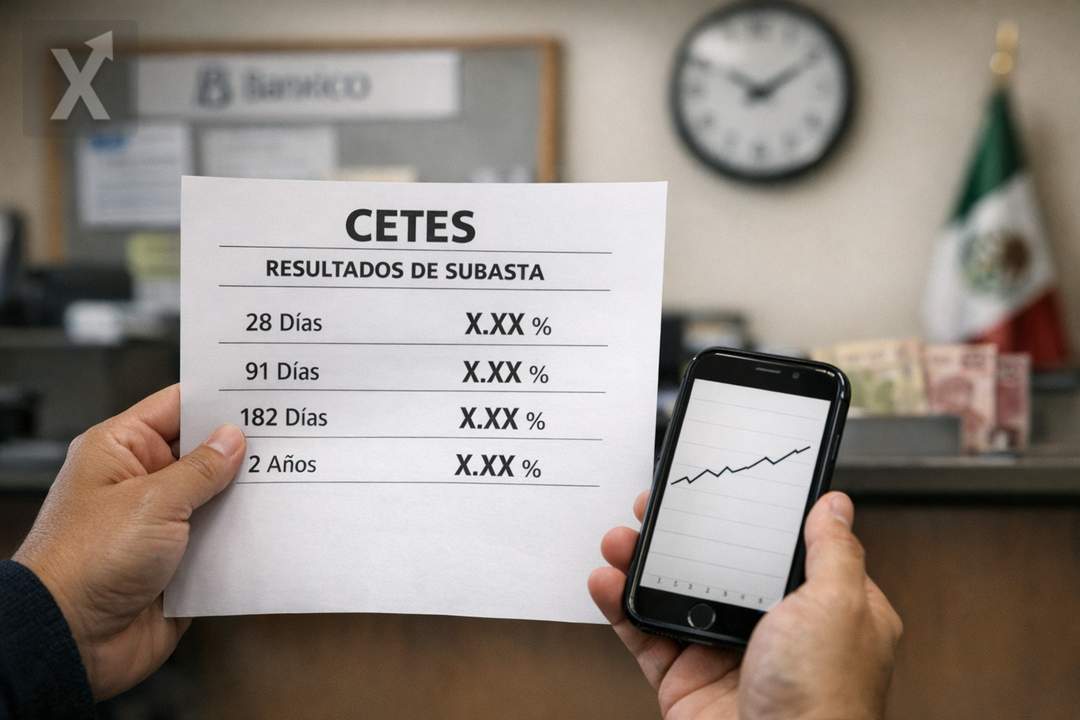
March’s inflation uptick reshaped expectations for Banxico and lifted Cetes yields across several maturities, raising the cost of money.
Mexico’s Treasury Certificates (Cetes) halted their downward trend and posted increases across most maturities in the latest auction, according to data from the Bank of Mexico (Banxico). The move comes amid inflation running hotter than expected in March and ahead of a key monetary policy decision—factors that often have an immediate impact on demand for short- and mid-term government securities.
In the domestic market, Cetes serve as a practical benchmark for the “price of money” in pesos: when the market thinks cuts to the policy rate could be paused or slowed, yields on government instruments tend to move higher, especially in maturities that best reflect expectations for the next quarter to one year. This also influences the broader financial system, from borrowing costs to the yields competing for household savings.
March’s inflation print became the main catalyst. The acceleration was largely driven by increases in sensitive components such as certain foods and energy, while core inflation—the measure Banxico tends to watch more closely to gauge how persistent pressures may be—remained elevated. In this context, financial-sector research teams adjusted their view toward a more cautious stance from the central bank, given the risk that inflation expectations could become unanchored.
At the auction, the 28-day Cete was basically unchanged around 6.81%, while the 91-day climbed to 7.11%. The 182-day came in near 7.28%, and the two-year note stood out with a bigger jump, to about 8.57%. While short-term moves may look modest, the adjustment at the longer end suggests the market is again demanding a higher premium to hedge against inflation uncertainty and the future pace of monetary policy.
For individual investors, the main appeal of Cetes is typically the combination of liquidity, low risk, and a rate that, at many times, outpaces the overall rise in prices. However, the “real” return (after inflation) can change quickly: if inflation picks up, the real benefit narrows; if inflation cools and rates hold, the real return improves. In practice, this difference is what determines how much purchasing power the investment preserves.
What Higher Cetes Mean for Credit, Consumption, and Portfolios
An upward adjustment in government yields tends to feed through—on different timelines—into other interest rates across the economy. For households, it can translate into less favorable terms for variable-rate loans or refinancing, while for businesses it can raise the cost of working capital and new debt issuance. On the savings side, more competitive rates on government instruments often intensify competition for deposits at banks and investment platforms, which can benefit savers, though it can also encourage a more conservative portfolio stance when economic growth looks moderate.
Looking ahead, Cetes performance will remain tied to three variables: the path of inflation (especially core inflation), Banxico’s signal on how much room it has to cut, and the external backdrop, where shifts in global financial conditions can ripple into the exchange rate and, through that channel, domestic prices. In Mexico, the balance between an economic slowdown and persistent inflation often determines how quickly monetary policy can ease without jeopardizing the price-stability mandate.
In short, the rebound in Cetes yields reflects a market that is more cautious in response to March inflation and the possibility that Banxico may proceed more carefully; for savers, the rate pickup improves across several maturities, but the key will continue to be the real return and choosing the right duration for the investment horizon.






