Oil Falls After U.S.–Iran Truce, but Volatility Still Weighs on Mexico’s Inflation and Public Finances
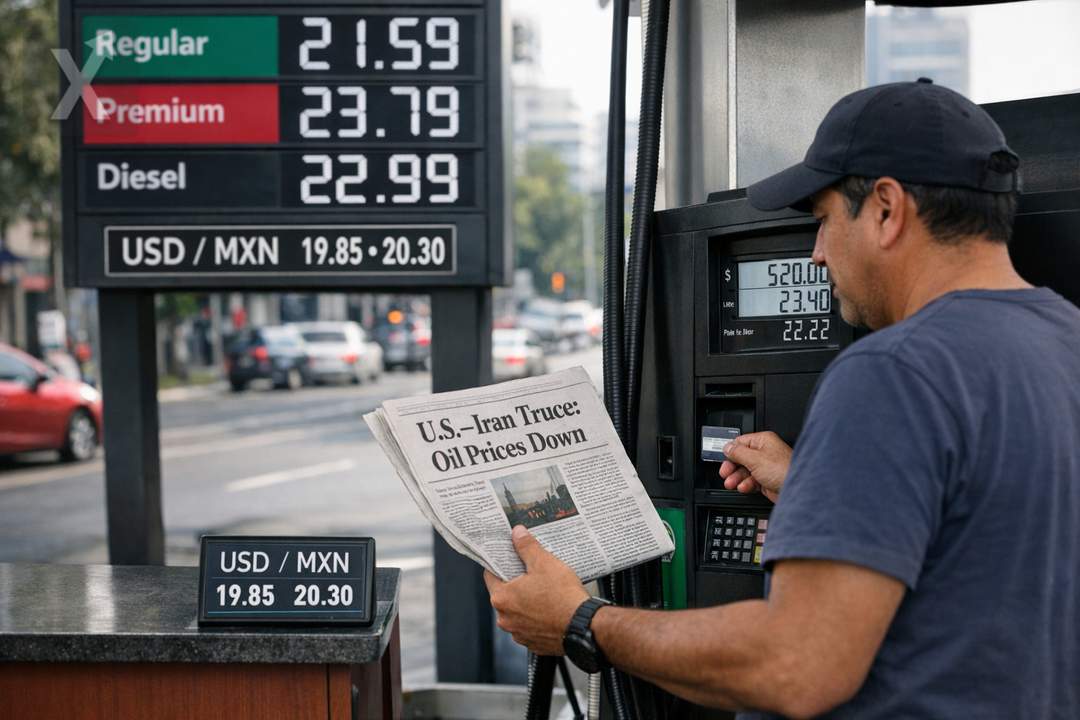
Relief in crude prices eases inflation pressures in Mexico, but geopolitical uncertainty keeps risks alive for the exchange rate and Pemex.
The preliminary peace agreement between the United States and Iran triggered an immediate adjustment in energy markets: international oil prices pulled back from levels that had begun to reflect a scenario of severe disruption in the Strait of Hormuz. For Mexico—which imports a meaningful share of gasoline and diesel but is also a crude producer and exporter—the move has mixed implications: it lowers the energy component of inflation and reduces logistics costs, but it can also pressure oil-related revenues and Pemex’s financial position if the decline persists.
The global reaction was shaped by a drop in the geopolitical risk premium. In the days after the announcement, Brent moved toward the $80-a-barrel range, down from peaks near $120 seen at the height of tensions. Still, the market remains cautious: the understanding includes a negotiation window, and the risk persists that renewed frictions could drive up shipping and marine insurance costs again.
Another factor adding to uncertainty is the smaller “cushion” the United States has after drawing down part of its Strategic Petroleum Reserve to soften the shock: the release of millions of barrels has pushed inventories to multi-decade lows. That reduces the room to respond to any new closure or restriction along key routes, which tends to increase volatility even if the average price stays relatively contained.
In Mexico, the immediate impact of cheaper oil typically shows up as less pressure on energy and transportation, with second-round effects on certain distribution costs. Even so, pass-through is not linear: consumer gasoline prices are influenced by logistics, retail margins, the exchange rate, and the IEPS tax framework, as well as public-policy decisions aimed at smoothing abrupt moves.
Banxico: Energy Inflation and the FX Channel
Oil’s path matters to the central bank because of its influence on headline inflation and, indirectly, on expectations. A sustained drop in fuel prices can help cool near-term inflation, but the effect can be offset if global uncertainty translates into risk-off episodes that put pressure on the exchange rate. For an open, highly integrated economy like Mexico’s, the FX channel remains important: a weaker peso makes imports more expensive—including fuels—and can limit the relief provided by cheaper crude.
In addition, shifts in U.S. interest rates remain a key driver of flows into emerging markets. If lower energy prices reduce global inflation fears and lead investors to anticipate a less restrictive monetary stance in the United States, rate differentials and risk appetite could temporarily favor Mexican assets. But the story isn’t one-directional: the combination of lower oil and higher geopolitical volatility often produces alternating episodes of yield-seeking and flight to safety, with intermittent impacts on the peso.
On the fiscal side, falling oil prices can reduce the momentum of oil-related public-sector revenues, although the net effect depends on production levels, Pemex’s performance, extraction costs, and the evolution of the oil hedges the federal government traditionally uses to protect the budget. In recent years, the challenge has been twofold: stabilizing the oil contribution in an environment of constrained production while also containing spending pressures tied to energy, transportation, and support for the state-owned productive enterprise.
For Pemex, crude-price volatility is particularly sensitive. A lower price tends to squeeze margins if operating and financing costs remain elevated, although it can also reduce the cost of certain inputs and services. On the refining front, a backdrop of lower international fuel prices can pressure profitability if spreads narrow, while the domestic market remains shaped by demand, logistics, and the cost of importing components.
Looking ahead, Mexico’s risk balance centers on two questions: whether the truce consolidates without new episodes that disrupt maritime routes and, in parallel, whether the global economy confirms a slowdown that cools demand for crude. With OPEC revising consumption forecasts and global inventories still vulnerable to any disruption, a baseline of “lower but unstable” prices looks more likely than a return to a prolonged period of cheap energy.
In sum, oil’s drop after the U.S.–Iran understanding offers Mexico some breathing room on inflation and transportation costs, but it does not eliminate the risk of new shocks. For households, businesses, and policymakers, the challenge will remain managing an environment in which crude prices may fall, but geopolitical uncertainty and the FX channel continue to set the tone.






