U.S. Alarm Over a Cybersecurity AI Reignites the Debate on Operational Risks in Mexican Banking
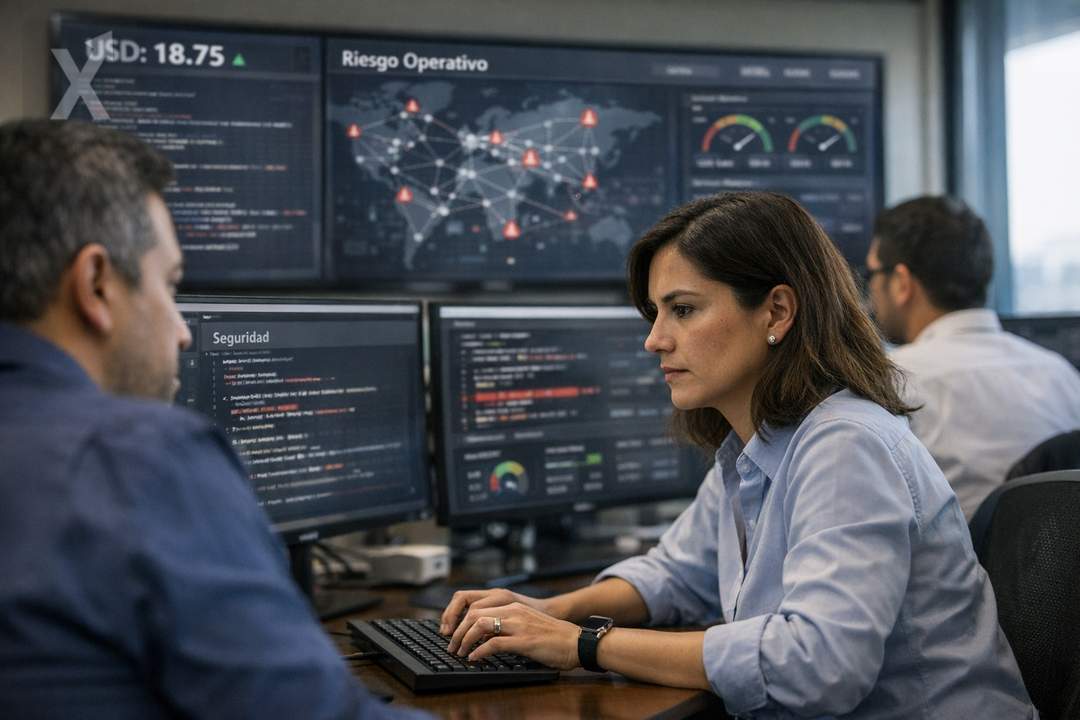
U.S. concern about an AI capable of finding and exploiting software flaws brings cyber risk for the financial system back to the forefront.
The U.S. Department of the Treasury and the Federal Reserve’s decision to urgently convene Wall Street leaders over the cyber potential of Anthropic’s Claude Mythos artificial intelligence model has reignited a debate that crosses borders: the operational risk tied to technologies capable of auditing, detecting, and—under controlled scenarios—even “weaponizing” attack proofs based on real vulnerabilities.
For Mexico, where financial digitalization is moving quickly and traditional banks coexist with fintechs and a growing digital payments ecosystem, the signal is relevant on two fronts: indirect exposure to global technology supply chains (software, cloud, vendors, and code libraries) and the system’s interconnectedness with counterparties in the United States. Even though the case originates in the U.S., the episode underscores that cyber risk is becoming more sophisticated faster than many control frameworks—and that technology resilience is now a financial stability issue, not just an IT concern.
Based on available information, Claude Mythos was not created exclusively as a cybersecurity tool, but its performance in code analysis and complex problem-solving allows it to review large volumes of software, identify flaws, and suggest exploitation paths. The fact that a company chose to restrict access after detecting its ability to build functional proof-of-concept attacks illustrates a shift in the nature of risk: it no longer depends solely on highly specialized human actors, but on capabilities that could be scaled far more easily.
In Mexico, the conversation is taking place in a context of simultaneous pressure for efficiency and security. Banks are investing steadily in digitalization to compete on costs and user experience, while facing a fraud environment that moves at the same speed as digital channels. The challenge is compounded because critical financial infrastructure depends on multiple layers—from operating systems and browsers to third-party components—where “old” vulnerabilities can remain hidden for years.
Implications for Mexico: business continuity, compliance, and trust
The main potential impact on Mexico’s financial system would not be a spectacular “hack,” but rather the gradual erosion of business continuity and user trust if incidents, outages, or data leaks increase. For regulated intermediaries, the cost of a significant cyber event shows up as fraud losses, remediation expenses, penalties, and litigation—on top of reputational damage. In a country where electronic payments are growing and financial inclusion is advancing through mobile channels, trust is a macroeconomic asset: it supports service adoption and reduces cash usage, with effects on productivity, traceability, and transaction costs.
On the regulatory front, the episode reinforces the idea that technology risk management must account for the digital supply chain: cloud providers, third-party software, integrators, and development tools. For Mexico, that translates into stricter requirements for monitoring, penetration testing, network segmentation, recovery plans, and incident-response exercises. It also pushes for stronger public-private coordination to share indicators of compromise and attack patterns, especially when Mexican systems interact with U.S. platforms and counterparties.
Economically, a sustained increase in cyber risk can raise operating costs across the financial sector—through higher spending on security, insurance, audits, and specialized talent—which may eventually be reflected in fees, spreads, or a reduced appetite for rapid innovation. At the same time, the need for resilience could accelerate investment in infrastructure, automation, and training, creating demand for local technology services. The balance will depend on how quickly standards and practices develop that allow the adoption of defensive AI without opening new attack surfaces.
Looking ahead, the clearest signal is that AI can become an amplifier of both defense and offense. For Mexico, the challenge will be to move forward with digitalization without underestimating operational risk and without stifling innovation: strengthening controls, demanding better practices from vendors, and raising incident preparedness will be key to sustaining stability and trust in the financial system.