Ratings Agencies Tighten Fiscal Scrutiny: Finance Ministry Faces the Challenge of Cutting Without Stalling the Economy
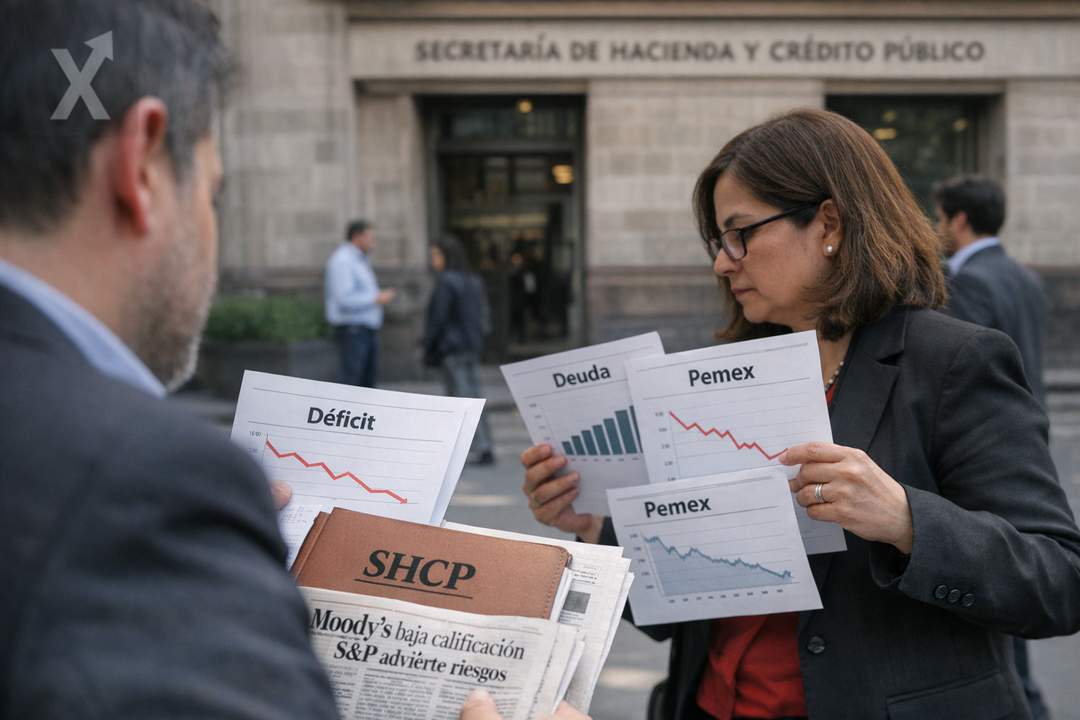
Moody’s and S&P put the spotlight on the deficit, Pemex, and weak growth—raising the urgency for a credible fiscal consolidation.
Moody’s sovereign downgrade and Standard & Poor’s (S&P) shift to a negative outlook have increased pressure on the Ministry of Finance and Public Credit (SHCP) to show—through measurable results—that Mexico can reduce its deficit and stabilize its debt path without triggering a sharper deterioration in economic activity.
In practical terms, the agencies’ message is twofold: on one hand, the country still retains investment-grade status; on the other, room to maneuver has narrowed amid moderate growth, spending pressures, and the persistence of contingent liabilities—especially those tied to financial support for Pemex. For markets, this not only affects risk perception; it can also translate into a higher cost of funding if fiscal credibility weakens.
S&P kept the rating at BBB but changed the outlook from stable to negative, arguing that slow growth, budget constraints, and the potential materialization of off-balance-sheet commitments could complicate fiscal consolidation. Soon after, Moody’s cut Mexico’s rating from Baa2 to Baa3; while it revised the outlook to stable, it underscored fiscal weakness and insufficient economic performance as structural factors.
The spotlight is on a deficit that has remained elevated and on reliance on one-off resources to balance the books. The government has laid out a path to reduce the deficit as a share of GDP: after bringing it down from high levels in 2024 to a lower reading in 2025, the official target aims to keep pushing it lower in 2026 and 2027. However, progress becomes more complex when revenues fall short of projections and the economy grows below expectations.
At the start of the year, fiscal data showed strain: public revenues came in below expectations and, at the same time, observed spending was below the budgeted level—signaling an attempt to contain outlays in a weaker-growth environment. For analysts, this combination suggests consolidation is being sustained more through spending—where the SHCP has immediate control—than through revenues, which depend more heavily on the economic cycle.
The situation becomes more delicate because of Pemex’s role in the fiscal equation. Support for the state-owned oil company has been significant in recent years and, although authorities have sought to reorganize its maturity profile and back it through financial and budgetary mechanisms, ratings agencies and the market still view the issue as a factor that could put pressure on debt, interest costs, and public spending priorities.
The Dilemma: Cutting Investment to Meet Targets Can Weaken Growth
One of the main risks of a cuts-based strategy is where the adjustment lands. In practice, public investment is often among the most vulnerable line items, given its administrative flexibility compared with rigid spending such as pensions, debt-service costs, or operating commitments. But cutting public investment can have second-round effects: it reduces demand in the short term and limits capital formation in the long term, hurting productivity, infrastructure, and the country’s attractiveness for private investment.
In addition, if spending restraint extends to sensitive areas—such as health, education, or the environment—social pressures may increase and state capacity can erode, which also ends up affecting the conditions for growth. In a country where the domestic market matters and North American manufacturing integration drives specific regions, a disorderly fiscal consolidation can widen disparities and complicate the goal of sustained growth.
The backdrop includes an economy that, while still supported by engines such as manufactured exports and supply-chain reshoring, faces headwinds: the global slowdown, regulatory uncertainty in some sectors, infrastructure bottlenecks, and an environment of still-elevated interest rates that makes credit more expensive. Added to that is the challenge of improving tax collection without choking formality: Mexico still has a relatively narrow tax base compared with peers, making the balance among enforcement, simplification, and certainty for investment crucial.
Over the next few quarters, the risk is not only greater financial volatility; it is also that the fiscal adjustment will be either insufficient to convince the agencies or too aggressive to sustain growth. With a negative outlook still in place at least at one major ratings agency, the government faces pressure to present credible measures—whether through spending efficiency, reallocations, strengthening recurring revenues, or a clearer strategy for Pemex—before the deterioration in the fiscal narrative shows up in higher costs and less budget space.
In sum, decisions on the balance among spending cuts, boosting tax collection, and managing contingent liabilities will set the tone of Mexico’s economic debate: the goal is not only to meet an annual deficit target, but to stabilize debt and sustain growth in a less favorable domestic and external environment.