Moody’s Cuts Mexico’s Sovereign Rating to Baa3, Spotlighting Fiscal Fragility
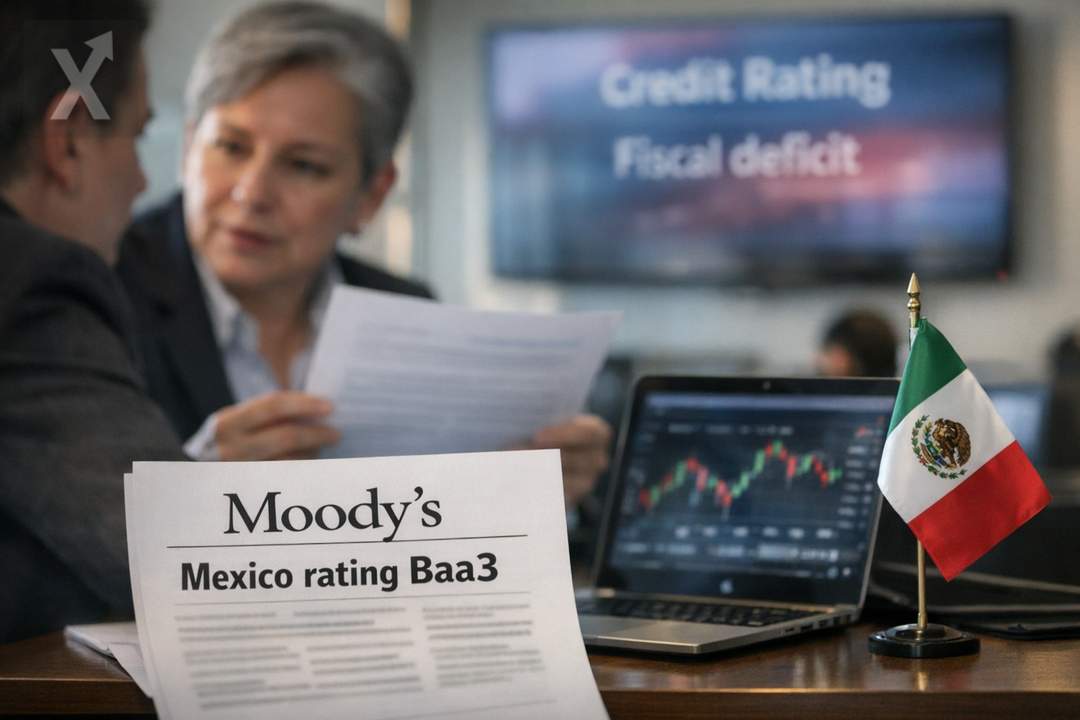
Moody’s move reflects a tighter fiscal position and less room to absorb shocks, even as Mexico keeps its investment-grade status.
Moody’s Investors Service downgraded Mexico’s credit rating to Baa3 from Baa2, citing a sustained deterioration in fiscal strength and a backdrop of moderate economic growth. The agency also revised the outlook to “stable” from “negative,” suggesting that under its base-case scenario it does not expect further action in the near term, though it does see a narrower path for correcting the course of public finances.
In its assessment, Moody’s said fiscal weakening accelerated in 2024 and, in its view, could persist due to rigid spending, a narrow revenue base, and recurring support for Petróleos Mexicanos (Pemex)—factors that reduce the government’s ability to stabilize the debt trajectory in a low-growth environment. The call matters because Baa3 is the lowest rung of Moody’s investment-grade scale, a threshold many institutional investors watch closely when setting mandates and risk limits.
Mexico’s Ministry of Finance and Public Credit (SHCP) responded that Mexico remains investment grade and that, in its reading, the decision does not point to additional changes over the next 18 months. It also emphasized that in 2025 the government implemented a fiscal adjustment equivalent to 1.3 percentage points of GDP—the largest since 1995, according to the ministry—aimed at normalizing the deficit without affecting social programs and preserving macroeconomic stability.
Beyond the one-off move, the downgrade comes as markets watch three fronts at once: the promised fiscal consolidation, the debt’s interest burden in a still-high-rate cycle, and Mexico’s ability to sustain the appeal of nearshoring, which depends on infrastructure, energy, security, and regulatory certainty. In that context, a tighter rating can increase the country’s sensitivity to episodes of global volatility, even if the immediate impact on borrowing costs is not automatic.
What Baa3 Means: Debt Costs, Confidence, and Policy Room
Baa3 keeps Mexico in investment-grade territory, but with less cushion. In practical terms, the main risk is that further fiscal slippage or a macroeconomic shock could raise the risk premium and increase sovereign borrowing costs—and, by extension, the costs for some Mexican companies that fund themselves off the country risk benchmark. At the same time, a “stable” outlook lowers the odds of an immediate follow-up action, giving fiscal policy some runway to show results on the deficit and debt path. Still, room to maneuver is limited: structurally low tax revenues relative to peer countries and spending pressures—including interest costs—require a more precise budget allocation if Mexico wants to preserve productive public investment without weakening the fiscal balance.
Moody’s also acknowledged offsets that support the credit profile: a large, diversified economy; a deep domestic financial market compared with other emerging economies; and, above all, preferential access to the U.S. market, which serves as an anchor for trade and investment. Strong manufacturing exports, integrated supply chains, and momentum in sectors tied to relocation have helped cushion slowdowns, though translating those tailwinds into higher potential growth requires more investment, higher productivity, and greater availability of key inputs such as electricity and logistics.
The energy component remains a focal point. Fiscal support for Pemex has become a recurring variable in the credit discussion: while the government seeks to maintain energy sovereignty, the company’s liabilities and investment needs weigh on public accounts. The path to reduce that vulnerability—greater operating efficiency, a profitable investment strategy, and a framework that attracts capital without compromising national goals—is one of the elements rating agencies and analysts typically monitor when assessing fiscal sustainability.
For its part, the Finance Ministry highlighted the “Plan México” strategy and a regulatory framework aimed at accelerating strategic infrastructure projects with public, private, and mixed participation, with the expectation of expanding productive capacity and strengthening regional integration. If executed with budget discipline and clear rules, these projects could support medium-term growth; if they are delayed or run over budget, the economic payoff could fade while pressure on debt and spending remains.
In broader perspective, Moody’s downgrade puts added focus on the tradeoff between fiscal consolidation and public-policy priorities. Mexico retains structural strengths, but the central message is that credit resilience will depend on achieving stronger, sustained growth, broadening the revenue base, and reducing vulnerabilities tied to the energy sector—without losing the macro stability that has set the country apart for decades.
Bottom line: the cut to Baa3 does not signal an immediate crisis, but it does raise the bar on outcomes. Credible fiscal discipline, effective execution of investment, and a clear strategy to contain risks—especially those linked to Pemex—will be decisive in sustaining market confidence.






