More expensive oil due to the war in Iran forces Mexico’s Finance Ministry to recalibrate inflation, interest rates, and the exchange rate for 2026
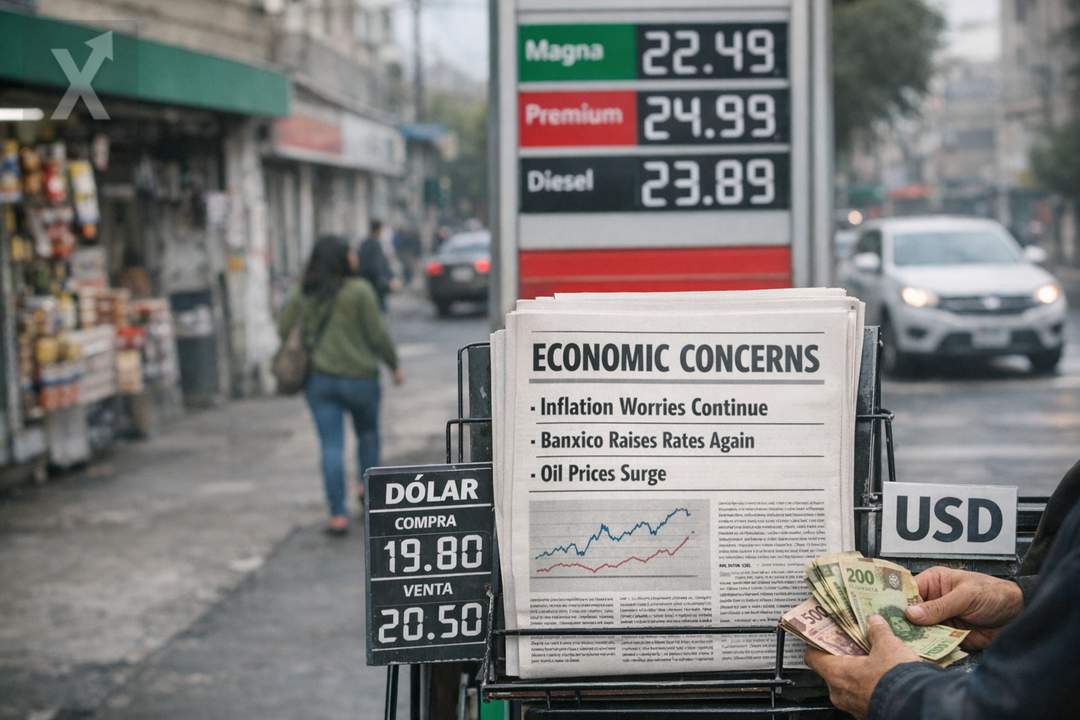
The oil shock raised the 2026 inflation and rate outlook, while the peso would remain supported by the interest-rate differential despite external uncertainty.
The rise in oil and fuel prices, amid a war in Iran involving the U.S. and Israel, led Mexico’s Ministry of Finance and Public Credit (SHCP) to adjust its macroeconomic compass toward the end of 2026. In its 2027 General Economic Policy Pre-Criteria, the agency updated key assumptions—crude prices, inflation, the interest rate, and the exchange rate—that serve as the basis for designing next year’s Economic Package.
The biggest move comes from the energy market: the Finance Ministry raised its estimate for the average price of the Mexican crude blend in 2026 to $77.3 per barrel, up from $54.9—an increase of $22.4 compared with what was approved in the 2026 Economic Package. The official assumption is based on a “conservative” scenario in which the conflict would not last more than two months, though it acknowledges elevated uncertainty due to developments on the geopolitical front, the war in Ukraine, shifts in Venezuela’s oil industry, and U.S. tariff policy.
On growth, the Finance Ministry left its 2026 GDP forecast range unchanged at 1.8% to 2.8%. The implicit message is that, while the energy shock puts pressure on prices and can erode purchasing power, the central scenario still rests on a gradual normalization of shocks seen in 2025 and better investment performance as the regulatory framework becomes clearer and the USMCA review moves forward.
The document also includes an adjustment to the fiscal path: the forecast for Public Sector Borrowing Requirements moved from -4.3% of GDP to -4.1% of GDP. In practice, higher crude prices can boost oil revenues and partially ease budget pressures; however, they can also raise the cost of fuel subsidies or stimulus if the government seeks to cushion increases for consumers, in addition to making transportation and logistics inputs more expensive for the economy.
The Finance Ministry said private consumption would continue to be supported by real wages and employment, as well as by the Welfare Programs. On the external front, it underscored solid export performance in a competitive environment where Mexico would retain a relatively more favorable effective tariff rate, although the final outcome will depend on the tone of the USMCA renegotiation and the industrial cycle in North America.
Inflation and Banxico: the gasoline effect shows up in the basket
The most immediate risk from the oil shock is inflationary. The SHCP raised its forecast for inflation from December 2025 to December 2026 from 3.0% to 3.7%, still within the variability range around Banco de México (Banxico)’s target, but high enough to influence the pace of monetary easing. When gasoline and energy prices rise, the impact does not only come through the direct component in the price index, but also through transportation, distribution, and production costs that can spread to goods and some services. In a country where trucking logistics carry significant weight, a sustained increase in fuel prices usually translates into second-round pressures if the supply chain passes costs through.
Consistent with that, the Finance Ministry adjusted its end-of-period policy rate assumption for 2026 from 6.0% to 6.3%. The change suggests slower inflation convergence and an environment in which Banxico would remain cautious to preserve anchored expectations, especially if global financial volatility rises due to the Middle East conflict or bouts of risk-off sentiment. In terms of activity, higher rates for longer can dampen consumer and business credit, though the effect depends on the depth of the financial system and the state of competition in the banking sector.
A notable shift in the document is the exchange rate: the Finance Ministry expects an average of 18.0 pesos per dollar in 2026, stronger than the previously projected 19.3. The official explanation points to the interest-rate differential—which keeps the peso attractive for carry trades—along with an external backdrop of a weaker U.S. dollar and greater risk appetite for emerging-market assets. From a market perspective, this implies the peso could remain resilient as long as the yield differential offsets the risk premium, though the same channel can amplify moves if expectations for U.S. monetary policy change or if global sentiment deteriorates.
The dilemma is familiar: a relatively strong peso helps contain imported inflation, but it can also squeeze margins for certain exporters and sectors that compete with imports. Even so, in recent years exchange-rate strength has acted as a buffer against external shocks, including energy price spikes and episodes of international volatility.
Looking to 2027, the Finance Ministry projected GDP growth of 1.9% to 2.9% and a budget deficit of -3.5% of GDP. It also anticipated 3.0% inflation (December 2026 to December 2027), an average exchange rate of 18.5 pesos per dollar, an interest rate of 5.5%, and a Mexican crude blend price of $54.7 per barrel—effectively assuming a return to more normal crude levels once the geopolitical shock fades.
Beyond the assumptions, the Pre-Criteria adjustment leaves two signals for the rest of the year: first, that oil’s pass-through to domestic prices remains a central risk to household well-being; and second, that peso stability depends to a large extent on external financial conditions and the interest-rate differential—factors that can shift quickly if the global landscape is reconfigured.
Overall, the Finance Ministry’s new framework sketches an economy that could still grow at a moderate pace in 2026, but with somewhat higher inflation and interest rates due to the energy shock, and with an exchange rate that would hold up if the financial environment cooperates. The final balance will be determined by the duration of the conflict, the reaction of energy markets, and the management of inflation expectations in Mexico.






