U.S. Companies Urge Caution in the USMCA Review: Tougher Rules of Origin Could Make Integration with Mexico More Expensive
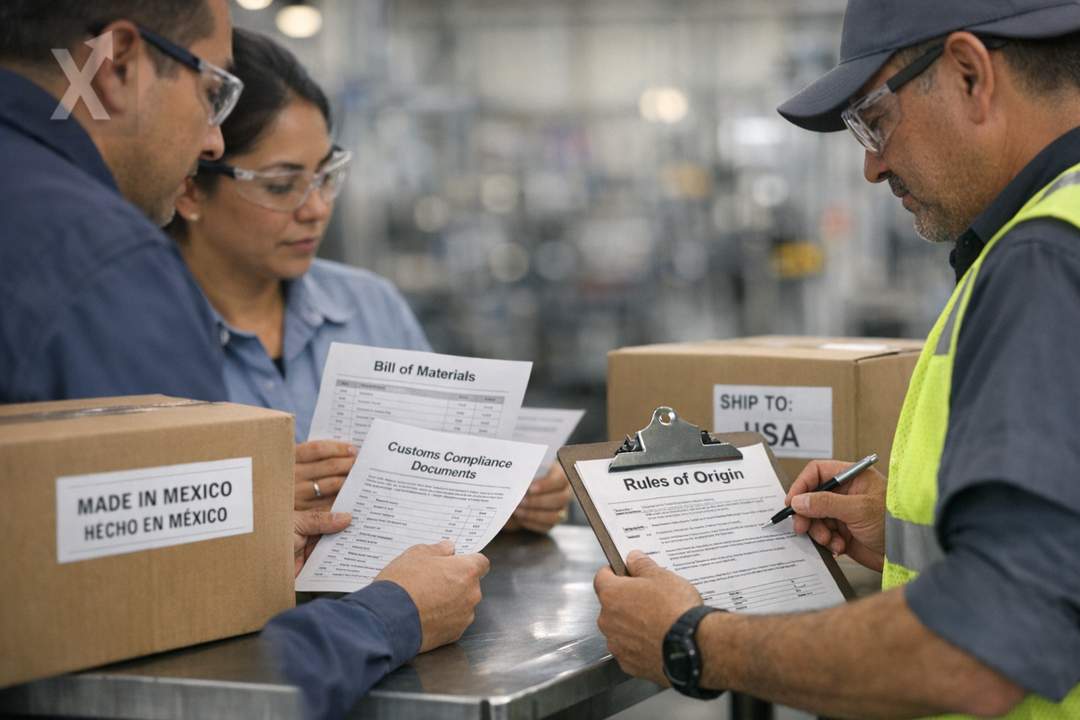
The private sector in the United States supports producing more in North America, but warns that broadly tightening rules of origin could raise costs and curb investment in Mexico.
The upcoming review of the United States–Mexico–Canada Agreement (USMCA) is already shifting pieces on and off the factory floor. As Washington explores changes to boost regional content and reduce reliance on Asian inputs, a key part of the U.S. private sector is starting to draw lines: strengthen North American manufacturing, yes—but without imposing rules that make today’s supply chains, which operate as a “shared factory” among the three countries, unworkable.
In a letter sent to U.S. Trade Representative Jamieson Greer, the United States Council for International Business (USCIB)—an organization that brings together companies across multiple industries and serves as a liaison in international forums—asked to extend the agreement’s term through 2042 and came out against a broad-based tightening of rules of origin. The message isn’t framed as a political dispute, but as an operational argument: raising regional content requirements without transition periods and without accounting for the realities of supplier networks makes production more expensive and undermines the region’s competitiveness versus other blocs.
Greer has publicly acknowledged that the United States and Mexico are already working on a review of rules of origin, looking not only at autos but also industries such as electronics and pharmaceuticals. In various circles, proposals include raising the auto regional content threshold from 75% to levels closer to 82%, and the possibility of requiring that a meaningful share of content come specifically from the United States. While there is no final proposal, the mere idea is already setting off alarms for companies that invested in Mexico under the assumption the agreement would provide regulatory stability.
For Mexico, the issue is especially sensitive: the USMCA is the backbone of the export model and of the manufacturing investment Mexico has attracted over the past decade, particularly in the north and the Bajío region. Mexico’s economy has gained ground as a production platform supplying the U.S. market, supported by geographic proximity, competitive logistics costs, and an industrial base built on decades of integration. Tweaking rules of origin could reshape investment decisions, domestic content, and trade patterns at a time when industry is still dealing with high financing costs, energy-infrastructure bottlenecks, and growing labor and environmental compliance demands.
From a business perspective, the risk is turning the discussion into a numbers race that ignores how complex production processes really are. Many goods shipped from Mexico include components that cross the border multiple times: machinery, specialized steel, semiconductors, sensors, wire harnesses, chemicals, and parts that move among plants in all three countries before final assembly. In that environment, an overly rigid rule can force companies to redesign bills of materials, replace suppliers, redo certifications, and absorb administrative costs that hit hard—especially in supply chains with hundreds or thousands of inputs.
USCIB has also focused on the method. Some regional trade qualifies for origin through a “tariff classification change,” a mechanism that avoids painstaking content calculations and reduces friction. The concern is that an intensive verification model—constant calculations, audits, and granular traceability—could spread to more sectors, multiplying burdens for companies and customs authorities. At bottom, the organization argues that raising internal barriers could weaken the stated goal of competing more effectively against Asia.
Implications for Mexico: Nearshoring, Investment, and Compliance Costs
The review is arriving as Mexico tries to lock in nearshoring as a growth driver, but faces constraints. On the one hand, integration with the United States has boosted manufactured exports and supported formal employment in industrial clusters; on the other, companies report that access to reliable power, water availability in some regions, logistics congestion at border crossings, and regulatory uncertainty are factors that can limit new investment. If the USMCA also raises compliance costs (through stricter rules or more complex verification), some projects could be delayed or shift toward different production strategies, including more automation or greater relocation within the United States.
In autos—one of the pillars of Mexico’s foreign trade—tougher rules could speed up the replacement of Asian inputs with regional suppliers, opening opportunities for Mexican auto-parts and materials producers. Still, the adjustment won’t be immediate: building local capacity takes time, requires financing, and depends on developing technical talent. For electronics and pharmaceuticals, the challenge may be greater due to global dependence on certain components or active ingredients where Asia maintains dominant scale. That’s why the debate isn’t only “more regional content,” but how to create the conditions to produce it without driving up costs and without triggering shortages.
At the macro level, the outcome could be felt through several channels: gross fixed investment, export momentum, the exchange rate, and tax revenues tied to industrial activity. It also affects Mexico’s public-policy agenda: improving customs, traceability, and enforcement against origin fraud could become necessary to maintain the agreement’s credibility, alongside reinforcing infrastructure at ports, highways, railroads, and border crossings. In a tougher negotiation scenario, Mexico could face pressure to speed up the development of domestic suppliers, particularly in materials, chemicals, devices, and higher value-added components.
On the U.S. side, the push to reduce dependence on China reflects both economic-security concerns and industrial-policy goals. For Mexico, that trend represents a window of opportunity—if it translates into investment and process transfers—but also a risk if integration is conditioned on rules that, in practice, reward reshoring to U.S. territory. The balance, as the companies urging caution suggest, is to combat transshipment and abuses without penalizing legitimate production chains that already operate under a regional logic.
In the short term, markets will be watching for concrete signals: which sectors will be included, what percentages will be proposed, what transition periods will be offered, and how verification will be implemented. In the medium term, the issue ties into the productivity debate: more regional content is not just a trade requirement, but a challenge of industrial capacity, technology investment, and regulatory improvements across all three countries.
In short, the USMCA review puts a central question for the Mexican economy back on the table: how to deepen productive integration with the United States without turning compliance into a cost that slows nearshoring and makes key exports more expensive. The result will depend on the political negotiation, but also on the technical feasibility of the rules and the region’s ability to build competitive suppliers over time.






