Mexico and the United States Launch the USMCA Review: Rules of Origin and Supply Chains Take Center Stage
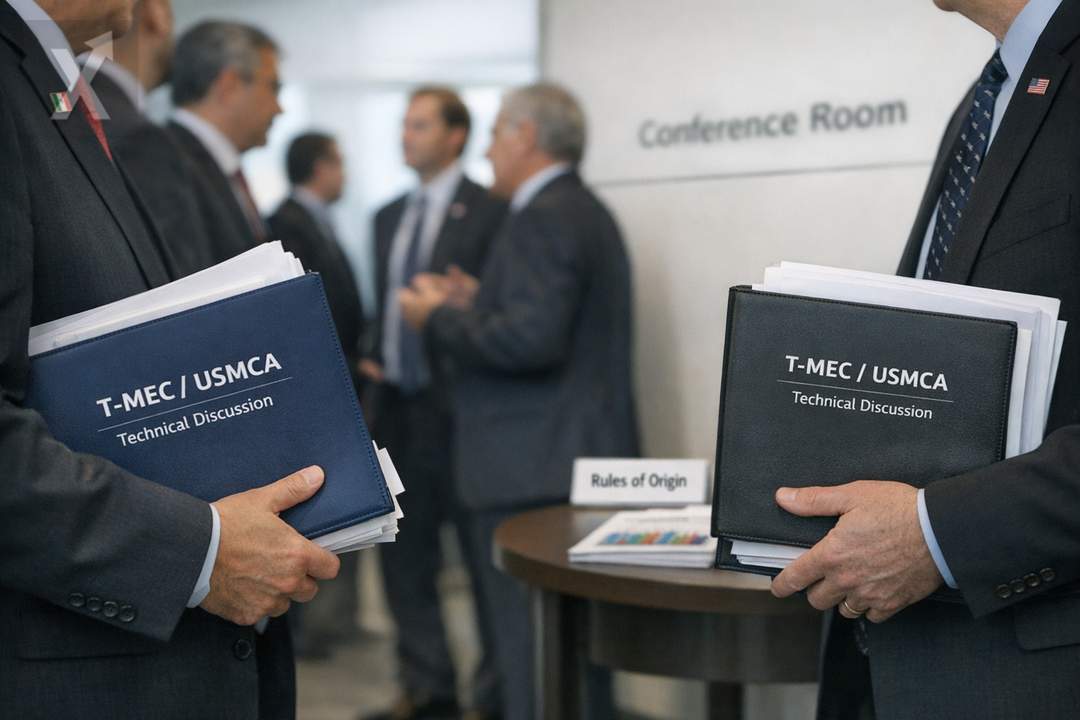
The USMCA review kicks off with technical teams and points to negotiations focused on regional content and tighter control of Asian inputs.
The run-up to the 2026 review of the United States–Mexico–Canada Agreement (USMCA) is beginning to take shape as technical teams from Mexico and the United States come online, in a phase aimed at defining the issues and setting the discussion calendar. Economy Secretary Marcelo Ebrard confirmed talks with U.S. Trade Representative Jamieson Greer and their respective teams, with the goal of opening a more formal workstream.
The start comes at a pivotal moment for the Mexican economy: the country has solidified its position as one of the United States’ top trading partners, driven by deep manufacturing integration and the nearshoring trend. But the environment is also more complex than in prior years: U.S. trade policy has grown stricter around the origin of inputs, supply-chain oversight, and scrutiny of potential transshipment schemes routed through Asia.
From Washington, the message is that the review won’t be a mere formality. Greer has publicly said talks with Mexico are moving forward and heading into a more structured phase. At its core, the debate points to the same question: how “North American” does a good have to be to qualify for preferential tariff treatment? That definition is no small matter, because it directly affects sectors that underpin Mexico’s export momentum, such as auto parts, automotive manufacturing, electronics, electrical equipment, and certain categories of machinery.
For Mexico, the USMCA has served as an anchor of trade certainty in a global cycle of slower growth, with manufactured exports heavily dependent on the U.S. market and stable rules. For the United States, the review also intersects with industrial and geopolitical goals: strengthening regional production, reducing reliance on Asia for critical inputs, and at the same time responding to domestic pressure from sectors calling for stricter enforcement of the agreement’s disciplines.
Rules of origin: the barometer of integration and nearshoring
One of the most sensitive points in the review is rules of origin—the set of criteria that determines what share of regional content a product must include to benefit from zero tariffs within the bloc. In practice, tougher North American content requirements can mean supply-base reconfiguration, cost adjustments, and new investment decisions. For Mexico, the challenge is twofold: capitalize on nearshoring with more local component production while also remaining competitive against other manufacturing hubs.
The discussion matters because a large share of Mexico’s export platform runs on global value chains in which Asian inputs still play an important role due to price, availability, and specialization. If the United States tightens the criteria to prevent Mexico from serving as an indirect entry platform for components coming from China or Vietnam, companies could face a dilemma: switch suppliers, relocate processes within North America, or absorb higher compliance costs. In any scenario, the impact could show up in margins, delivery times, and the ability to attract new investment.
In addition, the debate isn’t happening in a vacuum. Mexico’s economy combines a highly sophisticated export sector with a domestic market that has shown resilience—supported by formal employment, remittances, and social programs—but that also faces pressures such as high financing costs, infrastructure bottlenecks, and security challenges along logistics corridors. In that context, the outcome of the USMCA review could shape investment expectations, plant planning, and the pace at which Mexican suppliers are integrated into higher-value chains.
In the coming months, the technical agenda is likely to broaden to verification mechanisms, compliance, and regulatory cooperation, as well as chapters that often trigger disputes when political priorities shift. Even with nearshoring gains, Mexico needs to strengthen internal capabilities—reliable energy, logistics, human capital, and regulatory certainty—so that any increase in regional content requirements becomes an opportunity for import substitution rather than a drag on exports.
In short, the start of technical work marks the first step in negotiations that could redefine production incentives across North America. The key question in the review will be how far the United States pushes stricter rules—and how Mexico responds with a strategy that preserves preferential access, attracts investment, and raises regional content without losing competitiveness.
Looking toward 2026, the message for the market is that the USMCA will remain the backbone of Mexico’s foreign trade—but with a more demanding conversation around origin and input traceability, in an environment where regional integration competes directly with geopolitics and industrial policy.






