Sabadell Raises Funding on the BMV, Targets Energy and Hospitality to Grow Lending in Mexico
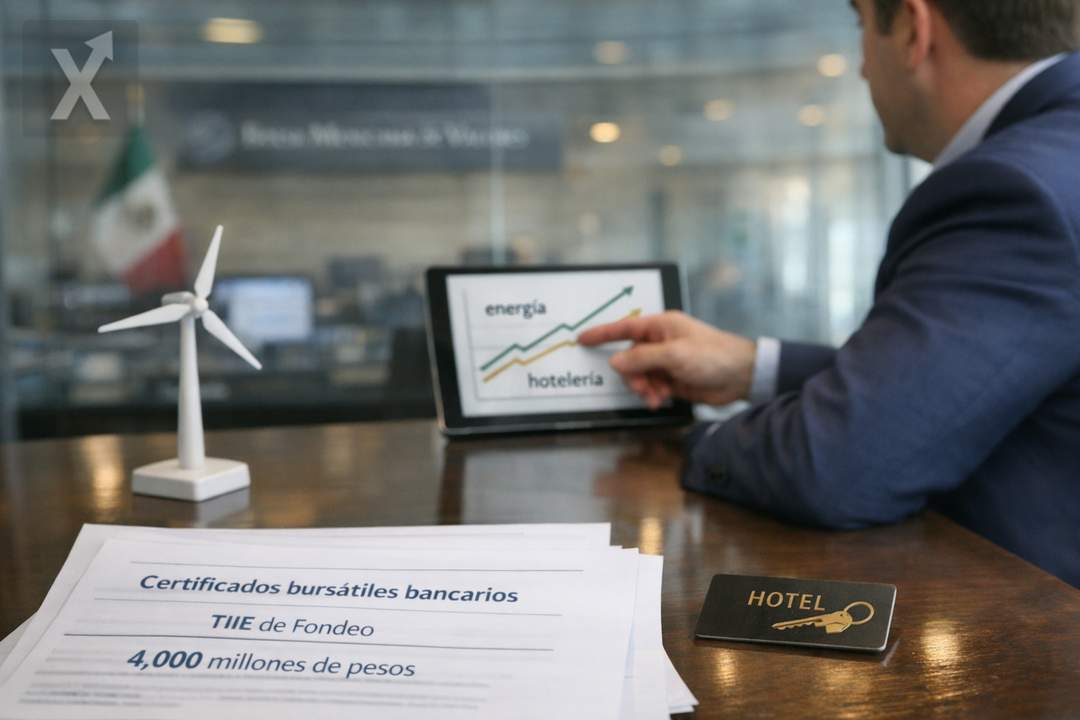
The 4 billion–peso issuance gives Sabadell Mexico a local funding channel to expand lending, with a focus on energy and tourism.
Banco Sabadell Mexico kicked off a new phase in its funding strategy by making its debut in the Bolsa Mexicana de Valores (BMV) local debt market with a 4 billion–peso offering—an operation the institution views as key to supporting its business loan book. The bank, Spanish in origin but with operations and regulatory capital in Mexico, identified the energy and hospitality sectors as the main engines to accelerate its growth in the coming years.
The issuance was carried out through three-year bank notes (certificados bursátiles bancarios) with a floating rate indexed to the TIIE Funding Rate (TIIE de Fondeo), and it was part of a program authorized for up to 20 billion pesos. According to bank executives, the transaction was oversubscribed—an important data point in an environment where the cost of money remains high and investors have become more selective amid global financial volatility.
Beyond the proceeds raised, entering the public market implies greater discipline: visibility with institutional investors, ongoing oversight from rating agencies, and constant comparison against other bank issuers. In practice, that “scrutiny” often translates into incentives to strengthen corporate governance, transparency, and financial consistency—factors that affect funding costs and the ability to compete for corporate clients in a banking system dominated by large players.
In Mexico, bank lending to the private sector has continued a gradual recovery after the pandemic shock years, though with differences by segment. Corporate demand typically reacts to rate cycles with a lag and tends to concentrate on projects with more predictable cash flows and robust structures. In that context, diversifying funding in local currency can be an advantage for mid-sized banks looking to grow without relying heavily on intercompany lines.
Energy: Hybrid projects, regulatory certainty, and appetite for financing
The energy sector stands out as one of the bank’s clearest bets, at a time when the country faces growing needs for electric capacity driven by industrial expansion and consumption. Sabadell executives have said that mixed-investment structures between private companies and Mexico’s Federal Electricity Commission (CFE) could trigger significant medium- and long-term credit needs—especially for solar and wind generation projects, as well as related infrastructure.
For banks, the opportunity comes with conditions: bankable projects typically require clear contracts, a solid collateral package, permits, and a predictable regulatory path. In recent years, the public conversation around energy in Mexico has been shaped by debates over the role of the state and private participation; as a result, any sign of more stable rules tends to increase banks’ willingness to lend and reduce risk premiums. If projects reach orderly financial close, credit can become a channel to translate financing into productive investment and, eventually, ease electricity bottlenecks that push up costs and limit new industrial facilities.
Sabadell’s offering is also being read through a macro lens: with rates still high, the market rewards issuers that can sustain margins and control risk. While the monetary cycle has been moving toward rate normalization, financing costs remain a decisive factor in the viability of capital-intensive projects like power generation. That makes access to competitively priced funding—and sound asset-liability management to avoid maturity mismatches—even more important.
Hospitality and tourism: Demand tailwinds, but sensitive to costs and the exchange rate
Hospitality is the second growth front. The bank says it has built a meaningful position financing projects from early development through operations, supported by the tourism momentum Mexico has maintained in recent years. The sector’s performance, however, is not uniform: beach destinations, business-travel cities, and corridors with international connectivity tend to respond differently to changes in room rates, occupancy, security, and flight availability.
In the near term, developers face a twofold challenge: on one hand, higher financing costs that force more selectivity in locations and scale; on the other, pressure on construction and operating costs. Even so, well-structured projects—with pre-sales, strong management agreements, and conservative occupancy assumptions—remain natural candidates for commercial bank financing. In addition, part of the sector’s revenue can be tied to foreign visitors, which introduces sensitivity to the U.S. dollar and to external demand cycles.
At the same time, Sabadell also sees opportunities linked to trade with North America, in an environment where regional productive integration has become structural. The outlook for manufacturing, logistics, and industrial parks depends heavily on regulatory certainty, infrastructure, and energy availability, as well as the review process and ongoing operational continuity of the USMCA (T-MEC). For banks, these sectors often generate credit demand for working capital, capacity expansion, and supplier financing—though with increasingly strict risk standards.
Finally, the BMV issuance fits into a strategy of reducing dependence on the parent company and strengthening local funding. In a financial system where deposits and market access determine competitiveness, expanding peso-denominated funding sources can allow Sabadell to better fine-tune pricing, tenors, and loan volumes—especially if it aims to grow in segments tied to long-horizon investment projects.
Overall, Sabadell’s move suggests that appetite for corporate financing is still there, but it is concentrating in sectors with clear investment narratives: energy because of the need for added capacity, and hospitality because of tourism demand. The challenge for this expansion to translate into more real investment will be maintaining clear rules, prudent financial structures, and projects with verifiable cash flows.






