Washington Puts the USMCA Renewal on Ice, Raising Uncertainty for Investment in Mexico
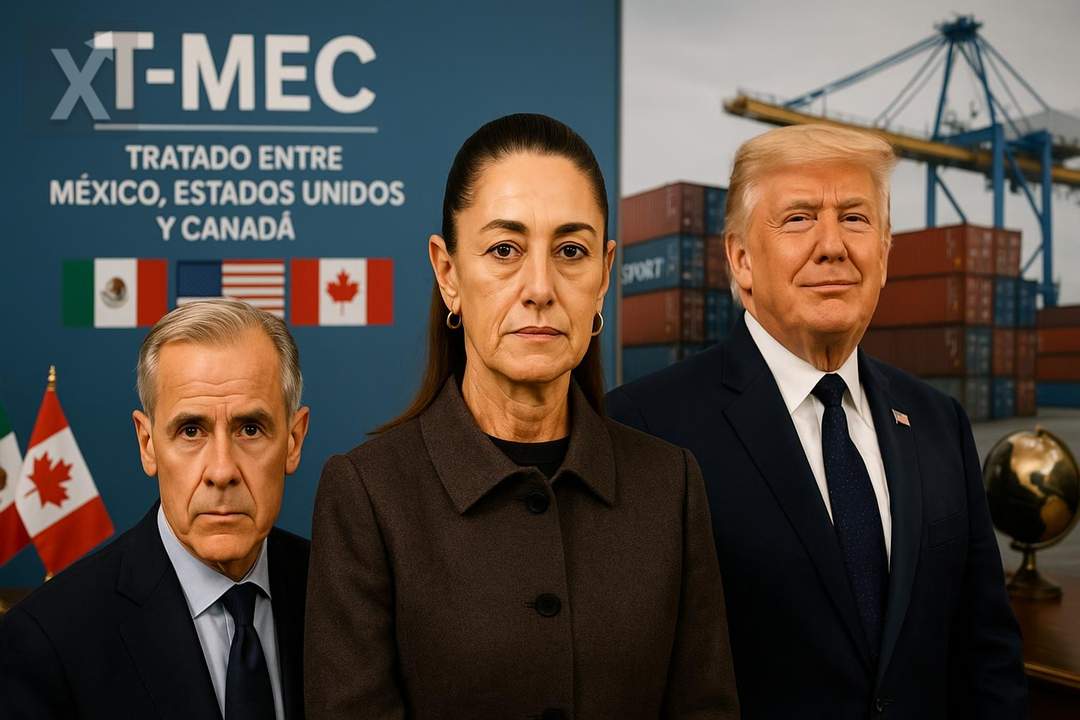
The decision to keep the USMCA under annual reviews opens a prolonged negotiation period that could affect investment plans and supply chains in Mexico.
The United States has decided, for now, not to sign off on the automatic extension of the United States–Mexico–Canada Agreement (USMCA) for an additional 16-year term, choosing instead to keep the deal under an annual review framework. In practice, the agreement remains in force, but the shift adds a layer of uncertainty that could influence decisions on investment, plant expansions, and the design of supply chains in Mexico.
The move was communicated after the first joint review built into the USMCA itself, which states that six years after it took effect, the partners must state whether they support extending it. When one country does not back that renewal, the treaty is not canceled: it shifts into a cycle of annual reviews until its scheduled expiration in 2036—unless consensus is reached earlier to extend it, or one of the parties decides to withdraw under the agreement’s rules.
The Office of the United States Trade Representative (USTR) said it will continue talks with Mexico and Canada to address what it views as “shortcomings” in the agreement and the trade deficits it says it runs with both partners. On the near-term calendar, the USTR confirmed a new phase of bilateral exchanges with Mexico, with a third round expected during the week of July 20.
For Mexico, the shift arrives at a time when foreign trade and the relocation of manufacturing to North America (nearshoring) had become a cornerstone of growth expectations. While manufactured exports—especially vehicles, auto parts, electronics, and electrical equipment—have kept industrial activity afloat, fixed investment has been uneven due to high financing costs, business caution, and local bottlenecks such as energy and water availability in certain industrial corridors.
Economic impact: investment, rules of origin, and the auto industry
The main transmission channel for Mexico’s economy is not the agreement’s immediate validity—which remains intact—but rather the “uncertainty premium” that can make projects more expensive or delay them. In export manufacturing, planning horizons are typically multi-year: an automaker, an auto-parts supplier, or an electrical components plant makes capacity decisions based on stable rules, preferential access, and legal certainty. Under annual reviews, companies may demand higher returns before investing, diversify suppliers outside the region, or at minimum hold off on announcements until they see clearer signals about where the talks are headed.
On the technical front, rules of origin, customs verification, and disciplines tied to regional competitiveness tend to be flashpoints. In autos, for instance, compliance with regional content rules and requirements related to North American integration is critical to keeping tariff preferences. Any adjustment—or even the expectation of adjustments—can reshape purchasing, supplier location, and logistics strategies across Mexico, with direct effects on industrial employment, transportation demand, and related services.
At the same time, Mexico’s macroeconomic backdrop is a delicate balancing act. With interest rates still restrictive to contain inflation pressures and growth running at a moderate pace, external demand has been crucial. If the USMCA’s annual review process translates into greater investment caution, the country could become even more reliant on domestic consumption and the rollout of infrastructure projects, while Mexican states compete to attract capital through incentives, available industrial parks, and connectivity.
In financial markets, the news could lead to bouts of FX volatility, particularly if investors interpret the negotiations as becoming more hardline. A more risk-off environment tends to show up in the Mexican peso’s performance against the U.S. dollar, especially when it coincides with activity data, rate decisions, or trade-policy signals from Washington. For importing companies or firms with USD-denominated debt, this underscores the importance of hedging and tighter risk management.
Looking ahead, the outcome will depend on the three governments’ ability to manage differences without undermining the agreement’s core purpose: certainty for trade and investment in a highly integrated region. For Mexico, an additional challenge will be to lock in domestic conditions that make nearshoring viable—competitive energy, logistics infrastructure, security, and human capital—so regional integration does not depend solely on the text of the agreement, but on the real capacity to produce and export.
In short, the USMCA is not stopping, but it is entering a phase in which U.S. trade policy carries more weight in the economic calculus. The agreement’s continuity avoids an immediate rupture, though an annual review cycle may translate into more cautious corporate decision-making and an environment in which Mexico will need to strengthen its competitiveness to sustain investment and exports.






