Economy Ministry rolls out incentives to modernize heavy transport and shore up logistics
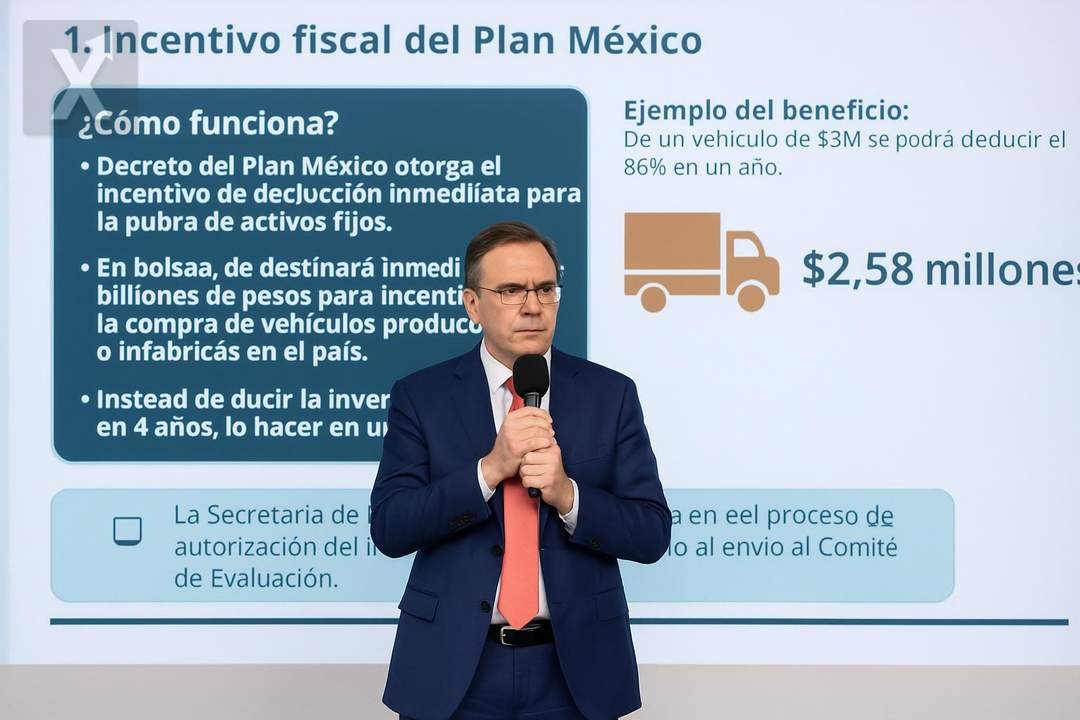
The new package combines tax breaks, credit guarantees, and safety rules to speed up truck replacement and lower logistics costs.
Mexico’s Ministry of Economy has launched an incentives package to push the renewal of the country’s heavy-vehicle fleet, with the dual goal of improving highway safety and strengthening domestic industry tied to the manufacturing and assembly of these units. The plan—presented by Economy Secretary Marcelo Ebrard—focuses on buses, freight trucks, and tractor-trailers, a key segment for moving goods and, by extension, for the economy’s performance.
The program arrives at a time when trucking remains central to domestic logistics but faces persistent challenges: an aging fleet, high operating costs (fuel, maintenance, and parts), and road-safety and cargo-security conditions that strain companies and drivers. Added to this is the need to improve the sector’s environmental performance, in line with emissions-reduction goals and pressure from supply chains demanding traceability and stricter standards.
The first lever in the package is a tax incentive allowing immediate expensing of the cost of a new truck, reducing the tax burden in the year of purchase and aiming to bring investment decisions forward. The government expects to allocate 2 billion pesos to this scheme, with the intention of encouraging the purchase of vehicles produced or assembled in Mexico and replacing older units that tend to be less efficient and more prone to breakdowns.
The second component is the reactivation of a guarantees program, in coordination with Nacional Financiera (NAFIN), designed to expand access to financing, particularly for small transport operators. In practice, a public guarantee typically lowers the risk banks perceive and can improve loan terms (maturity, interest rate, or collateral requirements), which is especially relevant for the “one-truck owner-operator,” a common player in the market and usually with less funding capacity.
The third pillar is regulatory: the creation of a new Official Mexican Standard (NOM) on safety for heavy vehicles operating in the country—whether new, used, or imported. The bet is that a uniform standard will help reduce accidents through enforceable minimum requirements and bring more order to the market by preventing vehicles with mechanical or equipment conditions that increase risk from entering or remaining on the road.
Fourth, the government will update the reference prices used for importing used vehicles, aiming to curb undervaluation practices and the entry of units that compete unfairly with domestic production or fail to meet adequate standards. Authorities are seeking a “level playing field” in used-vehicle trade, a sensitive issue for the sector because of its impact on fleet renewal and demand for new units.
Implications for inflation, competitiveness, and nearshoring
Beyond the direct impact on manufacturers, assemblers, and dealers, modernizing heavy transport can have meaningful macroeconomic effects. A more efficient fleet typically translates into lower costs per mile (through fuel use, downtime, and maintenance), helping contain pressure on logistics costs that ultimately feed into final prices—especially for goods with a high transportation component. In a country where trucking links production, ports, border crossings, and consumer hubs, productivity gains in the fleet can strengthen the competitiveness of exporting industries and local suppliers integrated into regional value chains—an increasingly important factor amid manufacturing reconfiguration and the push for nearshoring. In that sense, clearer rules for importing used vehicles and safety standards can also reduce operational uncertainty and improve service quality, elements global companies often consider when deciding on investments or allocating orders.
On the labor front, the government estimates the package would help protect around 200,000 jobs tied to the sector. Across the value chain, additional demand for new units can benefit plants, auto-parts suppliers, financing services, and specialized repair shops. However, the program’s reach will depend on the speed of implementation, transport operators’ ability to meet credit requirements, and the total cost of ownership of new units versus used alternatives.
There is also an environmental angle: replacing older units with newer-technology models typically reduces emissions per ton-mile and improves energy performance. Over the medium term, the effect could be more noticeable if the policy is paired with effective inspection, proper maintenance, and the availability of fuels and parts, as well as infrastructure that reduces idle time on strategic corridors.
Overall, the package combines tax incentives, backstopped credit, and regulation to accelerate heavy-fleet renewal. If carried out with oversight and coordination among states, industry, and the financial sector, it could become a lever to improve road safety and logistics efficiency, with positive effects on costs and competitiveness.
Looking ahead, the challenge will be balancing support for domestic industry with a more orderly used-vehicle market, without limiting small operators’ ability to renew their fleets; the program’s effectiveness will be measured by how many units are replaced, the reduction in crashes, and a verifiable improvement in the sector’s productivity.






