Mexican 10-year bond yields jump to 9.45%, signaling a higher global risk premium
Mexico’s long-term sovereign debt yields rose despite Banxico rate cuts, pulled higher by geopolitical tensions and rising U.S. rates.
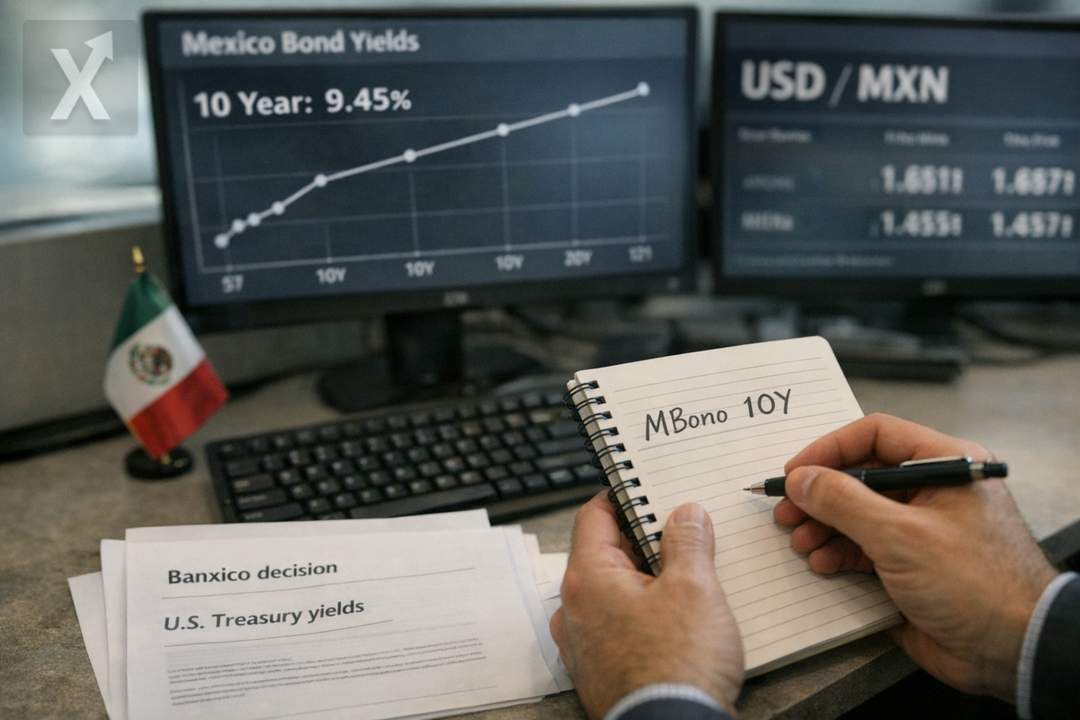
Yields on Mexico’s long-term government bonds have climbed so far in 2026, a clear sign that markets are demanding a higher risk premium amid a more fragile international backdrop. The 10-year Mbono yield, which started the year around 8.95% and hit lows near 8.73% in the first week of January, quickly moved above 9% and went on to reach a March peak of 9.45%, one of its highest levels of the year.
The move has taken place even as the Bank of Mexico (Banxico) opened the door to a rate-cutting cycle— a contrast that underscores the “decoupling” between short-term monetary policy and the long end of the curve. In practical terms, the market is asking for more compensation to lock up capital for longer maturities, especially as global risk perceptions intensify.
External factors are driving the rise: escalating tensions in the Middle East—with implications for energy supply and strategic shipping routes—and higher yields on U.S. Treasuries, which increase the opportunity cost of holding positions in emerging markets. When U.S. fixed income offers higher returns, Mexico typically needs wider spreads to keep flows into its long-term debt.
February saw a period of relative calm, but in March the adjustment accelerated within a matter of days: the yield climbed from around 8.79% to 9.45%, a pattern consistent with “flight to quality” episodes and increased risk aversion. By April, the yield had stabilized around 9.03%—still above the year’s lows—suggesting the risk premium has not fully faded.
Banxico cuts, but the long end is driven by global inflation, energy, and the U.S.
Mexico’s yield curve reflects a mix of domestic and external variables, but the long end is often especially sensitive to expected inflation, the term premium, and global shocks. While Banxico directly influences short maturities through its policy rate, 10- and 20-year yields incorporate expectations about the balance of inflation and growth risks over longer periods, plus a component of global uncertainty. A sudden spike in oil prices can feed into inflation expectations (through energy and logistics costs) and complicate the outlook for real rates, while higher U.S. yields typically push bond prices lower worldwide, including Mexican debt.
For investors exposed to long-term debt, higher rates imply potential mark-to-market losses. This is particularly important in high-duration portfolios: relatively modest moves in yields can trigger meaningful declines in bond prices. Sovereign default risk remains low in the near term, but rate volatility translates into an immediate financial cost for investors who need liquidity or are forced to rebalance risk.
At the same time, levels near 9% on the 10-year Mbono have revived the debate over gradual entry opportunities for long horizons—so long as investors can tolerate volatility. In environments marked by energy shocks or greater uncertainty, some investors tend to shift toward short-term or floating-rate instruments to reduce sensitivity, while inflation-linked debt can become more attractive if the market continues to revise inflation expectations upward.
On the macro front, the episode comes as Mexico seeks to maintain price stability and anchor expectations, while operating with moderate growth and a high dependence on North America’s manufacturing cycle. The path of long-term rates also affects financing costs for companies and households and can tighten conditions for private investment—especially if the adjustment persists and coincides with a strong dollar or bouts of capital outflows from emerging markets.
Looking ahead, the main focus will be on the trajectory of inflation—including second-round effects from energy—the direction of U.S. monetary policy, and the persistence of geopolitical risks. If external shocks ease, risk premia could gradually compress; but if global volatility persists, the market will likely keep demanding higher term yields from Mexico, even with additional Banxico cuts.
In sum, the rise in Mexico’s 10-year bond yield is a barometer of a more uncertain international environment: even as local monetary easing signals emerge, the cost of locking in long-term returns has increased due to energy, global rates, and heightened risk aversion.