Mexico Negotiates the Future of the USMCA as Its Imports from Asia Accelerate
The rebound in Asian inputs shows that nearshoring is coexisting with a technology dependence that North America has not yet replaced.
Mexico heads into the USMCA review with messaging focused on strengthening North American production integration, but recent foreign-trade flows point to a more complicated transition. Between January and April 2026, Mexican imports from Asia jumped 42%, far above the 2.1% growth seen in purchases from its agreement partners, the United States and Canada. In absolute terms, the country imported $121.054 billion in goods from Asian economies in the first four months of the year—an indication that manufacturing based in Mexico remains tied to global supply chains where Asia still carries decisive weight in components, machinery, and technology.
This figure takes on political and economic relevance because the USMCA review is happening amid heightened scrutiny of rules of origin, input traceability, and economic security. At the same time, Mexico’s export boom to the United States—across sectors such as autos, electronics, and medical devices—still requires intermediate goods that, in many cases, are not produced at sufficient scale within the region. The result is a duality: deeper trade integration with North America in the final destination of exports, but a production platform that still sources from Asia to sustain output, costs, and technological sophistication.
China remained the top supplier, with $42.851 billion in the first four months of the year. However, momentum is no longer coming only from the Asian giant. A standout is the surge in imports from Taiwan, along with significant increases from Singapore and Hong Kong—suggesting a reshuffling of suppliers rather than a break from Asian sourcing.
For the Mexican government, the global realignment offers a window to attract investment in advanced manufacturing. The Economy Ministry, led by Marcelo Ebrard, has stressed that the U.S. strategy to reduce dependence on Asia could translate into reshoring/relocation to North America in industries such as semiconductors, pharmaceuticals, electronics, medical devices, and automation. Under that narrative, Mexico aims to position itself as the region’s most competitive link to expand capacity and capitalize on nearshoring. Even so, import figures show that this process—if it happens—will be gradual and does not immediately eliminate the need to buy technology and components from Asia.
USMCA Review: Rules of Origin Under Pressure and the Challenge of Regional Content
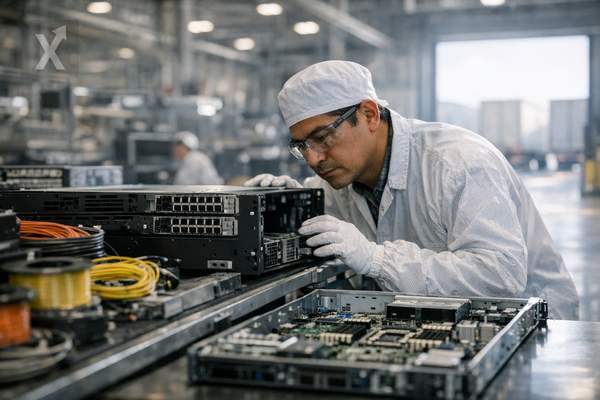
One natural focus in the USMCA review will be regional content in sensitive sectors, especially those where the global supplier base is harder to “regionalize.” In mature industries such as automotive, Mexico has spent decades building a North American supplier network and, relatively speaking, Asian dependence looks smaller compared with the volume exported to the United States. But in electronics-intensive products—from modules, sensors, and components to consumer goods like smartphones—regional integration is thinner, and imports of Asian parts remain decisive.
This creates a practical dilemma for industrial policy: raising regional content requires investment in capabilities that are scarce today (chip fabrication, advanced packaging, specialized machinery, chemicals, and materials), along with infrastructure and reliable energy. Mexico, with a strong manufacturing sector and logistical advantages thanks to its proximity to the United States, also faces structural constraints frequently cited by analysts and rating agencies: financing costs, bottlenecks in power transmission, water availability in industrial hubs, and the need for greater regulatory certainty for capital-intensive investment.
Meanwhile, the external environment adds pressure. The United States has accelerated economic-security and industrial-strengthening policies, which often translate into stricter requirements for supply chains in strategic areas. For Mexico, the challenge is twofold: maintain preferential access and competitiveness under the USMCA, while also preventing tighter origin or traceability standards from becoming a barrier for industries that currently operate with substantial imported content.
Another feature of the current moment is that “reducing dependence” doesn’t necessarily mean less Asia, but rather a shift in sourcing within Asia. In 2025, Mexico’s imports from China grew moderately, while imports from Taiwan soared—a trend that continues in 2026. The backdrop is Taiwan’s central role in semiconductors and electronic components, as well as the search for alternative suppliers in a more tense geopolitical environment. Mexico’s export-oriented manufacturing base needs these inputs to meet timelines, specs, and costs—particularly in electronics, computing, communications, and industrial automation.
In some segments, Mexico has made progress in production integration. Exports of computer equipment, for example, have grown notably over the past decade and, relatively speaking, with a smaller share of Asian inputs than in prior years—suggesting some development of local and regional capabilities. But in other products, the pattern looks more like assembly with high imported content: the final good is exported to the United States while parts and subassemblies are imported from Asia in large proportions. That unevenness is key to understanding why the debate over “triangulation” does not fully explain the dynamics on its own: sectors with mature regional supply chains coexist with others where technology dependence persists.
In perspective, the acceleration of imports from Asia does not invalidate nearshoring; it qualifies it. The industrial shift may be boosting production in Mexico—and therefore demand for inputs—even before a sufficient regional base is in place to replace imports. If investment in local and North American supplier networks doesn’t move as fast as manufacturing expansion, reliance on Asian components may persist or even rise in the short term, even when the final destination of exports is North America.
The USMCA review, in this context, will act as a barometer: it will show how far the region is willing—and able—to build tighter supply chains without raising costs or undermining competitiveness. For Mexico, the outcome will depend on its ability to attract investment in higher value-added links, raise productivity, and address infrastructure, energy, and logistics constraints, while preserving its position as an export platform to the United States.
In short, Mexico is seeking to deepen North American integration in the USMCA review, but the data show that manufacturing still depends on Asia to sustain its expansion. The opportunity to substitute imports is real, but it requires consistent industrial policy, investment, and time for regional content to catch up with the realities of global supply chains.