Medical Devices: the Quiet Engine Strengthening Mexico’s Manufacturing Exports
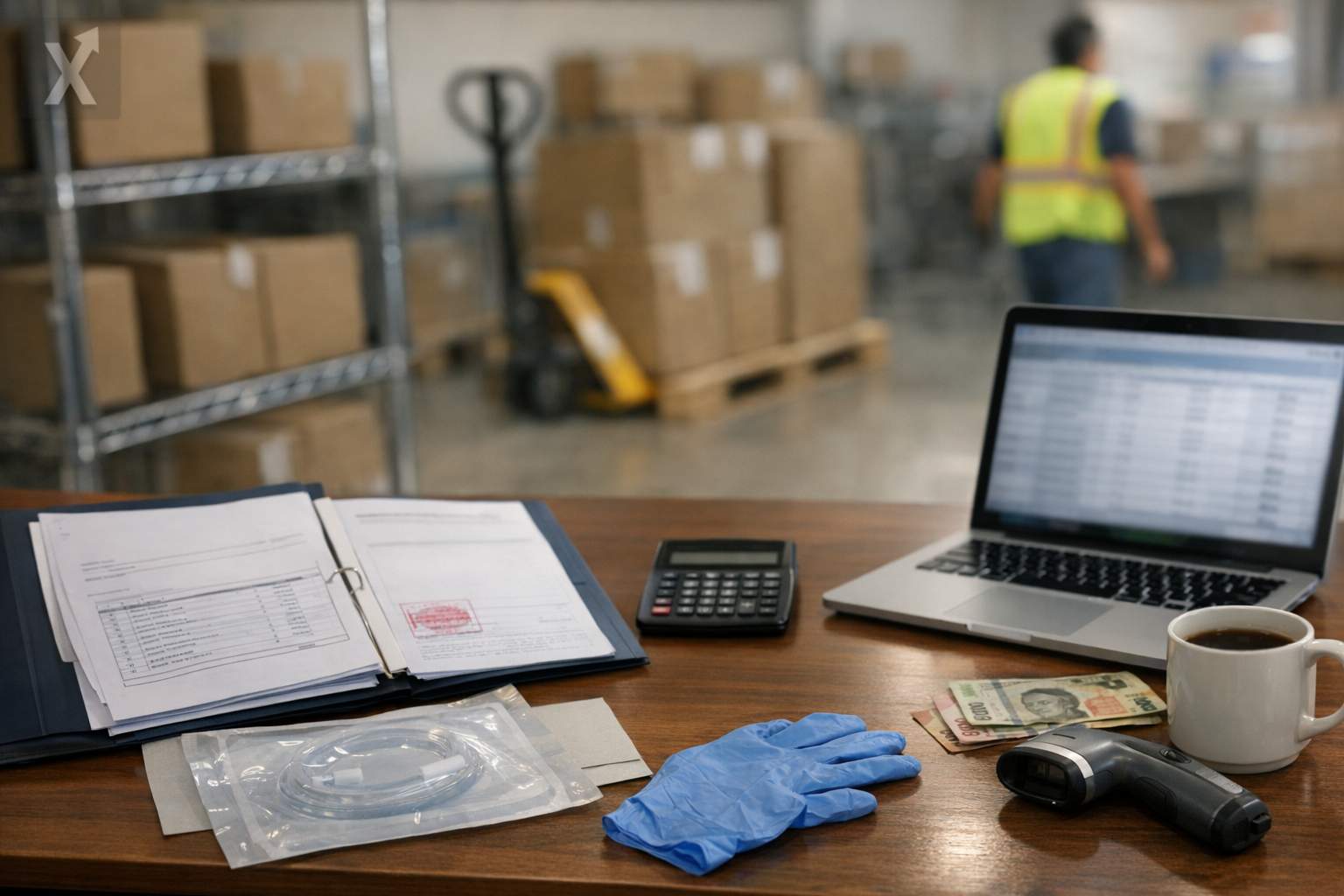
Mexico doubled its medical-device exports in five years, driven by industrial clusters, U.S. demand, and production reshoring.
Mexico’s medical-device industry has moved beyond a peripheral activity to become one of the pillars of advanced, export-oriented manufacturing. In a global environment shaped by supply-chain reorganization and rising international logistics costs, Mexico has found an unusual mix in this sector: scale, specialization, and immediate proximity to its main market.
The latest data show the leap: the value of medical-device exports rose from $10.668 billion in 2020 to $20.550 billion in 2025, according to figures from the Bank of Mexico. This performance reflects a broad set of tariff lines ranging from disposable supplies to more complex equipment, suggesting that growth isn’t explained by a single product but by an expansion of productive capabilities.
This boom comes as the Mexican economy looks to lock in more stable sources of growth, amid interest rates that remain high by historical standards, cost pressures, and consumer demand that has shown signs of cooling. Export manufacturing—especially what is tied to North America—has remained one of the main shock absorbers, and within it, medical devices stand out for their higher value added and the type of jobs they create.
According to industry estimates, Mexico remains Latin America’s largest exporter of medical devices and ranks among the leading exporters globally. Integration with the United States is decisive: roughly 90% of shipments go to that country, reflecting a regional chain in which Mexico serves as a platform for manufacturing, testing, assembly, and, in some cases, process development.
Mexico’s comparative advantage rests on costs, but also on manufacturing know-how. Different sector analyses indicate that producing in Mexico can be meaningfully cheaper than producing in the United States, and competitive with Asia in segments where regulatory standards, traceability, and delivery speed matter as much as labor costs. Added to that is an ecosystem of suppliers, technicians, and engineers that has matured alongside foreign investment and knowledge transfer.
Clusters, Talent, and the New Industrial Geography
The sector’s growth is not evenly distributed: it is concentrated in clusters that have built reputation and critical mass. Baja California and Sonora have strengthened as export corridors thanks to their proximity to the border and their experience in regulated manufacturing; Chihuahua leverages a strong industrial base and decades-long export culture; and Jalisco has sought to differentiate itself by integrating electronics capabilities, prototyping, and innovation-related services. In central Mexico, the Mexico City metro area and neighboring states concentrate design, research, specialized services, and corporate coordination functions, completing the chain beyond assembly.
This industrial geography ties into a broader trend: the relocation of processes toward North America. For Mexico, the phenomenon creates opportunities, but it also requires raising domestic content, strengthening suppliers, and improving logistics infrastructure. As plants increase complexity—for example, in cardiovascular devices, diagnostic equipment, or precision components—it becomes more important to have certifications, metrology, specialized packaging, and quality-control talent.
Sector multinationals have reinforced their presence with export-oriented operations and facilities that meet international standards. The logic is straightforward: producing close to the end market cuts delivery times, makes coordination with hospitals and distributors easier, and shortens product-improvement cycles. For Mexico, this translates into specialized employment, technological learning, and greater industrial density—though also a high dependence on U.S. demand.
At the same time, Mexico’s domestic health market maintains a mixed structure: most of the population receives care through public institutions, while the private sector is growing in cities and industrial corridors. Even as Mexico exports more and more, it still imports a significant share of advanced equipment and critical inputs, creating room to substitute imports in certain niches while underscoring the importance of resilient supply chains.
The geopolitical dimension is also present. The technology competition between suppliers in the United States and China shows up in standards, components, intellectual property, and corporate decisions about where to locate stages of production. For Mexico, the challenge is to navigate that environment without stalling investment while gradually diversifying markets to reduce concentration in a single destination.
In industrial policy, the federal government has placed the pharmaceutical and medical-device industries among its promotion priorities. In practice, the effectiveness of this bet will depend on structural factors: regulatory certainty, permitting timelines, access to reliable energy, water availability in regions facing water stress, security along logistics corridors, and technical training aligned with the needs of highly regulated plants.
Looking ahead, the opportunities with the most momentum are in imaging, minimally invasive surgery, process automation, digital health and telemedicine, as well as cold-chain logistics and related services. If Mexico manages to deepen its supplier base and shift part of the activity toward higher-value design and engineering stages, the sector could become one of the clearest examples of nearshoring with real technology spillovers.
In sum, the rebound in medical devices confirms that Mexico can scale up in advanced manufacturing when investment, talent, and preferential market access converge. The challenge is to turn export growth into a more integrated platform that is less dependent on a single customer, by raising domestic content and production resilience.






