Mexico’s Farm Sector Faces USMCA Labor Scrutiny: Recruitment, Migration, and Export Risk
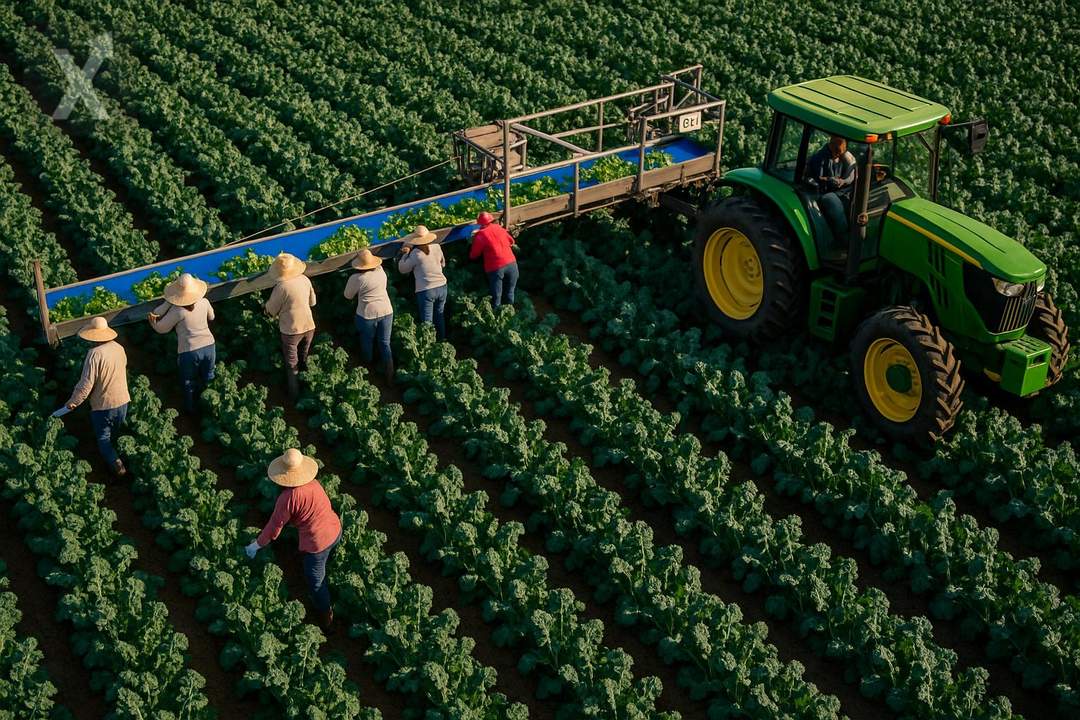
Farm competitiveness no longer depends only on productivity and sanitary standards, but on proving that its workforce was hired without fraud or coercion.
As the USMCA review approaches, Mexico’s agrifood sector is confronting a new front of commercial risk: labor. On top of the food-safety, traceability, and phytosanitary requirements that have historically determined market access in North America, there is growing pressure to show that farmworkers—including migrants—were recruited without deception, improper fees, document confiscation, threats, or any practice associated with forced labor.
This issue is not marginal. Rural employment in Mexico combines high informality, seasonality, and hiring through intermediaries—conditions that increase worker vulnerability and raise companies’ reputational exposure. In the first quarter of 2026, 5.2 million people were working informally in the agricultural sector, according to official figures. At the same time, labor shortages have become a real constraint for several export supply chains, especially in states with labor-intensive agribusiness.
This combination—too few available workers and opaque hiring practices—raises the likelihood that labor compliance will become a trade filter. In the United States, the Department of Labor has reiterated that the USMCA requires partners to enforce their laws against forced labor and to block imports of goods produced wholly or partly under those conditions. In practical terms, the labor standard is shifting from an ethical concern to a risk-management requirement: audits, due diligence, and documentary proof of recruitment are starting to carry more weight in relationships with buyers, packing operations, and retail chains.
For Mexico, the challenge has broad economic implications. The export-oriented farm sector is a significant source of foreign currency and regional employment, and it operates on margins that are sensitive to changes in logistics costs, the exchange rate, and staffing levels. If a company faces delays due to labor shortages or allegations of improper recruitment, the impact can translate into contract penalties, lost customers, or regulatory friction—just as North American agrifood trade is looking for greater certainty.
At the same time, orderly labor migration is increasingly serving as a regional pressure valve. The U.S. H-2A program hit a record 398,258 certified positions in 2025, reflecting that U.S. agriculture cannot meet its labor demand with domestic workers alone. Most of those permits go to Mexican nationals, which tightens labor supply in Mexico’s rural communities—especially during harvest seasons that overlap in both countries.
Temporary migration: between a pressure valve and a rural labor-market mismatch
The rise in H-2A slots cuts both ways for Mexico. On one hand, it offers a regular pathway that can raise rural household income through remittances and reduce exposure to irregular routes; on the other, it pulls working-age labor out of areas where employers already struggle to recruit, pushing up wages and turnover in Mexico’s own farm sector. The phenomenon also has macroeconomic implications: in a context of moderate growth, remittance inflows have supported consumption in sending regions, but they do not replace the need for productivity gains and formalization in agricultural employment.
In this environment, ethical recruitment initiatives are trying to become part of trade infrastructure. Organizations such as CIERTO México, linked to efforts that bring together civil society, companies, and authorities, have documented for years that vulnerability begins before a farmworker ever reaches the fields: fraud, abusive intermediation, and fees charged to “get a job” are factors the International Labour Organization identifies as triggers that elevate the risk of forced labor. The model they promote shifts recruitment, transportation, and paperwork costs to the employer and prioritizes transparency from the community of origin: wages, contract length, housing, and working conditions that are clear and verifiable.
The debate also highlights regulatory bottlenecks. Mexico has immigration categories to hire workers from neighboring countries, such as the Cross-Border Worker Visitor Card, but its reach is concentrated along the southern border. To fill vacancies in central and northern regions—where a significant share of the export-oriented agribusiness is located—costs and requirements rise, discouraging formal arrangements precisely where they are most urgently needed. The result is a perverse incentive: when the legal route is expensive or slow, more space opens up for opaque intermediation.
From a business standpoint, ethical, well-documented recruitment is increasingly seen less as an “extra cost” and more as operational insurance. In a market where international buyers demand traceability not only of the product but also of the process, proof of clean hiring practices reduces the likelihood of disruptions and strengthens business continuity. For the country, standardizing practices across agricultural corridors could help bring order to the rural labor market, increase formal employment, and improve productivity per worker.
The pressure is not coming only from North America. In 2026 Mexico also signed the Modernized Global Agreement and an interim trade agreement with the European Union, which include binding commitments on labor rights, environmental protection, and responsible business conduct. For Mexico’s farm sector, that widens the scope of scrutiny: market access may increasingly depend on the ability to demonstrate labor due diligence across the supply chain, from recruitment to transportation and housing.
In the coming months, the sector will face practical decisions: investing in verifiable hiring systems, training suppliers and supervisors, and building partnerships with authorities and organizations to expand legal pathways for labor mobility. At the same time, the USMCA discussion could push Mexico to strengthen labor inspections and compliance mechanisms, with the familiar tension between raising standards and not disproportionately increasing costs for small producers who have less access to financing and technology.
Overall, the USMCA review is accelerating a paradigm shift: Mexico’s agro-export competitiveness is no longer determined only by yields and sanitary controls, but by the ability to prove that its workforce was recruited under clear rules, without coercion, and with shared regional responsibility.






