Mexico and the United States Move Into the “Fine Print” of the USMCA: What’s at Stake for Exports and Investment
The technical phase starting in July could redefine rules of origin, investment certainty, and Mexico’s access to its largest market.
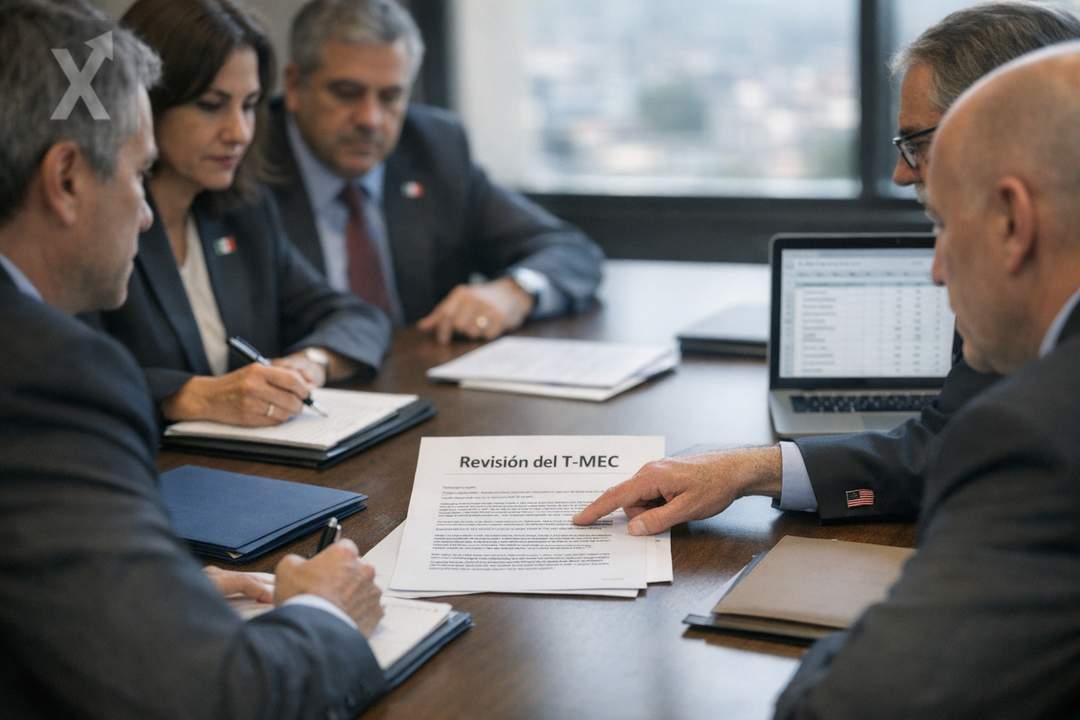
The USMCA review will enter a more decisive stage beginning in July, when Mexico and the United States start working on specific texts and more detailed proposals. This shift matters because it marks the move from political exchanges and broad assessments to negotiating the “fine print”: legal definitions, enforcement mechanisms, and potential adjustments that can directly affect costs, logistics, and investment decisions across North America.
Mexico’s Economy Secretary Marcelo Ebrard said that after two rounds of bilateral talks, progress was made on strategic issues such as rules of origin, economic security, agriculture, and the auto industry. The U.S. delegation was led by Trade Representative Jamieson Greer. Although the process involves all three partners, the Mexico–U.S. dynamic is especially pivotal for the Mexican economy given the outsized role of the U.S. market in Mexico’s foreign trade.
According to the timeline laid out by the Mexican government, a virtual meeting among the three countries will take place on July 1, formally kicking off the review. Then, on July 20 in Mexico City, the phase would begin in which negotiating teams discuss specific wording and content. In practical terms, that stretch usually concentrates the most sensitive points: technical definitions, exceptions, implementation timelines, and verification criteria.
The review is unfolding in a context of ongoing political uncertainty in the United States. President Donald Trump again questioned whether the agreement is worthwhile during his appearance at the G7 summit, though he left the door open to keeping it in place. His remarks renewed attention from companies and investors at a time when North American supply chains are still adapting to heightened geopolitical tensions and industrial competition with Asia.
For Mexico, the USMCA remains an anchor of certainty: most Mexican exports go to the United States, and export-oriented manufacturing investment depends heavily on clear rules, preferential access, and a dispute-settlement framework that reduces regulatory risk.
Rules of Origin and Autos: The Barometer of Regional Integration
If there is one chapter that serves as a barometer of productive integration, it is rules of origin—especially in autos. In recent years, the sector has operated under stricter regional content requirements and labor provisions aimed at raising standards and reshaping supplier networks. In practice, any change in percentages, calculation methods, or verification schemes can alter compliance costs for automakers and parts suppliers, and in turn influence where the next investment goes, which components are sourced within the region, and how production platforms are designed.
The push to fine-tune these rules intersects with the tech transition: electrification, batteries, semiconductors, and new materials. Mexico has sought to leverage nearshoring to attract projects tied to electric mobility and advanced manufacturing, but its ability to capitalize on that trend depends on conditions such as energy availability, logistics infrastructure, and regulatory certainty. That’s why the outcome of the USMCA review affects not only tariffs, but also expansion plans, domestic content, and the depth of local supplier networks.
Beyond industry, the agenda includes agriculture and economic security—areas where disagreements tend to be more visible because of their domestic political impact. In agriculture, issues around market access, sanitary and phytosanitary measures, and inspection mechanisms can affect high-volume trade flows. In economic security, the focus is typically on the resilience of critical supply chains, risk controls, and coordination in response to trade practices viewed as unfair, which could translate into more traceability requirements or tighter controls on certain inputs.
In the background, the review is also being read in light of Mexico’s recent economic performance: activity has shown episodes of slowdown after the post-pandemic boost, while inflation has tended to ease from the 2022 peaks, though with persistent pressures in some services and food. In that environment, maintaining a stable trade framework can help sustain investment and formal employment in export corridors, even if the global manufacturing cycle remains uneven.
Another point markets will watch closely is the signal of certainty coming out of the talks. An automatic extension of the agreement for 16 years would provide a long runway for capital-intensive investments, while a system of frequent reviews—without clarity on direction—tends to raise the “cost of waiting,” as businesses postpone decisions until the rules are settled.
In the coming months, the key will be separating political noise from technical progress. The July phase opens the opportunity to translate national interests into concrete clauses, but it also brings to the surface the issues where each country’s incentives clash. For Mexico, the balance lies in preserving preferential access to the U.S. market, sustaining export competitiveness, and preventing new requirements from becoming operational barriers.
In short, the USMCA review is entering the stretch where the details that often determine its effectiveness are set. If the negotiation manages to preserve certainty and workable rules for regional supply chains—without abruptly raising compliance costs—Mexico could strengthen its manufacturing appeal. If uncertainty prevails, the impact would show up in investment decisions and in the pace of productive integration over the next several years.