World Cup 2026: a limited but timely boost for Mexico’s low-growth economy
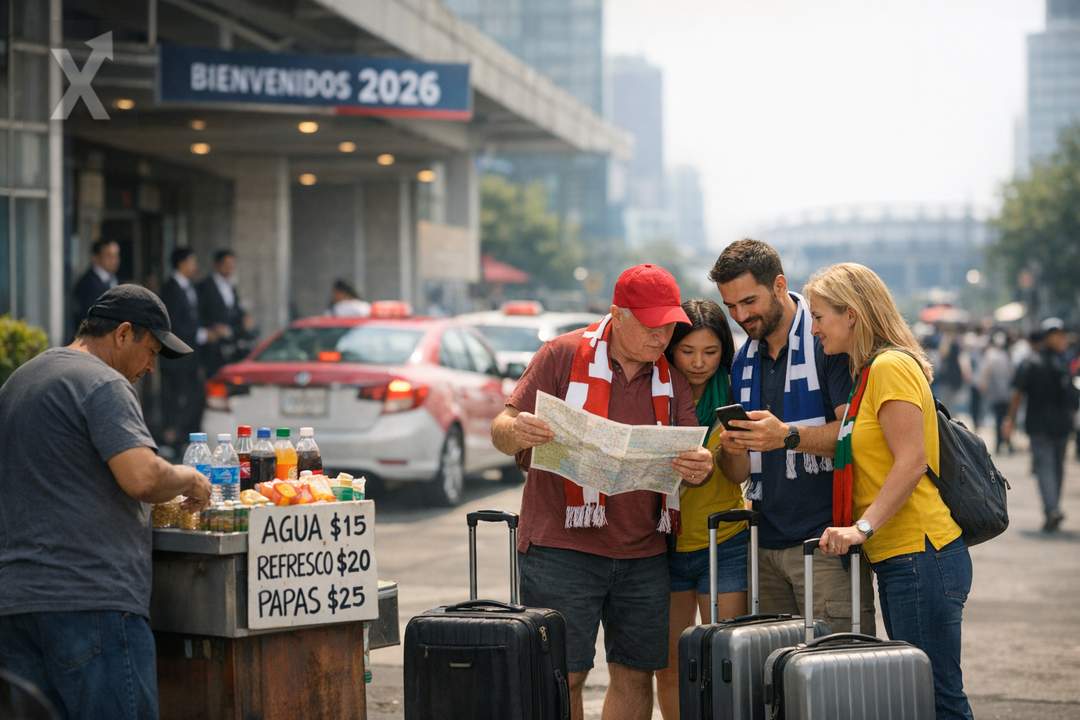
Moody’s estimates the World Cup will add 0.13 percentage points to Mexico’s GDP in 2026—more than in the U.S. and Canada—given the weight of tourism and services.
The 2026 World Cup, which Mexico will co-host with the United States (U.S.) and Canada, is expected to have a positive but moderate effect on regional economic activity. Still, the relative benefit for Mexico would be larger than for its partners, largely because tourism spending and event-related consumption carry more weight in a smaller economy that relies heavily on in-person services.
According to Moody’s Analytics, the World Cup would add 0.13 percentage points to Mexico’s GDP growth in 2026. By comparison, the boost would be 0.05 points in the U.S. and 0.07 in Canada, suggesting that even though a greater share of matches will be played on U.S. soil, the sheer size of the U.S. economy dilutes the statistical impact. For Mexico, by contrast, an increase of that magnitude is more noticeable in a context of low trend growth.
The firm also revised its 2026 growth forecast for Mexico from 1.4% to 1.5%, incorporating part of the tournament’s effect. The change may look marginal, but it matters given that in recent years economic performance has been constrained by the global slowdown, cautious private investment, and domestic demand that depends heavily on formal job creation, credit, and purchasing power.
In practical terms, the World Cup “bump” doesn’t look like a large-scale public works program: it is concentrated in short-term revenue from ticket sales, lodging, transportation, restaurant spending, and entertainment. That benefits hotel chains, airlines, mobility platforms, retailers, and local services, but it doesn’t necessarily translate into lasting productivity gains unless it is paired with complementary investment and urban planning.
Tourism, services, and the challenge of turning a demand spike into lasting benefits
The clearest channel of economic transmission will be tourism. In a country where a significant share of GDP and employment is tied to services, a temporary increase in visitors tends to show up quickly in sales and hotel occupancy. The challenge, however, will be avoiding an effect that fades into an “extended peak season.” International experience suggests the spillover depends on connectivity, safety, lodging supply, and the ability of host cities to absorb flows without sharply raising logistics costs, travel times, and prices—factors that can undermine the visitor experience and reduce average spending.
Another difference from prior editions is that the 2026 World Cup will rely largely on existing infrastructure, with targeted upgrades to stadiums and surrounding urban areas. In Mexico, the fact that most adaptations will be financed with private capital reduces pressure on public finances and limits the risk of “white elephants.” Even so, the final balance will depend on how effectively authorities coordinate mobility, urban services, and airport operations—areas where bottlenecks can translate into real economic costs.
At the macro level, the World Cup arrives as Mexico seeks to sustain its appeal for export-oriented investment and capitalize on the reshuffling of North American supply chains. While the tournament does not, by itself, change the fundamentals of competitiveness—available energy, regulatory certainty, security, and human capital—it can strengthen the country brand and encourage investment in hospitality, retail, and entertainment if the operating environment is viewed as stable.
There is also a distributional component: the benefits are concentrated in host cities and tourist corridors, so the national impact may be felt unevenly. To broaden the spillover, the key will be integrating local suppliers, formalizing temporary services, and raising standards (training, electronic payments, logistics) so the event leaves behind installed capabilities—even if modest—in visitor-facing sectors.
Across the region, Moody’s estimates an impact of about 0.056 percentage points of GDP for North America, confirming that the tournament does not redefine the bloc’s economic trajectory. Even so, for Mexico the relative effect is larger and comes at a time when any additional lift helps cushion an environment of moderate expansion.
In sum, the 2026 World Cup will not be a macroeconomic turning point, but it will be a timely stimulus—and more visible for Mexico than for the U.S. and Canada. The challenge is to turn the temporary surge in demand into operational improvements and a stronger tourism offering that lasts beyond the final match.






