The Fed Succession and Political Pressure in Washington Are Reshaping the Outlook for Mexico
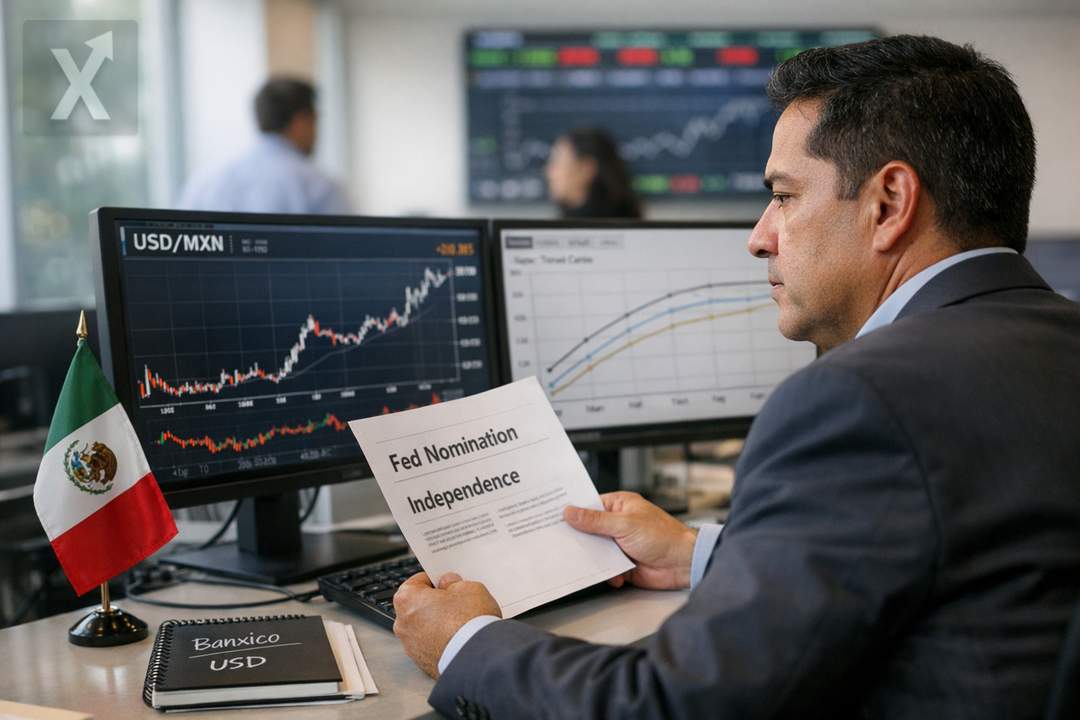
How the Fed’s independence is defined could move global rates, the U.S. dollar, and therefore Mexico’s financing costs and exchange rate.
The confirmation hearing for Kevin Warsh—nominated by President Donald Trump to lead the U.S. Federal Reserve (Fed) after Jerome Powell’s term ends—reopened a key debate for markets: to what extent U.S. monetary policy can withstand political pressure in an environment where inflation remains a latent risk.
Warsh told the Senate that monetary policy must remain “strictly independent” and rejected the idea that he would act as an instrument of the White House. The discussion is far from trivial: a shift perceived as more accommodating toward U.S. rate cuts could change the trajectory of global yields and risk appetite, with immediate effects on the U.S. dollar (USD), flows into emerging markets, and sovereign and corporate financing.
For Mexico, the issue is especially sensitive given the high degree of financial and trade integration with the United States. When investors anticipate lower Fed rates, the relative appeal of USD assets often declines; that can ease global financial conditions and support inflows into markets like Mexico’s. Conversely, if markets believe faster cuts will fuel inflation pressures—for example, in response to energy shocks—they may demand higher risk premia and trigger episodes of exchange-rate volatility.
Implications for the peso and Banxico strategy
In the local market, expectations for the Fed are a central input for the interest-rate differential between Mexico and the United States—one of the pillars behind the peso’s recent performance. Banxico has navigated an environment in which inflation has cooled from the 2022–2023 peaks, but services remain sensitive and there have been bouts of pressure from energy and food. The board has cut the policy rate gradually, aiming to avoid unanchoring expectations and keeping a data-dependent tone.
If the market concludes that the Fed will accelerate cuts due to political pressure, Mexico could face a dilemma: a weaker USD would tend to support the peso, but a pickup in U.S. inflation or rising institutional uncertainty could drive risk-off behavior and capital outflows. In that scenario, Banxico could be forced to prioritize financial stability and inflation anchoring over rapid easing—especially if volatility feeds into prices through the exchange rate.
The link also runs through funding costs. Mexico has extended maturities and maintains market access, but a “higher for longer” rate environment in the United States raises debt-service costs and pressures corporate issuers with USD liabilities. At the same time, exporting companies benefit from external demand, though they face uncertainty when the exchange rate moves quickly or credit conditions shift.
In the short term, the debate over Fed independence overlaps with factors Mexico was already monitoring: gasoline prices tied to geopolitical tensions, core inflation readings in both countries, and signs of slowing or resilience in U.S. consumer spending. Over the medium term, the institutional variable—the credibility of the U.S. central bank—could become an additional factor that shifts the risk balance for emerging markets, even if local fundamentals remain relatively stable.
In sum, the Fed succession process is not just a domestic matter in Washington: for Mexico, the credibility and direction of U.S. monetary policy shape USD behavior, peso volatility, and Banxico’s room to maneuver—with direct impacts on investment, credit, and growth.






