Fuel IEPS: the fiscal cost of holding prices down in 2026 squeezes Treasury’s room to maneuver
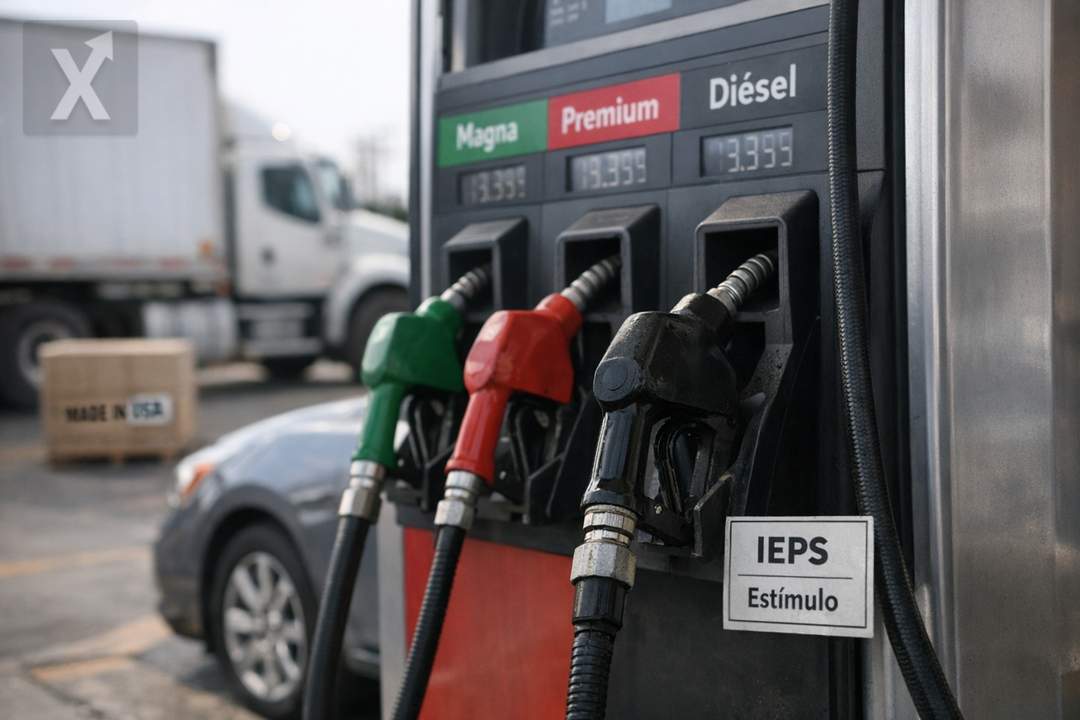
Mexico’s Finance Ministry estimates a 15.8 billion–peso revenue shortfall in 2026 from IEPS tax relief on gasoline and diesel meant to smooth price hikes.
The policy of providing relief on the Special Tax on Production and Services (IEPS) applied to gasoline and diesel will once again be a significant factor for public finances in 2026. Mexico’s Ministry of Finance and Public Credit (SHCP) expects to forgo more than 15.8 billion pesos in revenue by applying reductions to those per‑liter levies—an approach aimed at cushioning sharp increases in pump prices and, in turn, easing pressure on transportation and production costs.
The mechanism is familiar: when energy prices rise internationally, the government temporarily reduces the IEPS charged per liter so the adjustment doesn’t hit gas stations as quickly or as fully. Conversely, when the market stabilizes or pulls back, the relief can be scaled down or eliminated, allowing the tax authority to collect the full rate again. Different administrations have used this framework as a “shock absorber” against volatility, but it comes with a direct cost to the treasury.
In 2026, the international backdrop has intensified pressure on fuel prices. Crude prices have rebounded and pulled global benchmarks higher, translating into more expensive fuels in a country that—despite having oil production—still depends heavily on imports of gasoline and diesel from the United States. Against that backdrop, Finance has kept the relief in place for several consecutive weeks, more aggressively on diesel, the key fuel for moving goods and for long-distance public and private transportation.
The amount the SHCP expects not to collect is significant when compared with other spending categories: it is equivalent to the full annual budgets of several federal programs. From a public policy standpoint, this underscores a recurring dilemma: use resources to contain the price of an input that cuts across the entire economy, or preserve them to fund social priorities and investment.
Diesel: the most sensitive channel for inflation and activity
The heavier weight of diesel in these relief measures is no coincidence. In Mexico, diesel is essential for logistics: it powers freight trucking, a major share of retail distribution, and a substantial portion of intercity transport. When its price rises, shipping costs increase and, with a lag, the effect can seep into prices for food, manufactured goods, and services. That is why holding diesel prices down often has a macroeconomic rationale: it helps moderate “second-round” inflation pressures, even if it does not eliminate the underlying impact when an energy shock drags on.
Recent experience shows that inflation in Mexico tends to respond to energy prices immediately in the non-core component, and more gradually as those costs pass through supply chains. In that sense, the relief can serve as a “bridge” to avoid spikes, but it can also delay necessary adjustments and shift the cost onto public finances. The balance depends on how long the shock lasts, how the exchange rate behaves, and how competitive the fuels market is at the distribution and retail stages.
For Finance, the challenge is managing this cost without undermining the fiscal path. The government has argued that tax revenue should continue to perform favorably, supported by a strong domestic market, stepped-up enforcement, and regulatory changes in foreign trade. Even so, IEPS relief introduces budget volatility: in a high-crude-price scenario, the revenue hit can widen, while a price correction would allow support to be withdrawn and revenues to recover.
In addition, the impact of these relief measures is not distributed evenly. Although the stated goal is to protect purchasing power, the benefit is larger for those who consume more fuel (households with cars and transport-intensive businesses), while other segments feel the effect indirectly through the prices of goods and services. That asymmetry has kept alive the debate over whether broad-based support for fuel consumption should be prioritized, or whether more targeted measures for transportation, logistics, and vulnerable groups would be preferable.
Looking ahead, the room to maneuver for this relief policy will hinge on the mix of global oil-market conditions, domestic refining and logistics capacity, and fiscal discipline. If volatility persists, the government will face the choice of maintaining the tax shock absorber—with a revenue cost—or allowing a larger pass-through to prices, with potential effects on inflation and economic activity.
In perspective, IEPS relief remains a fast tool for stabilizing consumer prices, but its fiscal cost makes it necessary to evaluate the duration, targeting, and transparency of the scheme—especially in a context where revenue and spending are competing for limited resources.






