Holy Week 2026: bank branches closed and the impact on payments, payroll, and cash flow
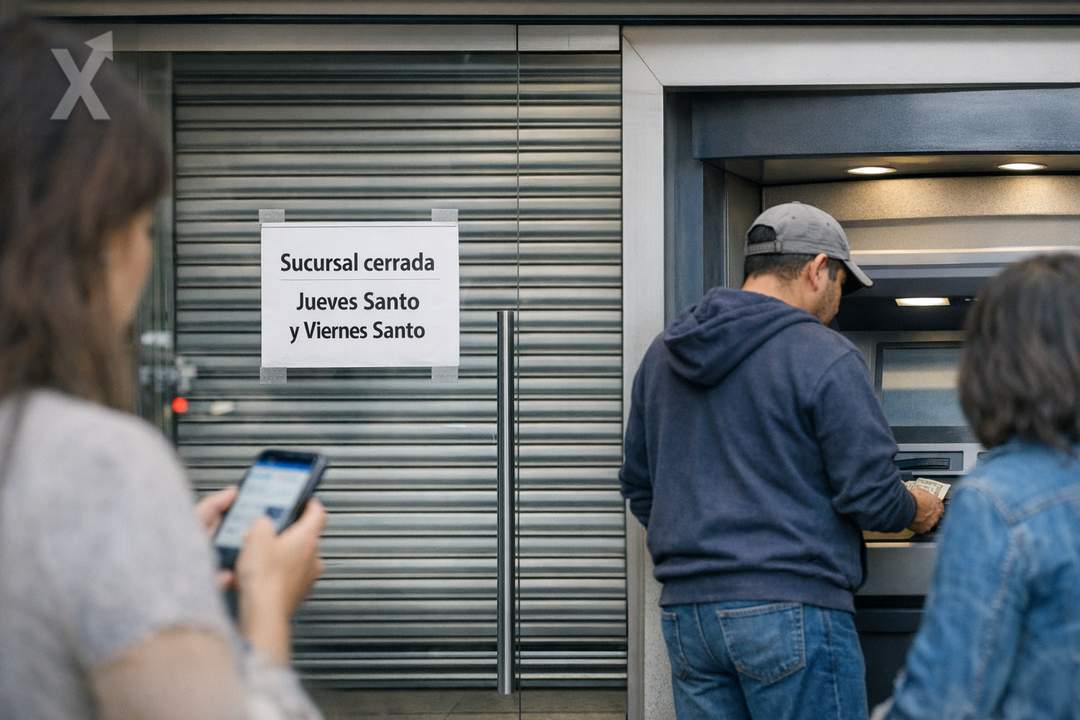
The closure of bank branches on Maundy Thursday and Good Friday makes it necessary to move payments and collections up, even though digital channels will continue operating.
Holy Week 2026 will once again test the financial planning of households and businesses in Mexico. While for many people it’s a time for time off and travel, operationally it also means a pause in in-branch service and adjustments to the logistics of payments, deposits, and paperwork. For the financial system, these days typically bring high demand for digital transactions and ATM withdrawals, along with a reshuffling of collections and disbursement schedules.
According to the liturgical calendar, Maundy Thursday will fall on April 2, 2026, and Good Friday on April 3, 2026, followed by Holy Saturday on April 4. Because these are movable dates, they shift year to year, making it important to plan payment schedules in advance—especially when Holy Week lines up with mid-month or end-of-month pay periods, credit card statement cutoffs, or service due dates.
In Mexico, the Mexican Bankers Association (ABM) typically publishes the calendar of days when financial institutions suspend in-person operations in accordance with rules applicable to the sector. On those days, branches do not provide customer service, but digital banking (apps, web portals, transfers, and electronic payments) generally remains available. In practice, the advice for customers is straightforward: anything that requires a teller window—such as certain deposits, disputes, document submissions, or specific procedures—is best scheduled before branches close.
This is not a minor issue: in an environment where consumption and services are increasingly paid for electronically, Holy Week’s “operational bridge” doesn’t shut down the economy, but it can create friction if people or businesses rely on cash movements or in-person processing. Planning ahead helps avoid late fees, invoice surcharges, and disruptions across the payment chain.
What to check before the closure: transfers, payments, and cash
For personal finance and corporate treasury management, Holy Week is often a reminder that bank calendars don’t always line up with due dates. To reduce risk, it’s best to confirm operating days and transfer cutoff times in advance, and to schedule recurring payments (utilities, rent, loans) so they process before the days when branches are closed. For small businesses, it’s also helpful to gauge cash needs—change and register cash—since ATMs can see higher demand during vacation periods. For companies that run payroll, the critical point is disbursement: if payday falls on those dates, treasury teams typically move processes up to ensure funds are credited without delays.
From a macroeconomic perspective, these kinds of closures don’t change the fundamentals on their own, but they do affect the “fine mechanics” of consumption. Holy Week tends to boost spending on tourism, food, and transportation, and that demand is processed mostly through point-of-sale terminals, transfers, and card payments. For banks, keeping digital channels running is key to sustaining activity. At the same time, the heavy use of financial apps and electronic payments aligns with the trend of recent years: more digitization, more low-value transactions, and growing pressure to improve infrastructure, cybersecurity, and the user experience.
Looking ahead, the combination of scheduled in-person closures and the expansion of digital services will continue to reshape payment habits. For end users, the upside is 24/7 access to transfers and payments; the challenge is understanding that some transactions may post at different speeds depending on the type of operation, the institution, and reconciliation processes. During vacation periods, planning—rather than improvising—often makes the difference between a trouble-free break and a costly delay.
In short, Holy Week 2026 will mean branch closures on Maundy Thursday and Good Friday, but not a “shutdown” of the financial system: digital channels will keep operations moving, and the key for households and businesses will be to plan ahead for in-person procedures, critical payments, and cash needs.






