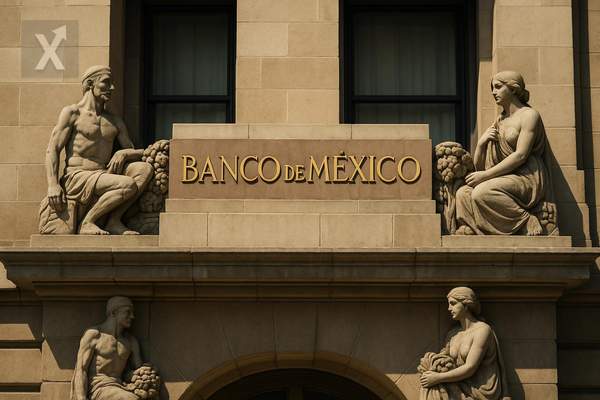
Treasury Estimates Revenue Forgone of 3.4 Trillion Pesos in 2026–2027, Reopening the Debate Over Mexico’s Tax Base

Incentives and exemptions will reduce potential revenue by roughly 4.5% of GDP per year, with a focus on the 0% VAT rate, the northern border region, and preferential regimes.
Mexico’s Ministry of Finance and Public Credit (SHCP) expects that in 2026 and 2027 the federal government will forgo about 3.4 trillion pesos in revenue due to tax benefits—exemptions, subsidies, and incentives—applied mainly to the VAT (IVA), income tax (ISR), and the excise tax (IEPS), according to the document “Revenue Forgone 2026: Fiscal Policy and Revenue Estimation.” For 2026, the estimate totals 1.67 trillion pesos (about 4.48% of GDP), while for 2027 it is projected at 1.76 trillion (around 4.45% of GDP).
The Finance Ministry stresses that this revenue forgone is not a direct expenditure, but rather income the tax authorities could have collected if differential tax treatments did not exist. In practice, these provisions allow certain taxpayers to reduce, avoid, or defer tax payments under specific rules. The official narrative holds that the incentives aim to promote investment, regional competitiveness, and social welfare goals, though their scale once again puts the debate over efficiency, targeting, and measurable outcomes front and center.
Among the highest-impact items are the 0% VAT rate on food and medicines; incentives for the northern border region—which lower VAT and income-tax rates for certain taxpayers—and structures tied to trusts such as FIBRAs and FIBRA E. At the same time, income-tax exemptions for individuals stand out, mainly those linked to retirements, pensions, and employment benefits.
Finance Ministry estimates indicate that the 0% VAT rate on food will represent revenue forgone equivalent to 1.26% of GDP: 471.748 billion pesos in 2026 and 502.178 billion in 2027. Meanwhile, incentives in the northern border region would total 143.402 billion pesos in 2026 and 152.652 billion in 2027. For the trusts (public FIBRAs and FIBRA E), the combined impact is placed at 133.860 billion pesos for 2026 and 142.494 billion for 2027, representing a significant share within the universe of tax incentives.
In a context of moderate growth, spending pressures, and demands for public investment—from infrastructure and security to health—the size of this revenue forgone takes on macro-fiscal importance. Mexico continues to have low tax collection compared with peer economies in Latin America and OECD countries, and while the government has strengthened enforcement and collection efficiency in recent years, the revenue structure still depends on a relatively narrow base and a large number of special tax treatments.
The dilemma: social equity, competitiveness, and fiscal space
The 0% VAT rate on food and medicines is often defended as a policy to protect basic consumption, but its distributional effectiveness is also debated: because it is a broad-based benefit, a significant portion of the “implicit subsidy” also goes to higher-income households that consume more in absolute terms. By contrast, border-region incentives are justified by competition with neighboring markets and trade integration, but their permanence raises questions about opportunity cost and whether the benefits translate into greater formal investment, jobs, and productivity—or whether they function as a vehicle for tax arbitrage. In the case of FIBRAs and FIBRA E, their design is intended to channel resources to sectors such as real estate and infrastructure, though the debate focuses on whether the incentive is proportional, the transparency of its fiscal cost, and how to measure its impacts on urban development, housing, and project financing.
Income-tax exemptions for retirements and pensions are often explained as a mechanism to protect income in old age, but they also reflect the challenge of reconciling progressivity with fiscal sustainability. In Mexico, the demographic transition and the gradual rise in the older adult population put pressure on social spending and, at the same time, increase the value of preferential treatments unless they are adjusted or targeted more precisely.
Looking ahead, the size of revenue forgone becomes a key indicator for assessing the government’s room to maneuver amid spending needs and the stability of public finances. While changing exemptions or incentives is often politically sensitive—given their effects on prices, regions, or sectors—the issue gains traction as demands for investment and public services grow. In terms of economic policy, the challenge is to balance competitiveness and social protection with a stronger tax base, clear rules, and systematic cost-benefit evaluation.
In perspective, the figures presented by the Finance Ministry underscore the weight of special tax treatments within Mexico’s tax model: they support social and investment objectives, but they also limit potential revenue. The debate in the coming years will likely revolve around which incentives to keep, which to redesign, and how to measure results without undermining macro-fiscal stability.