Treasury cuts IEPS fuel tax breaks for regular and diesel; premium still gets no support
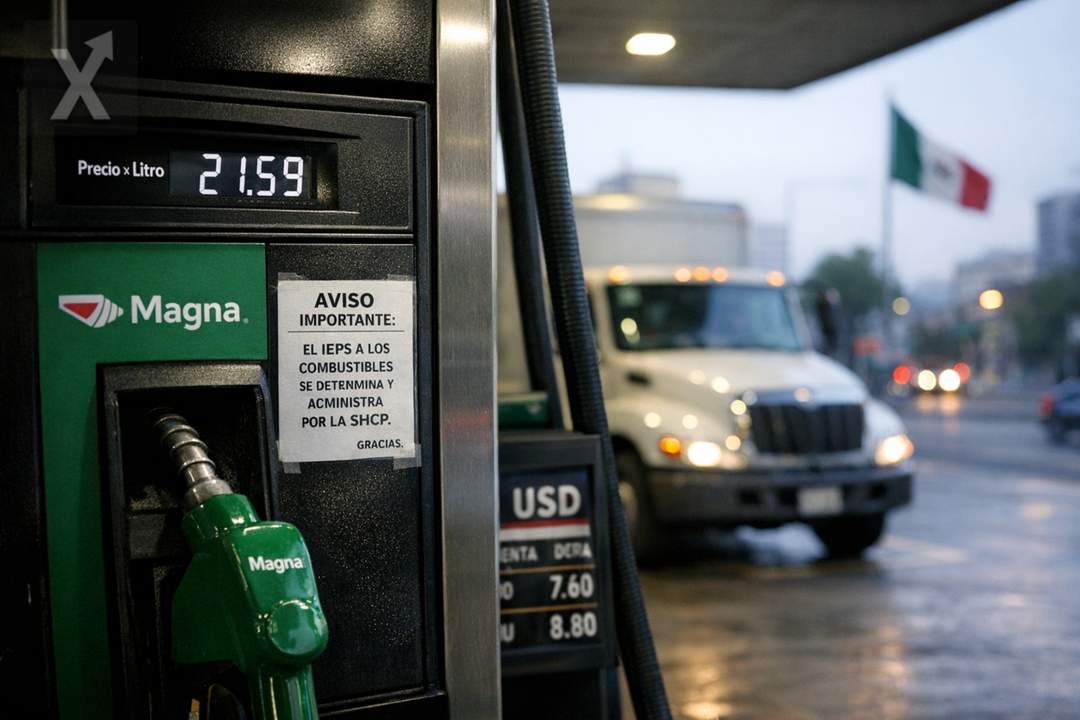
The fiscal tweak increases the IEPS burden and could limit how much pump prices fall, despite volatility in crude oil and the exchange rate.
Mexico’s Ministry of Finance and Public Credit (SHCP) reduced the fiscal stimulus applied to the Special Tax on Production and Services (IEPS) on regular gasoline (Magna) and diesel for the week of June 27 to July 3, while premium gasoline remains without a subsidy for the fourth consecutive week. The move means a higher tax load built into the final price, at a time when consumers are still watching oil’s path and the cost of importing fuels.
For regular gasoline (Magna), the IEPS charge will stand at 6.12 pesos per liter, with a stimulus of 0.59 pesos, lower than the prior week’s. For diesel, the discount fell to 1.08 pesos per liter, with a charge that will be reflected in the final price of 6.29 pesos. Premium gasoline, for its part, remains without fiscal support, so its per-liter charge also stays at 6.29 pesos.
The adjustment comes in an environment where the recent drop in crude oil prices does not necessarily translate immediately—or fully—into prices at the pump. In Mexico, the IEPS tax component coexists with factors that often dominate short-term dynamics: the exchange rate, logistics and transportation costs, marketing margins, international fuel benchmarks, and limited domestic refining capacity, which keeps imports important for meeting demand.
In practice, the weekly stimulus works like an adjustment valve to smooth abrupt moves in consumer prices and, at the same time, to manage the flow of public revenue. When Finance cuts the stimulus, the effective IEPS rate rises and can (partially) offset declines in other price components; when it increases it, it cushions spikes coming from international markets or from a stronger U.S. dollar (USD) against the peso.
What it means for inflation and public finances
Fuel behavior matters beyond what drivers pay: it has second-round effects on transportation and distribution costs, particularly in the case of diesel, a key input for freight and logistics. During episodes of sustained increases, these costs are often passed on to goods prices, putting upward pressure on core inflation with a lag. Although inflation in Mexico has improved from the peaks of recent years, energy prices remain a recurring source of volatility and a sensitive component in perceived price pressures.
On the fiscal side, reducing stimulus also tends to strengthen IEPS revenue, which can ease budget pressures amid elevated spending needs. When fuel stimuli are activated aggressively, they imply foregone revenue that competes with other priority items; that’s why the government typically calibrates them based on international markets, the peso’s trajectory, and available fiscal space. For analysts, the key signal is whether the cut becomes a trend or whether it reflects a one-off adjustment to recent changes in external benchmarks.
Looking ahead, the pass-through to pump prices will depend on a combination of factors: exchange-rate stability, the evolution of international gasoline and diesel benchmarks, and SHCP’s weekly IEPS strategy. In that context, keeping premium support at zero suggests that, for now, Finance believes that segment can absorb the full tax without a stimulus, while regular gasoline and diesel retain partial buffers.
Overall, the reduction in stimulus points to a larger IEPS contribution in the final price and could cap declines at the pump even if crude continues to cool. The key signal for consumers and businesses will be whether the adjustment holds and how it interacts with the U.S. dollar (USD), since a large share of fuel costs is determined in markets and supply chains tied to abroad.






