U.S.–India Trade Deal Reshuffles Crude Flows and Raises the Stakes for Mexico: FX, Inflation, and Exports in Focus

President Donald Trump’s announcement of a trade agreement with the United States and India—featuring a tariff cut to 18% and a pledge, according to Washington, to reduce purchases of Russian oil—reshapes expectations across energy markets and global trade. Although the arrangement is bilateral, its potential effects extend to economies tightly integrated with the U.S., like Mexico, through oil prices, logistics costs, investment flows, and the behavior of the foreign exchange market.
According to Trump, India would increase purchases of U.S. goods and replace part of its Russian crude intake with supplies from the U.S. and eventually Venezuela—a country whose oil output, under the White House’s narrative, would come under U.S. operational control following January’s political events. In the short run, markets tend to read announcements like this as a signal that barrels could be reallocated across the Atlantic and Pacific, affecting price differentials, freight rates, and the availability of specific crude grades used for refining.
For Mexico, the most immediate channel runs through international oil and fuel prices. A shift in India’s demand could alter the balance between light and heavy crude and change discounts on Russian oil, creating second-round effects in global benchmarks. If energy prices rebound or become more volatile, the risk is a partial pass-through to consumer prices—especially transportation and goods—even with domestic subsidy schemes or fiscal adjustments. In that scenario, attention turns back to Banco de México: any added inflation pressure would complicate room for rate cuts and increase market sensitivity to Mexico’s biweekly inflation prints.
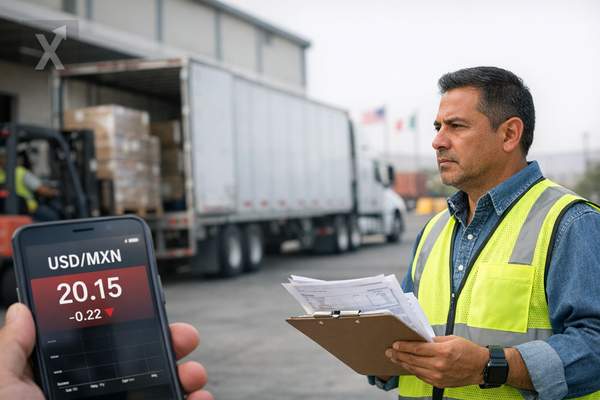
The second channel is currency and financial markets. Headlines that blend trade, implicit sanctions on Russian oil, and geopolitical repositioning tend to shift global risk appetite. For the Mexican peso, the impact usually shows up through moves in the USD and changes in emerging-market risk premiums. During periods of heightened uncertainty, the peso can face tactical outflows; in “risk-on” episodes, Mexico may benefit from liquidity and carry—though with higher intraday volatility.
On the real-economy side, the deal also signals Washington’s broader trade strategy: using tariffs as leverage for objectives that aren’t strictly commercial (energy, security, geopolitical alignment). For Mexico, which depends on the U.S. as its top export destination, this reinforces the importance of regulatory certainty and compliance with USMCA rules of origin—especially in sensitive sectors such as autos, steel and aluminum, and electronics. In an environment where tariff policy is used more frequently, the value of diversifying markets and hardening supply chains through traceability and regional content increases.
At the same time, if the reshuffling of energy flows benefits North America—through higher exports of crude and refined products from the U.S. and an expanded role for suppliers in the hemisphere—Mexico faces a dual challenge: capturing investment opportunities tied to energy and manufacturing (nearshoring) while addressing domestic bottlenecks. Key issues include competitively priced access to electricity, expanding logistics infrastructure (ports, rail, customs), and providing certainty for investment in refining, storage, and fuel transportation.
Looking ahead, markets will track two variables: how verifiable India’s energy commitments are and how Russia and OPEC+ respond on the supply side. For Mexico, the net effect will depend on whether volatility turns into persistent inflation pressure or remains limited to temporary episodes—and on whether the rate cycles in the U.S. and Mexico stay aligned without surprises. A more uncertain external environment tends to reward strong fundamentals: fiscal discipline, a clear debt trajectory, and consistent monetary-policy signals.
In sum, the U.S.–India announcement matters for Mexico not because of the tariff terms themselves, but because of the potential energy reallocation and the signal of a trade policy increasingly tied to geopolitical objectives. If energy prices and risk aversion rise, the peso and inflation could face periods of pressure; if the adjustment is orderly, Mexico could preserve stability and capture investment opportunities—provided it addresses its structural gaps in energy and infrastructure.