Finance Ministry boosts diesel IEPS tax break, easing inflation pressure on fuels
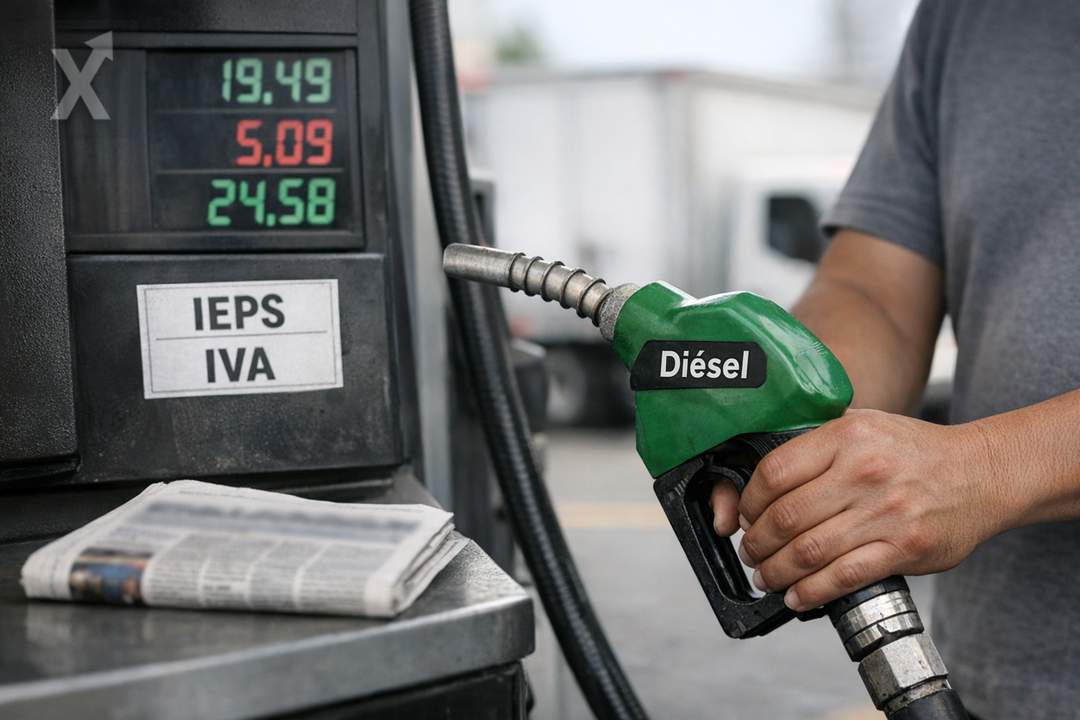
A bigger discount on diesel’s IEPS aims to soften the impact of external shocks on prices and transportation, with fiscal costs to watch.
Mexico again leaned on its fuel “shock absorber”: for a third consecutive week, the Ministry of Finance and Public Credit (SHCP) increased the stimulus on the Special Tax on Production and Services (IEPS) applied to diesel—an essential input for freight transport and a large share of mobility across the country. For the week of March 28 to April 3, the diesel stimulus will be 70%, equivalent to 5.18 pesos per liter, bringing the effective federal IEPS rate down to 2.19 pesos per liter, according to what was published in the Official Gazette of the Federation (DOF).
The adjustment comes amid heightened international volatility in energy markets. When the price of crude oil and refined fuels rises abroad—due to geopolitical tensions, logistics disruptions, or sharp market moves—the government often temporarily reduces the federal IEPS charge to prevent the increase from hitting end consumers all at once. This time, the diesel stimulus is larger than in the prior two weeks, signaling an effort to contain increases in a fuel that is especially sensitive for the supply chain.
For gasoline, the Finance Ministry also kept support in place, though at smaller levels. Regular gasoline (Magna) will have an IEPS rate of 5.15 pesos per liter after a 23% stimulus (1.55 pesos). Premium will receive a stimulus of 0.45 pesos per liter (8%), leaving an IEPS rate of 5.21 pesos. These moves are intended to smooth week-to-week swings and, in particular, avoid spikes that could push up short-term inflation.
Retail prices continue to reflect a mix of international costs, logistics, and the tax burden. Based on market data as of the morning of March 27, Magna averaged 23.7 pesos per liter; Premium, 27.8; and diesel, 28.7 pesos per liter nationwide. The final price is shaped by both the fuel cost and distribution, as well as taxes: the federal IEPS, state IEPS, the IEPS on CO2 emissions, and 16% VAT applied to the total.
IEPS as a “shock absorber”: consumer relief, pressure on public finances
Using IEPS stimuli works as a countercyclical tool: it reduces the immediate impact of external shocks on household and business budgets and can limit second-round effects on inflation—for example, in food and goods transported by road. However, it also carries a fiscal cost: by collecting less federal IEPS per liter, the government takes in less tax revenue in the short term, which can force budget reallocations or tighter spending management if international prices stay high for extended periods.
The trade-off is especially relevant for an economy like Mexico’s, where over-the-road transport plays a dominant role in national logistics. Diesel powers freight fleets, public transportation, and part of the productive sector, so abrupt moves in its price tend to show up in operating costs. At the same time, fuel tax collection is an important source of non-oil revenue, so an extended period of stimuli can strain fiscal balance targets—particularly if it coincides with moderate growth or weaker momentum in overall tax collection.
In addition, from a public policy standpoint, these stimuli coexist with environmental goals and the energy transition. In practice, when the federal tax is reduced as prices rise, it softens the price signal that might otherwise encourage lower consumption. That’s why economic discussions often suggest that if these stimuli become recurring, they should be complemented with more targeted measures or with logistics and transportation efficiency strategies to reduce vulnerability to energy shocks.
Looking ahead, the key factor to watch will be how long external pressure on energy markets lasts and how much of it feeds into inflation. If volatility persists, the Finance Ministry will face a complicated balancing act between stabilizing consumer prices and protecting revenue. For now, the larger diesel stimulus appears aimed at containing the impact on transportation and goods, with direct implications for both inflation and the government’s fiscal room.






