Treasury Presses for Cheaper Credit and a More Active Banking Sector to Spark Investment
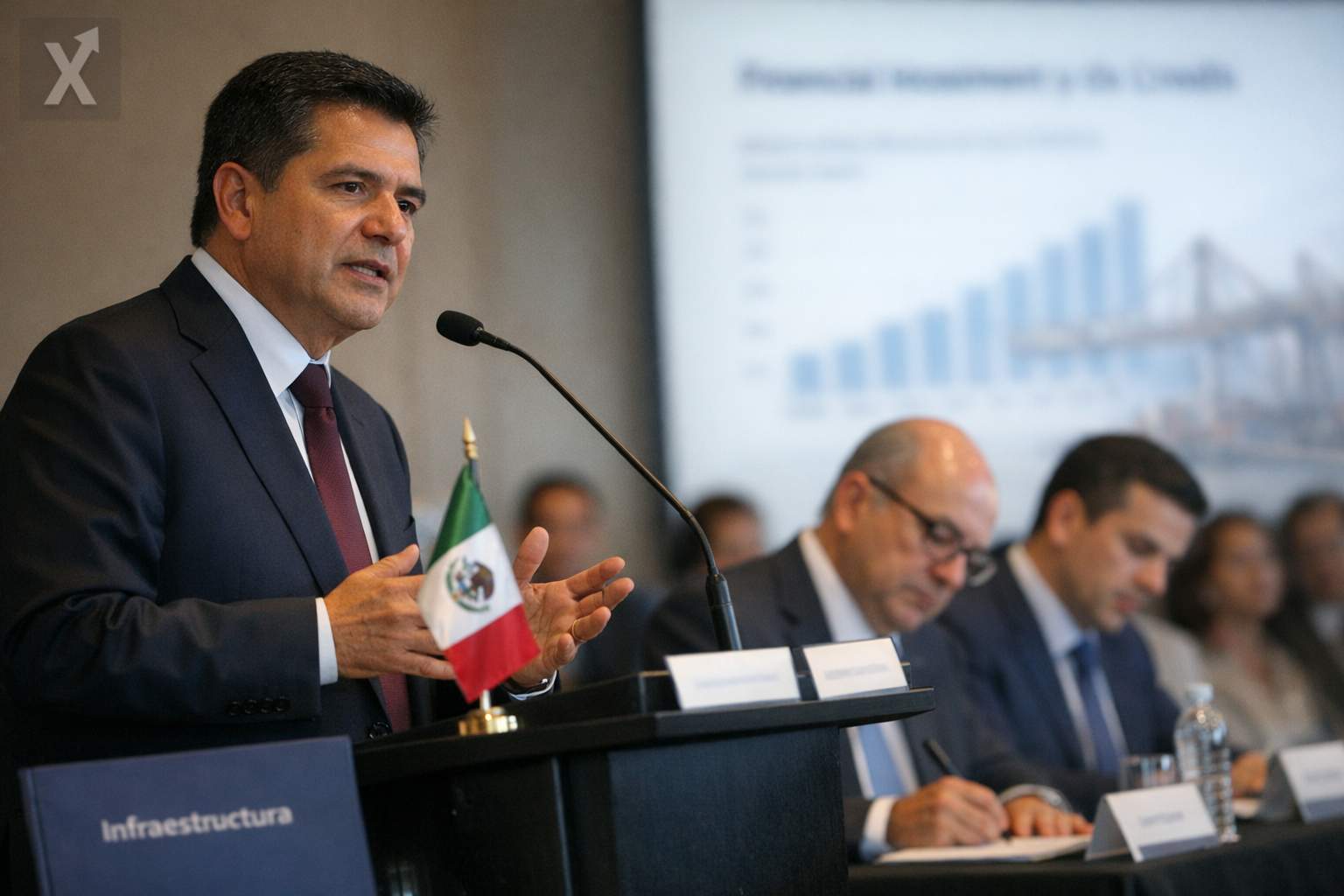
The Ministry of Finance called on banks to expand financing for small businesses, young people, and women to support the infrastructure plan without putting fiscal discipline at risk.
Mexico’s Ministry of Finance and Public Credit (SHCP) struck a sharper tone with commercial banks: Mexico needs more affordable credit, with more competitive terms and broader reach for groups that typically face barriers to entry—such as women, young people, and small and medium-sized enterprises (SMEs). Finance Minister Édgar Amador Zamora made the case during a meeting with industry executives in Mexico City, stressing that financing will be a key gear to sustain growth in a global environment that remains volatile.
At the center of the discussion is the National Infrastructure Plan, which the government has presented as a pipeline of more than 1,500 projects aimed at accelerating public investment and, above all, “catalyzing” private investment. The Finance Ministry’s message is that the plan is designed to avoid pressure on fiscal sustainability—in other words, to expand productive capacity and address bottlenecks without public spending translating into a deterioration of public finances.
The official argued that, despite uncertainty in international trade and economic policy adjustments in the United States, Mexico managed to avoid recession forecasts in 2025. For 2026, the Finance Ministry is holding to a growth projection near 3%, supported by a gradual recovery in domestic demand, the kickoff of infrastructure projects, and a larger multiplier effect on industries tied to construction, logistics, energy, manufacturing, and services.
The call for more credit comes at a moment when the country is balancing opportunities and constraints. On one hand, the reshoring of supply chains to North America has increased interest in expanding industrial capacity in key regions; on the other, borrowing costs remain significant and access to financing is still uneven between large companies and the broader SME base. In that context, the Finance Ministry wants banks to play a more central role, both in consumer lending and in productive investment.
Infrastructure, development banking, and “legal certainty”: the triangle to unlock investment
The Finance Ministry laid out a three-pronged strategy to improve how financing reaches the real economy: strengthening development banks to increase guarantees and reduce perceived risk for certain borrowers; promoting new investment vehicles with clear rules; and bolstering legal certainty so projects can be financed from start to finish. In practice, this aims to solve a recurring problem: many projects and companies are operationally viable but don’t meet the risk, track-record, or collateral requirements demanded by private intermediaries. Greater use of guarantees and co-investment structures can broaden the pool of eligible borrowers, though it also requires strict evaluation standards to avoid inefficient allocation of resources.
The emphasis on legal certainty also aligns with a constant demand from the private sector: stable rules, contract enforcement, and predictable regulatory processes. For banks, the rule of law isn’t an abstract concept; it translates into recoveries, litigation, timelines, and costs. For investors, it determines whether an infrastructure project can be financed over long tenors at reasonable rates. In that sense, the official message suggests the government is seeking to align public planning, the regulatory framework, and execution to reduce frictions that currently raise financing costs.
The challenge, however, is not limited to “providing more credit.” For financing to be truly more accessible and competitive, the system needs deeper financial penetration, more competition across products, better credit information, and mechanisms that reduce origination costs—especially for smaller-scale segments. Digitalization has enabled progress in risk assessment and disbursement, but gaps in formality, income, and financial education persist, shaping the quality of credit demand.
There is also the question of how to align credit with productivity. To the extent financing is directed toward modernization, technology adoption, working capital, and export expansion, the impact on potential growth is greater. By contrast, expanding credit without strengthening business capabilities can translate into higher delinquencies or a smaller impact on fixed investment. For banks, the challenge is finding the point where inclusion and profitability are compatible; for the government, it is designing incentives and guarantees that do not distort the market.
Looking ahead to 2026, Mexico’s economic performance will depend on the speed at which the infrastructure plan is executed, how the external environment evolves—including U.S. economic policy—and the financial system’s ability to support projects and households without loosening risk standards. An orderly expansion of credit, with clear rules and rigorous evaluation, could help sustain growth and broaden opportunities for SMEs, young people, and women.
In perspective, the Finance Ministry’s call signals an effort to make investment and credit more visible drivers of the business cycle again; its effectiveness will depend on banking competition, well-targeted guarantees, and a climate of certainty that makes long-term projects financeable.






