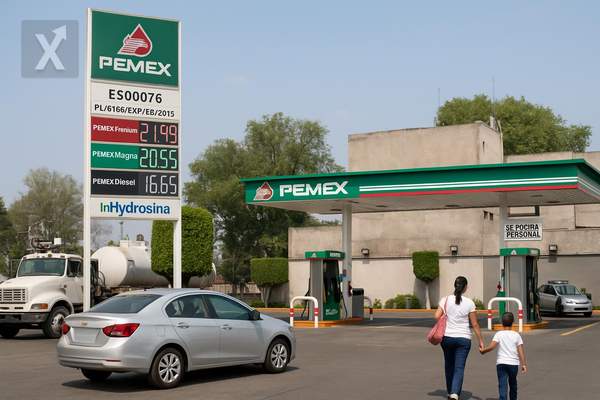
Gasoline Subsidies Strain Public Finances: IEPS in the Crosshairs as Fiscal Adjustment Gets Harder
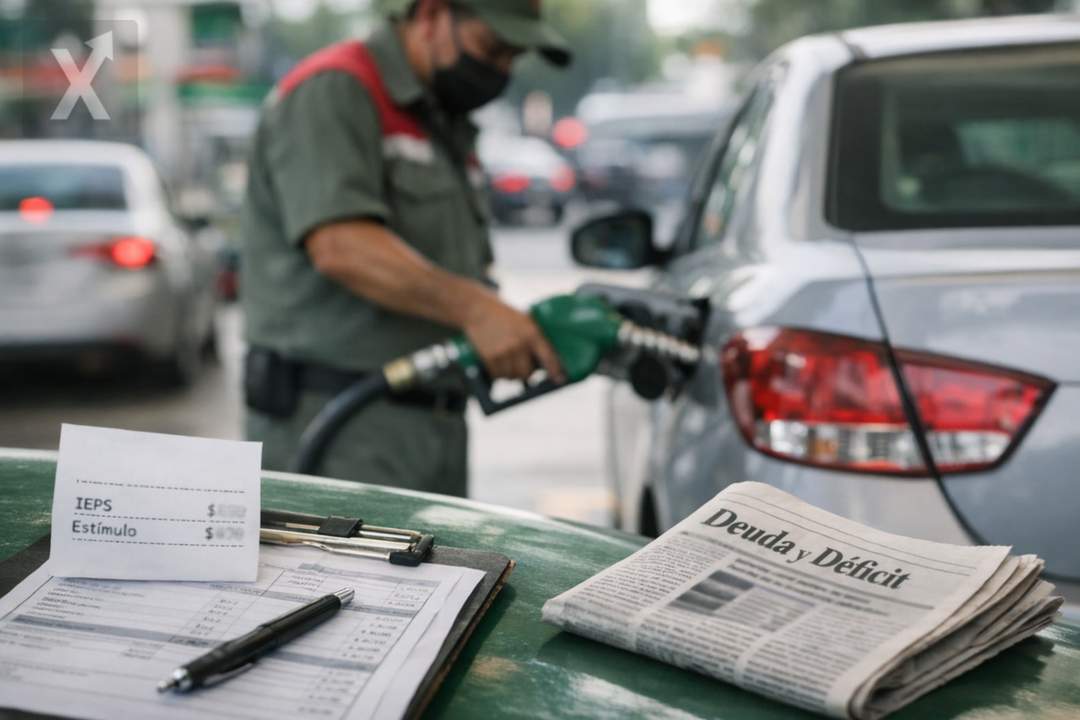
With oil prices rising on geopolitical tensions, the IEPS tax break cushions prices at the pump but increases pressure on the deficit, debt, and investment.
The federal government’s attempt to contain retail prices for gasoline and diesel—through tax credits applied to the Special Tax on Production and Services (IEPS)—is once again pushing public finances into a more fragile zone. The international rise in fuel prices, tied to the escalation of the conflict involving Iran and its impact on energy markets, is increasing the cost of sustaining tax discounts, precisely as Mexico has committed to a path of fiscal consolidation.
In recent days, the presidency acknowledged that the price-containment effort could imply a gross cost on the order of 5 billion pesos per week, with partial offsetting from higher oil-related revenue; even so, the net impact would remain meaningful for the budget balance. In parallel, the government’s preliminary economic policy guidelines (Precriterios) outlined a scenario of limited pressure if the tension lasts only a short time, but they also acknowledged high uncertainty about the size and persistence of the shock.
Operationally, the diesel and gasoline credits—which have been in place since March—already imply a significant cumulative hit to tax collections. For a treasury that depends on stable tax revenue to finance social spending, public investment, and debt service, forgoing IEPS revenue becomes a dilemma: keep the subsidy and erode revenue; remove it and pump prices rise, with political and economic costs.
The problem is clearer when viewed on an annual scale. For 2026, the revenue law projected IEPS collections on fuels in the hundreds of billions of pesos. Under scenarios of elevated international prices and credits near 100% for extended periods, private-sector analysts have warned the cost could exceed 100 billion pesos and, in an extreme scenario where it persists throughout the year, approach levels above 200 billion.
The debate is far from minor: the fuel IEPS works as a fiscal shock absorber. When oil rises, the government may receive more from exports and hydrocarbon-related levies, but at the same time the incentive typically grows to subsidize the tax to avoid abrupt increases in consumer prices. The final balance depends on production volumes, prices, the exchange rate, gasoline import costs, and the structure of oil revenue—now more limited than in past periods.
Deficit, Debt, and the Consolidation Path: The Cost of Keeping a “Political Price”
The most immediate implication of “forgiving” the IEPS is fiscal: either spending is cut, the deficit increases, or additional revenue is found. In Mexico, the room for a short-term tax reform is usually narrow and politically costly, so adjustments tend to fall on the most flexible items, such as administrative spending and capital investment. That reallocation can worsen infrastructure maintenance and delay projects, with negative multiplier effects on growth and productivity.
In a context where fiscal policy seeks to bring the deficit closer to prudent ranges—often referencing international thresholds around 3%–3.5% of GDP—a prolonged fuel shock could push the balance toward levels nearer 5% of GDP, raising the Public Sector Borrowing Requirements and, therefore, the debt trajectory. This matters not only because of the deficit “headline number,” but because higher borrowing increases financing costs and reduces future budget space, especially if interest rates stay higher for longer.
In addition, debt service competes with programmatic spending. If the government chooses to protect social programs—which today carry high political rigidity and, in some cases, legal anchors—the pressure is more likely to shift onto investment and operations. In practice, the fuel subsidy may end up being financed by fewer resources for highways, water projects, preventive healthcare, or industrial maintenance at state-owned productive enterprises, with efficiency and safety risks.
This episode also reopens the discussion about the quality of fiscal stabilizers. While the IEPS credit helps moderate short-term inflation—by containing a cross-cutting input for logistics, transportation, and some foods—its design is poorly targeted: it benefits all consumers, including those with greater ability to pay, and reduces resources that could be directed to better-targeted transfers or investment with lasting impact.
From a macroeconomic perspective, the subsidy operates like temporary anti-inflation “insurance,” but with a steep premium. In Mexico, where fuel consumption is intensive and distribution depends heavily on gasoline imports, pass-through from external shocks is often felt quickly. If the subsidy is maintained indefinitely, the fiscal bill grows; if it is withdrawn abruptly, the impact on inflation and expectations could complicate the interest-rate cycle and consumer spending.
Another factor is Pemex’s situation. The state oil company faces investment constraints, maintenance needs, and a heavy financial burden. While higher crude prices can boost gross revenue, they do not necessarily translate into greater net investment capacity, especially if costs, obligations, and the need for federal support also increase. For the country, this means the “oil cushion” is no longer as large as it was in past decades for absorbing shocks without affecting the budget.
Going forward, markets will watch the consistency between the fiscal-consolidation narrative and the week-to-week decisions on IEPS credits. A more transparent rules-based scheme—such as price bands, explicit revenue targets, or compensation mechanisms—could reduce uncertainty. However, as long as international volatility persists, the government will continue to face a tradeoff: consumer price stability today, or fiscal stability and investment capacity tomorrow.
In sum, holding down gasoline and diesel prices through IEPS credits reduces inflation pressure in the short run, but increases the risk of investment cuts, a larger deficit, and a debt burden that becomes harder to manage if the external shock drags on.