Banamex Replaces Its CEO: Edgardo del Rincón’s Arrival Speeds Up the Bank’s Preparation for Its Next Stage
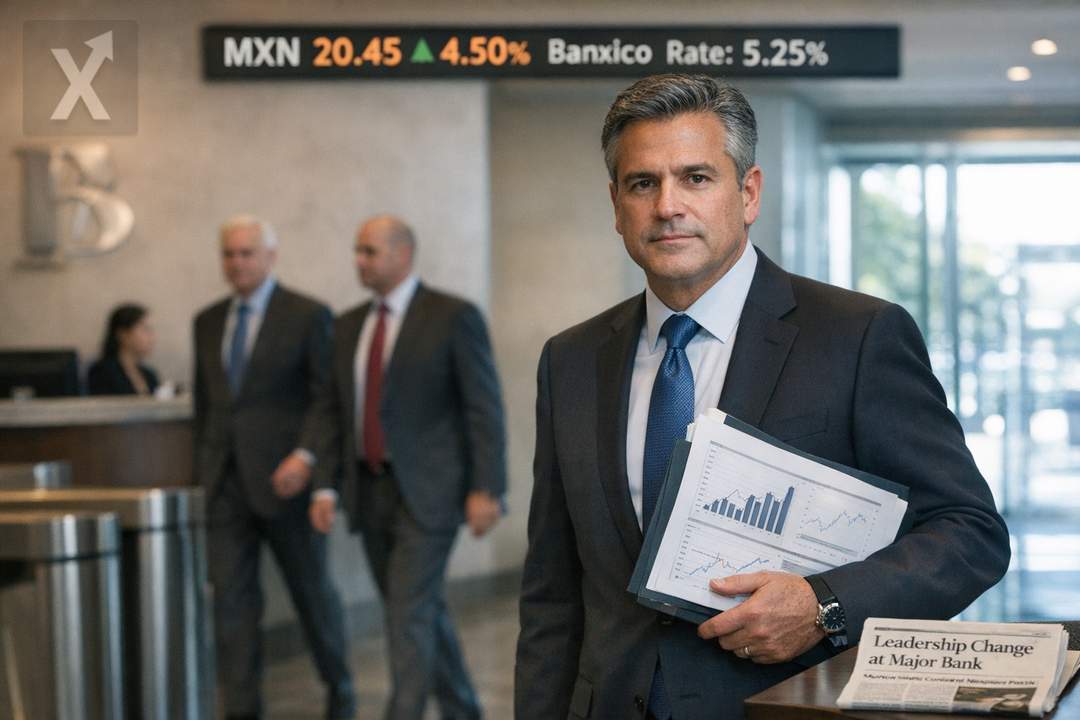
The leadership change at Banamex reinforces its bet on efficiency and profitable growth in an increasingly competitive Mexican banking system.
Banamex announced a смен in its top leadership: Manuel Romo stepped down to focus on personal projects tied to social development, while Edgardo del Rincón Gutiérrez will take the helm of Banco Nacional de México at a pivotal moment for the institution—now under the leadership of the controlling group led by Fernando Chico Pardo.
The move comes at a time when Mexico’s banking sector is navigating still-elevated interest rates, tighter funding costs, and intensifying competition for high-value customers, payroll accounts, and small and mid-sized businesses. In that environment, the new CEO’s profile points to strengthening profitability through operational discipline, digitalization, and more refined risk management—factors that today matter as much as loan growth.
Romo exits after a tenure marked by Banamex’s reconfiguration, with an emphasis on operational separation from Citigroup and the consolidation of the new corporate control structure. From a business standpoint, the goal has been to regain commercial momentum without loosening prudential standards—a challenge in Mexico that becomes more visible when consumption slows and loan portfolios start showing greater sensitivity to shocks in employment, inflation, or interest rates.
Del Rincón arrives from BanBajío, where he led a period of standout stock-market performance and efficiency improvements. His track record includes more than three decades within the broader Banamex–Citigroup ecosystem, as well as experience in emerging markets in Asia and Central America—a combination that is often valued when making retail and digital banking decisions during volatile periods.
What the Leadership Change Means for Credit and Banking Competition in Mexico
Del Rincón’s appointment signals continuity, with a twist: Banamex will look to grow, but with a clearer tilt toward efficiency and profitability per customer. For the market, that typically translates into concrete priorities: streamlining processes, greater automation in origination and collections, more aggressive segmentation (by risk profile and profitability), and a credit policy that prioritizes “measured risk” over rapid expansion. In Mexico—where credit penetration remains below that of other comparable economies—there is room to grow, but the post-rate-hike lesson is that poorly calibrated growth quickly shows up in delinquencies and loss provisions.
In addition, the change comes as banks are competing not only with traditional peers, but also with sofipos, fintechs, and digital platforms that put pressure on fees, response times, and the user experience. For Banamex, the opportunity is to leverage its scale, brand, and customer base to sustain recurring revenue, while investing in analytics and digital channels to defend share in cards, payroll, and consumer lending.
In analysts’ view, leadership focused on operating efficiency tends to be especially relevant when the monetary cycle stops being a tailwind. Even if rates begin to normalize gradually, the challenge becomes preserving margins without relying solely on the interest-rate spread—by strengthening fee income, deepening customer relationships, and boosting productivity per branch and per banker.
Looking ahead to the next corporate stage, the appointment also aims to strengthen the narrative for investors: clearer corporate governance, visible profitability targets, and a credible execution plan. In Mexico—where major banks compete with sharply defined strategies, from mass-scale models to regional niches—strategic clarity is an asset, especially if the institution is seeking to maximize value in future market processes.
At the same time, Romo’s departure was framed as institutional and amicable, and his transition to an education-focused foundation backed by the controlling group is intended to preserve reputational continuity in a country where banks face scrutiny over fees, customer service, financial inclusion, and financing for small and mid-sized businesses.
In short, the leadership change at Banamex reflects how Mexican banking is entering a phase in which efficiency, technology, and risk management carry as much weight as credit expansion—a logical adjustment in an economy that continues to grow, but with greater sensitivity to financial conditions and digital competition.






