Nearshoring Cools in the North: Industrial Parks and Jobs Await USMCA Certainty
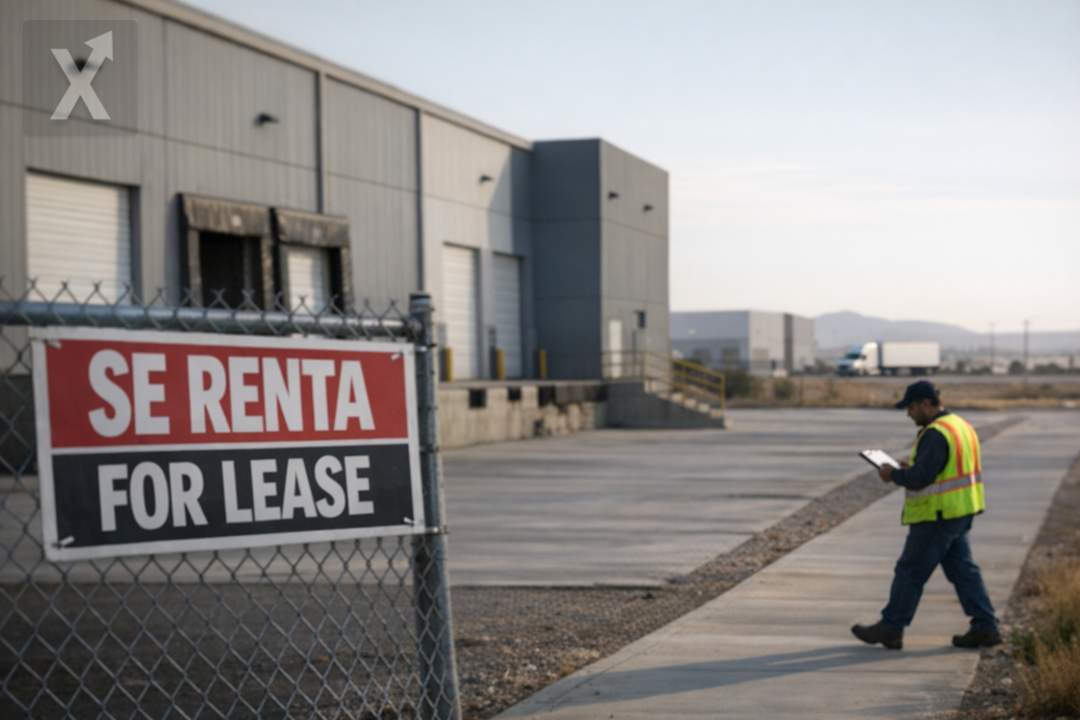
Manufacturing investment along the border is slowing as companies put off decisions ahead of the USMCA review and the trade environment with the United States.
The nearshoring boom in northern Mexico—which in the post-pandemic period sparked a rush to build and lease industrial facilities—is now showing clear signs of a pause. In key markets along the border region, developers and brokers report more available space and slower negotiations, as companies look for certainty before committing capital and long-term contracts. The factor that comes up most often in conversations across the industry: clarity on the future of the USMCA and the tone of U.S. trade policy.
The slowdown is visible in industrial real estate indicators. Vacancy rates, which in 2023 hovered near historic lows around 1% in several northern markets, have risen toward roughly 7% in 2025, according to estimates cited in academic and industry analyses. This shift doesn’t necessarily signal a broad-based collapse, but it does mark a transition: from an “overheated” market with scarce inventory to one where tenants have more negotiating power and projects are being assessed more cautiously.
At the same time, the cooling trend is showing up in manufacturing employment in some border cities. In Ciudad Juárez, for example, a significant cumulative loss of manufacturing jobs between 2023 and 2025 has been documented, consistent with weaker activity in labor-intensive segments and operational adjustments by export-oriented companies. While labor dynamics vary by region and subsector, the data point underscores that nearshoring does not move forward in a straight line or evenly everywhere.
Part of the adjustment stems from decisions made in 2022 and 2023, when speculative facilities were built in anticipation of a sustained wave of relocations from Asia to Mexico. Over time, several corporations chose to postpone leases, expand at a smaller scale, or wait for clearer conditions around trade and inputs (energy, water, logistics). The result is available inventory that has taken longer to absorb than expected.
Behind the pause, the corporate message is consistent: geographic proximity and competitive costs are no longer enough on their own. To install production lines, certify suppliers, or shift supply chains, companies weigh the stability of the trade framework, regulatory compliance, and the continuity of rules affecting everything from regional content requirements to customs processes. In that sense, the USMCA has become central to risk calculations.
The 2026 USMCA Review and the “Cost of Waiting”
The USMCA review timeline in 2026 acts as an anchor of uncertainty for projects that require long planning horizons. In manufacturing, a lease agreement, a plant expansion, or the decision to bring in a supplier can involve investments that pay off over years. If companies anticipate changes to rules of origin, new regional content requirements, or heightened sector-specific scrutiny, it’s rational for them to take a “wait and see” approach before signing. On top of that, the trade environment with the United States could include tariff measures or industry-specific pressure, increasing the incentive to wait for clearer signals.
For Mexico, the risk isn’t just a temporary dip in industrial leasing activity, but the potential deferral of investment flows that compete with other geographies. Still, there are counterweights: more than 500 U.S. business organizations have expressed support for keeping the agreement in place, and North America’s production integration makes it costly to unwind existing supply chains. In practice, the most likely outcome is a renegotiation with adjustments, but the critical issue is timing: until there’s clarity, activity may remain in defensive mode.
The nearshoring debate is also unfolding at a time when Mexico’s economy combines structural strengths with bottlenecks. On the one hand, Mexico retains advantages thanks to its network of trade agreements, its export-oriented manufacturing base, and its proximity to the United States, the main destination for its exports. On the other hand, investment decisions run into physical and regulatory constraints: electric power capacity, grid interconnection, water availability in some industrial hubs, security along logistics corridors, and congestion at border crossings. In the north, the logistics challenge—customs times, transportation costs, and the availability of drivers—matters as much as rent per square meter.
In this context, investment-attraction consultancies have warned that the trade framework is entering a defining stage: alongside the USMCA review, there is growing pressure for compliance and traceability across supply chains. For companies already operating in Mexico, the focus is often on protecting margins and staying flexible; for new entrants, the dilemma is whether to move forward now with a phased approach or hold off until the negotiation outcome is known.
Even with the pause, Mexico still ranks among the region’s key destinations for foreign direct investment, with flows concentrated in manufacturing, financial services, mining, and trade, according to reports from financial institutions. The market’s read is that nearshoring hasn’t disappeared—it has shifted phases. It is driven less by hype and more by risk analysis, which tends to favor projects with secured “anchor” demand, suppliers with firm contracts, and locations with proven infrastructure.
Looking ahead, the northern border could see a gradual rebound if trade uncertainty declines and signals of USMCA continuity strengthen. It’s also likely that the industrial market will normalize: higher vacancy isn’t necessarily negative if it helps stabilize rents, improve terms for new tenants, and bring supply into better balance. However, the opportunity window isn’t unlimited: if clarity on the agreement drags on or conditions tighten, some projects could be relocated or broken into stages to minimize exposure.
In short, nearshoring in northern Mexico is in a holding pattern: integration with the United States remains an asset, but a lack of clarity around the USMCA and the broader trade environment is delaying decisions, with visible effects on industrial space and employment.






