Finance Ministry Estimates a 15.8 Billion-Peso Fiscal Cost for Gasoline and Diesel Subsidies in 2026
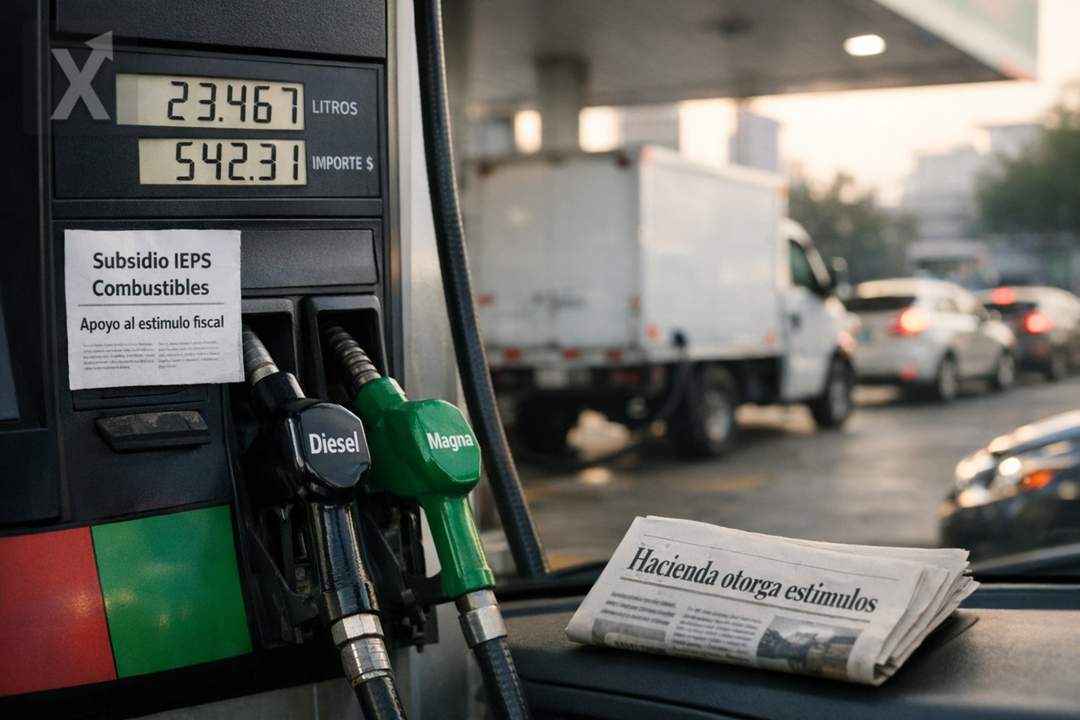
The government cushions fuel price increases by cutting the IEPS excise tax—an approach that shields prices but reduces public revenue in a year of greater oil-related pressure.
Mexico’s Ministry of Finance and Public Credit (SHCP) expects that in 2026 it will forgo more than 15.8 billion pesos in revenue due to the subsidies applied to the rates of the Special Tax on Production and Services (IEPS) levied on gasoline and diesel. The measure aims to soften the pass-through of external shocks—particularly increases in international crude oil prices—into pump prices, with the stated goal of protecting purchasing power and containing transportation and production costs.
In the economic policy pre-criteria submitted to Congress, the Finance Ministry said that support through IEPS subsidies will result in tax revenue coming in below what had been budgeted, even as it kept its outlook for annual real growth in collections, supported by stronger enforcement efforts and regulatory adjustments tied to controls on foreign trade. From a public policy standpoint, the trade-off is familiar: smoothing consumer prices reduces inflation volatility, but it also shrinks fiscal space at a time of elevated spending needs.
The fuel IEPS is a key component of non-oil tax revenue: it is charged per liter, and when the government grants a subsidy it partially or fully reduces that per-liter tax so the final price rises less. When international prices fall or stabilize, the Finance Ministry can roll back the subsidies and restore the full tax, recouping part of the revenue. The impact, however, is not neutral for public finances: the fiscal cost shows up precisely when the government needs resources for programs, investment, and debt service.
During April, the Finance Ministry maintained subsidies for several consecutive weeks on diesel as well as on regular and premium gasoline, amid heightened pressure in the global energy market. In the case of diesel—an essential input for freight trucking and therefore for the logistics of food, manufacturing, and commerce—the discounts have at times been significantly larger than those applied to gasoline, reflecting diesel’s broad impact across the economy’s cost structure.
One factor that increases the domestic market’s sensitivity is the heavy reliance on imported fuels. Mexico produces some of the refined products it consumes, but it still imports sizable volumes, particularly from the United States, making international prices, refining margins, and the exchange rate decisive for the final price. In practice, IEPS subsidies operate as an adjustment “valve” to prevent abrupt changes in prices at the pump.
Pressure on Inflation, Transportation, and Business Margins
The use of IEPS subsidies is often justified by its potential to limit inflationary pressures. In Mexico, core inflation tends to respond to energy shocks with a lag, but the non-core component—where energy is included—can spike quickly and spill into expectations. When diesel becomes more expensive, the hit moves through the logistics chain: it raises the cost of moving goods and people, putting upward pressure on the prices of food, consumer goods, and services. For transport-intensive companies, volatility translates into fare or rate adjustments, thinner margins, or postponed investments—especially in sectors with intense competition and limited ability to pass through costs.
The 15.8 billion pesos in costs that the Finance Ministry projects for 2026 helps illustrate the size of the price “insurance” represented by these subsidies. In budget terms, amounts of that scale can be compared with the annual funding of social programs or specific components of education and productive-development policy. For the government, the calculation is both political and economic: how much revenue to give up today to avoid a bigger deterioration in consumption, inflation, or activity—and how much fiscal room remains to respond if the external shock drags on.
In the background is the balance between price stability and the strength of public finances. If the subsidies remain in place for extended periods, tax revenue takes a hit, which can increase the need for cuts elsewhere, more borrowing, or offsetting revenue measures. By contrast, pulling them back too quickly can translate into visible increases in consumer prices, affecting expectations and wage negotiations, with potential implications for the inflation path.
Looking ahead, the effectiveness of this policy will depend on several factors: how long geopolitical tensions keep oil under pressure, the evolution of the refined-products market in North America, the performance of the exchange rate, and the government’s ability to sustain tax revenue through other channels. The role of the Bank of Mexico will also matter: if energy inflation leaks into core inflation, the central bank could keep a restrictive stance for longer, raising financing costs for households and businesses and cooling growth.
In short, IEPS subsidies work as a buffer against external shocks, but their fiscal cost is real and forces prioritization decisions. In a context of deep trade integration with the United States and sensitivity to international crude prices, the debate is not only about how much people pay at the gas station, but also about how the cost is shared among consumers, businesses, and the public budget.






