IMSS Logs Another Drop in Employers in March; Employer Base Shrinks Despite Gains in Formal Employment
The decline in employers registered with the IMSS deepens in 2026 and points to a more cautious environment for businesses, even as formal jobs continue to be created.
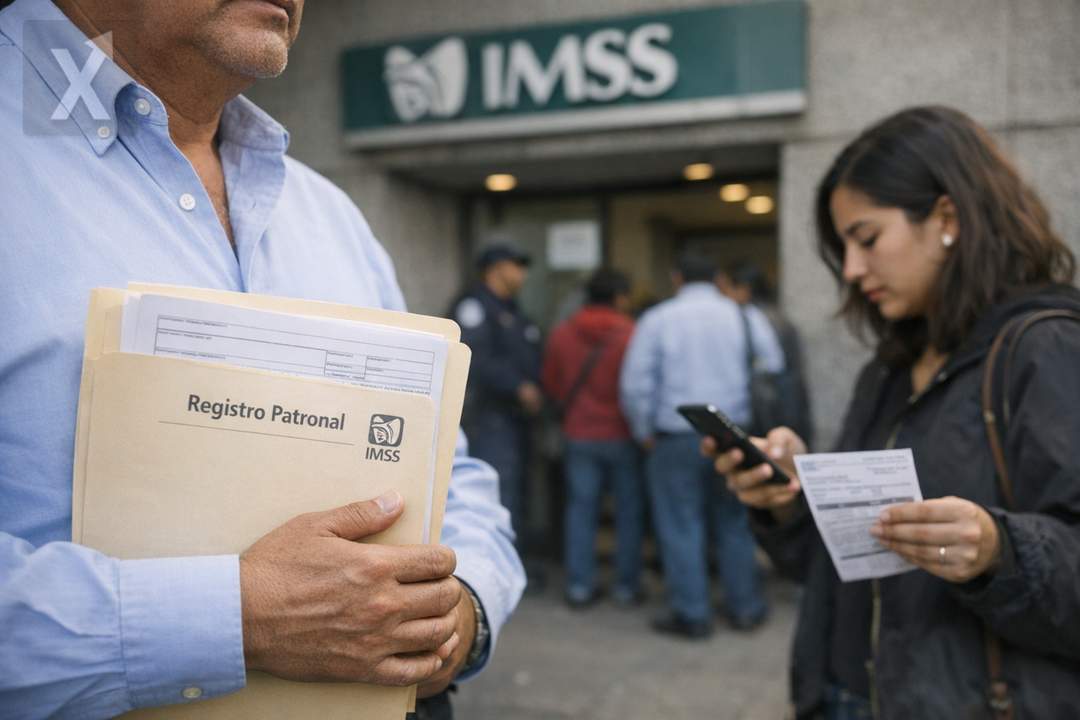
The roster of employers registered with the Mexican Social Security Institute (IMSS) fell again in March, a sign of cooling in the business fabric at a time when the country is still posting net formal job creation, but with a weaker economic pulse than in recent years. During the month, the number of employers fell by 1,726, equivalent to a 2.7% year-over-year drop.
The IMSS attributed the adjustment to the “implementation of security measures in the opening of employer registrations for individuals,” without offering additional details on the operational scope of those changes. Beyond that administrative factor, the figure fits into a weakening trend: as of the end of the first quarter, 9,010 employers have been deregistered, and the institute reports around 1.02 million registered employers.
Private-sector analysts have emphasized that the pattern of monthly declines in employer registrations has become persistent, with decreases in 22 of the past 23 months. On a year-over-year basis, the cumulative contraction looks meaningful, suggesting an environment in which some businesses shut down, scale back operations, consolidate, or shift toward arrangements that rely less on employer registration—an outcome that tends to intensify when growth slows and the cost of operating formally is perceived as higher.
A decline in employers is often interpreted as a leading indicator of pressure on micro, small, and medium-sized businesses, which account for a significant share of employment and are more sensitive to swings in demand, access to credit, and labor costs. In Mexico, business heterogeneity is pronounced: while some export-oriented industries tied to manufacturing supply chains show greater resilience, segments of local services and retail trade tend to feel consumer cycles more acutely.
Jobs and wages: progress, but signs of moderation
Despite the reduction in employers, the IMSS reported the creation of 32,930 formal jobs in March, bringing the year-to-date total to 207,604 positions. Most of these are permanent jobs, pointing to a more stable mix in hiring; however, the annual pace of formal employment growth has moderated compared with periods of stronger momentum. This performance is consistent with an economy that grew just 0.8% in 2025 and faces a mixed outlook in 2026: on the one hand, expectations of investment projects and nearshoring; on the other, business caution amid still-elevated financing costs and a more uncertain global environment.
On wages, the average base wage used for IMSS contributions came in at 663.50 pesos per day, up 7.14% year over year. Adjusted for inflation, the real increase is around moderate levels, helping sustain the purchasing power of formal workers but not necessarily offsetting the loss of momentum in sectors with high turnover or thin margins. The real wage increase also coexists with a two-speed labor market: the formal sector advances at a measured pace, while informality—which in Mexico tends to remain high—can absorb part of the labor force when small firms’ hiring capacity weakens.
Looking toward the end of 2026, private-sector forecasts for employment covered by social security have moved into conservative ranges, reflecting that the boost may be insufficient for a robust expansion. At the same time, the Ministry of Finance has put forward a growth estimate of 1.8% to 2.8%, supported by a potential gradual recovery in private investment and by public and mixed investment projects focused on infrastructure. The gap between estimates also highlights how sensitive Mexico’s cycle is to external factors, the investment climate, and the trajectory of domestic consumption.
In practice, the decline in the number of employers can have meaningful implications: less competition in certain local markets, adjustments among suppliers, fewer new productive units being created, and, in some cases, a shift toward subcontracting arrangements or higher turnover in registrations. The underlying takeaway is that employment can keep growing, but with a narrower business base—which, over the medium term, can limit the economy’s capacity to absorb workers if the trend is not reversed.
In perspective, the balance among job creation, wage trends, and investment will be key in determining whether the economy manages to return to firmer growth or whether a scenario of modest expansion persists. The IMSS employer figure, by its nature, offers an early signal of business sentiment and suggests the immediate challenge is to strengthen conditions for business survival and formalization, especially among smaller firms.
In sum, Mexico is adding formal jobs and maintaining real wage gains, but the sustained drop in employers registered with the IMSS points to a business sector under pressure, with implications for the pace of growth in 2026.