Ebrard and the USMCA Review: The Litmus Test Protecting Mexico’s Export Engine
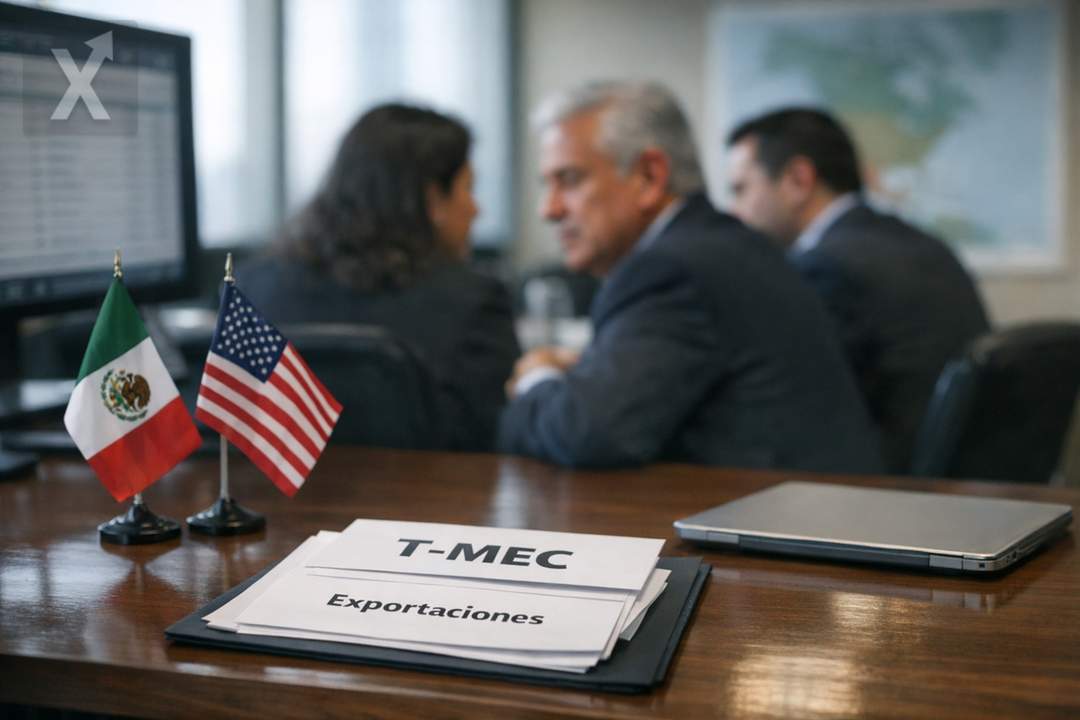
Trade talks with the United States and Canada are becoming decisive for investment and jobs in Mexico, as supply chains are reshaped.
The USMCA review puts Marcelo Ebrard, from the Ministry of Economy, at the center of a conversation that in practice works as insurance—or a risk—for the main engine of the Mexican economy: manufactured exports to North America. With annual trade measured in the hundreds of billions of dollars, the room to maneuver is narrow and the incentives to avoid an escalation of tensions are high, even as the political tone hardens.
In recent years, Mexico has solidified its position as the United States’ largest supplier of goods, overtaking other partners thanks to a combination of geographic proximity, production integration, and industrial capacity. That position strengthens Mexico at the table, but it also exposes it: any friction over rules of origin, quotas, border inspections, or “national security” measures can quickly translate into costs for plants, jobs, and investment flows.
The starting point is structural. Mexico’s economy depends significantly on external demand and, within that, on the U.S. market. Manufacturing—autos, auto parts, electronics, machinery, medical devices, and electrical equipment, among others—doesn’t just generate foreign currency: it organizes entire supply, logistics, and services chains. That’s why the treaty discussion comes with double pressure: on one side, the United States’ demand for higher regional content and tighter controls; on the other, Mexico’s need to preserve certainty for investment decisions tied to the reshoring/relocation trend (nearshoring).
In this context, negotiating style matters. The experience of recent episodes involving threats of broad-based tariffs left a practical lesson: the priority is usually to contain damage and keep day-to-day trade functioning, even while targeted adjustments are negotiated. Mexico’s strategy, as private-sector analysts broadly agree, starts from a reality that’s hard to ignore: production integration is so deep that abrupt changes would also affect U.S.-side operations and installed capital.
In addition, the USMCA review is arriving in an international environment that’s less tolerant of dependence on faraway suppliers. The discussion is no longer only about efficiency and prices; supply security, logistics resilience, and geopolitical competition carry more weight. That narrative supports the idea of “producing in the region,” but it opens the door to stricter demands on input traceability, labor compliance, and customs procedures—with a direct impact on costs.
Rules of Origin, Energy, and Agriculture: The Fronts That Can Move Investment
Among the issues most capable of reshaping the investment map are rules of origin—especially in sectors like automotive—because they define what share of a product’s value must come from North America to receive preferential treatment. Tightening them can encourage greater regional integration, but it can also raise compliance costs and trigger supplier reshuffling that takes years. At the same time, the energy chapter retains significant controversy potential: regulatory certainty influences investment decisions in electricity, natural gas, fuels, and energy-intensive manufacturing—right as Mexico faces the challenge of expanding generation capacity and grids to sustain industrial growth. The agriculture front, for its part, often flares up quickly for sanitary, seasonal, or political reasons; any restrictive measure can become a pressure point that affects domestic prices and food supply chains.
The negotiation also intersects with domestic challenges. Mexico wants to capitalize on nearshoring, but it faces constraints the private sector has consistently flagged: energy availability, water management, overburdened logistics infrastructure in certain corridors, and red tape that raises timelines and costs. USMCA stability is necessary but not sufficient: without complementary investment in ports, customs, rail, highways, and electric transmission, the opportunity can fade—or concentrate in just a few regions.
In the short term, the Mexican economy has shown resilience supported by exports, remittances, and consumption, though with signs of slowing as the global cycle normalizes and tight financial conditions persist. On that chessboard, trade certainty matters more than ever: if the agreement enters a prolonged period of uncertainty, companies may delay expansion, adjust inventories, or redirect projects to other destinations, even without immediate tariffs materializing.
For the United States, the incentive to preserve the framework is also tangible: Mexico is a production platform, a market, and a logistics partner. The region is competing against other blocs to attract advanced manufacturing and secure critical inputs. That’s why, even with political pressure and bouts of confrontation, the most likely path is a tense negotiation with selective tweaks rather than an outright rupture. Even so, the process may generate enough noise to affect expectations, particularly in sectors sensitive to permitting and regulatory compliance.
In perspective, Mexico’s performance will depend on two layers of decisions: its negotiating capacity to protect preferential access to the U.S. and Canadian markets, and domestic execution to turn that advantage into productivity and sustained investment. Keeping the USMCA working—with clear rules and functioning dispute-settlement mechanisms—will remain an anchor for the export-led growth model that has defined the country for decades.
In sum, the USMCA review isn’t an isolated technical exercise: it’s a certainty test for Mexico’s export model. The most valuable outcome would be maintaining market access while adjusting critical points without breaking the regional integration that supports jobs and investment.