Mexico Heads Into the USMCA Agricultural Review as U.S. Purchases Show Signs of Cooling
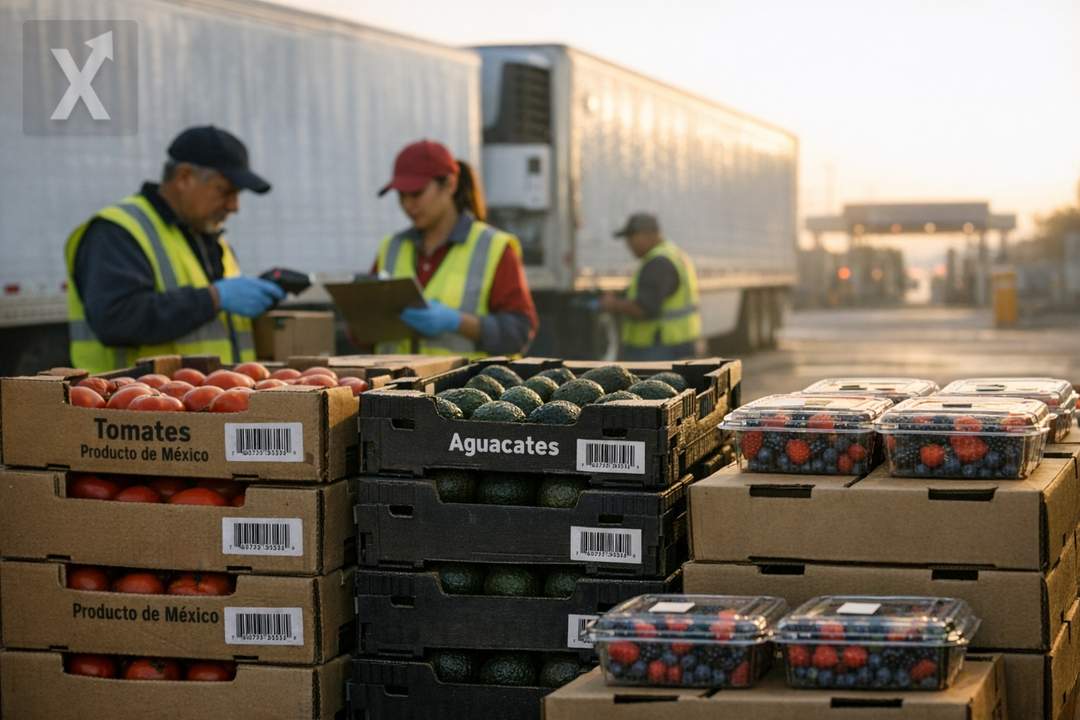
The first year-over-year decline in nearly 30 years in U.S. purchases of Mexican food is raising pressure on the USMCA’s agricultural negotiations.
For decades, agri-food trade has been one of the steadiest gears in North America’s economic integration. Since NAFTA’s launch and its transition to the USMCA, Mexico built out an export platform that supplies the U.S. market with fruits, vegetables, and beverages—supported by logistical advantages, seasonal complementarity, and supply chains that operate virtually every day.
That growth pattern has recently broken. According to figures from the U.S. Department of Agriculture, the value of U.S. agricultural imports from Mexico totaled $43.849 billion in 2025, down from $48.629 billion the year before—an almost 10% drop. Far from being a one-off dip, early 2026 kept the same tone: from January through April, Mexican agri-food exports to the United States fell 6% compared with the same period a year earlier, just as both economies enter a new phase of talks to review the USMCA.
The cooling comes at a time when Mexico’s economy is trying to keep its external engine running amid weaker global momentum. Even as the country has gained prominence as an export manufacturing platform, the agri-food sector remains pivotal because of its regional reach, the jobs it supports, and its spillover into related services (transportation, packaging, cold-chain logistics). That’s why a prolonged slowdown in the U.S. market would hit not only large exporters, but entire production corridors.
The pullback reflects a combination of factors: climate shocks—such as droughts and heat waves—that reduce yields; higher energy, fertilizer, and logistics costs; and a rougher political-trade climate that raises uncertainty for long-term investment. On top of that, U.S. consumers have periodically shifted toward cheaper options as inflation pressures persist in certain categories, hurting price-sensitive segments.
Within the export basket, several notable adjustments stand out. Fresh vegetables posted a significant contraction in 2025, with a partial rebound in the first months of 2026. For beer—one of Mexico’s most visible products on U.S. shelves—purchases have lost momentum. In spirits, the drop has been even sharper, and in flagship products like avocados and berries there has been a meaningful reduction at the start of 2026 after an already weak 2025.
The USMCA review context adds a strategic layer: when trade is flowing, the agreement works like invisible “infrastructure” that reduces friction; when it cools, incentives rise for trade litigation, defensive measures, and domestic pressure in each country to tighten rules or launch dispute panels. In agriculture, these episodes tend to escalate quickly given producers’ political sensitivity and the seasonality of harvests.
The Cost of Relying on a Single Market
Destination concentration has been both a strength and a vulnerability for Mexico’s farm sector. Most agri-food exports go to the United States, which simplifies logistics and contracting, but leaves the sector exposed to regulatory changes, antidumping investigations, and sanitary decisions. When domestic climate shocks are added—drought in the north, water stress in agricultural basins, rainfall variability—the impact is magnified: less exportable supply, higher irrigation costs, and added pressure on domestic prices for certain foods.
This dependence also intersects with a financial challenge. In Mexico, access to credit for small and mid-sized producers remains limited and expensive, partly because of informality, insufficient collateral, and security risks in certain regions. With interest rates still high by historical standards—though expectations point to gradual easing as inflation cools—financing modernization, irrigation infrastructure, greenhouses, or sanitary certifications becomes harder. That reduces the ability to respond quickly to demand shifts and new traceability requirements.
The diversification conversation often focuses on opening markets, but the challenge is broader: meeting sanitary protocols, adapting packaging, expanding cold storage capacity, securing logistics routes, and sustaining consistent volumes. Europe, Asia, and some Caribbean markets are frequently cited options, but they require investment and public-private coordination to reduce friction. Over the medium term, an effective diversification strategy would also help stabilize producer income amid volatility in the United States.
On the U.S. side, agriculture also has incentives to preserve the agreement. Mexico is a large-scale buyer of U.S. grains, meat, dairy, and other products, making bilateral trade a relationship of mutual dependence. Still, that interdependence coexists with domestic political pressure: producers and lawmakers call for action against what they view as unfair competition or regulatory asymmetries, especially in fruits and vegetables that compete directly with local harvests.
At the USMCA review table, agricultural issues typically center on market access, sanitary and phytosanitary measures, regulatory cooperation, and biotechnology. For Mexico, the core goal is to preserve preferential access and prevent new technical or sanitary barriers from disrupting integrated supply chains. For the United States, the priority is to secure conditions that, in its view, provide certainty for its producers and a comparable playing field.
The economic takeaway is straightforward: Mexico–U.S. agri-food trade exceeds $70 billion a year and functions as a regional stabilizer. A sustained deterioration would mean fewer foreign-exchange earnings for agricultural regions, potential pressure on seasonal employment, and greater exposure of domestic prices to climate shocks—while for the United States it would mean supply and price tensions in categories where Mexico is a dominant supplier.
Going forward, the trajectory will depend on whether the sector restores supply after climate shocks, how U.S. consumption evolves, and above all the ability of both sides to contain disputes and provide regulatory certainty. The “tail risk” is that uncertainty translates into less agricultural investment, just as competitiveness increasingly depends on modernization, robust sanitary systems, and modern logistics.
Overall, the recent drop in U.S. purchases doesn’t erase agri-food interdependence, but it does flash an early warning sign: Mexico enters the USMCA review with less room to maneuver and an urgent need to strengthen productivity, climate resilience, and diversification to reduce vulnerabilities.






