Mexican Sugar, Between Quotas and Price Pressure: The New Trade Push with the United States
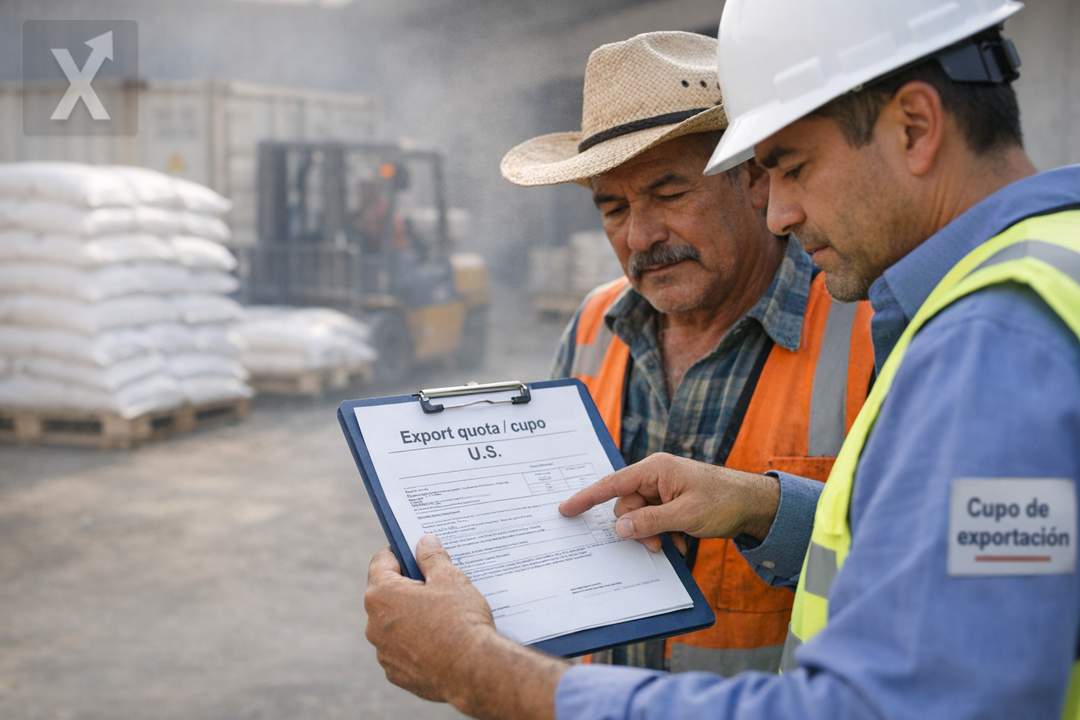
Mexico is looking to regain ground for its sugar in the United States, as the market operates with reduced quotas and ever-tighter margins.
The sugar trade between Mexico and the United States is back at the center of the bilateral economic conversation—not because of a sustained rebound, but due to a mix of tighter quotas, international prices under pressure, and the proximity of key decisions in the USMCA review. For an industry with significant regional weight—because of jobs, supply chains, and its presence in rural areas—access to its main export market has become an issue of production and financial stability.
In value terms, Mexican exports of raw sugar (from cane and beets) to the United States recently closed at around $386 million, a recovery from the prior year, but still far from the highs of recent years, when flows comfortably topped $500 million and even reached $700 million. At the start of 2026, shipments also posted declines versus the same period a year earlier, reflecting a market that is normalizing downward and facing access restrictions.
Beyond the month-to-month swings, the main structural factor is the reduction in the import quotas the United States sets for Mexican sugar, which in practice determine the physical ceiling of trade. With the quota at levels significantly lower than in previous years, every allocated ton becomes strategically valuable: it determines revenue for mills, liquidity for growers, and the ability to place surplus volumes on competitive terms.
In this context, the Mexican government has stepped up its efforts in Washington to expand the allowed volumes. The bet is significant: in a market where trade policy matters as much as price, a quota adjustment can shift the balance between inventory building up in Mexico and external sales that support the cycle’s profitability.
The domestic backdrop isn’t helping either. The industry is dealing with bouts of domestic oversupply and demand that isn’t growing at the same pace, while international prices have shown periods of weakness. At the same time, financial conditions—rates that remain high in real terms and more selective credit—raise the cost of carrying inventories and operating with thin margins, especially for players with less access to financing.
A “Managed” Market and the Asymmetry with Sweeteners
Sugar is a clear example of managed trade: it does not operate as a fully free flow, but rather under rules, quotas, and reference prices that tightened after the dispute that began in 2014, when U.S. producers accused Mexico of selling below fair value. The suspension agreement that avoided higher tariffs kept the market open, but in exchange for strict conditions: limited volumes, minimum prices, and a specific mix of exported product (raw versus refined). In 2017 the restrictions were strengthened, and since then access has been negotiated practically “ton by ton.”
In Mexico, the debate often returns to an asymmetry the industry perceives: while sugar faces limits in the United States, U.S. high-fructose corn syrup has a smoother path into the Mexican market and competes directly in industrial segments. That substitution has influenced consumption, the sweetener blends used in beverages and processed foods, and, as a result, the country’s sugar supply-and-demand balance. The tension isn’t new, but it becomes more relevant when Mexican sugar’s access to the U.S. market is reduced just as Mexico absorbs significant volumes of sugar and related products from its partner.
The issue is also unfolding at a time when Mexico is trying to sustain agro-industrial exports with greater value added while also containing food inflation pressures. While sugar alone does not explain the trajectory of the National Consumer Price Index (INPC), it is an important input across food and beverage supply chains, and its swings can partially pass through to consumer prices or to industry margins, depending on contracts and competition. On top of that is the social component: in several cane-growing regions, the harvest season and mill operations support local jobs and income.
On the bilateral front, sugar negotiations intersect with other Mexico–U.S. trade issues—from rules of origin and sector-specific disputes to the agenda for trade facilitation at the border. For Mexico, expanding quotas or easing conditions would relieve pressure on the domestic market and improve income certainty for growers and plants. For the United States, the issue is politically sensitive because of its protection-and-support framework for its own sugar industry, which has historically influenced quota design and the way the market is managed.
Looking ahead, the sector faces a dilemma: rely on the U.S. quota as a pressure-release valve or diversify markets and products. Diversification is not immediate—because of logistics, standards, competition, and pricing—but the discussion around farm productivity, industrial efficiency, and the ability to produce more refined sugar or higher-value derivatives could gain traction if access to the United States remains restricted.
In short, sugar is once again a thermometer of the trade relationship: when the quota tightens, internal tensions rise and diplomatic outreach accelerates; when it expands, the sector gets breathing room. The decisions in the coming months will be key to gauging whether the USMCA review opens space for pragmatic adjustments or whether trade will continue to operate under tight controls that limit Mexico’s export potential.






