Banxico Cuts the Rate to 6.75% and Reshuffles the Board: Cetes Ease, Borrowing Gradually Gets Cheaper
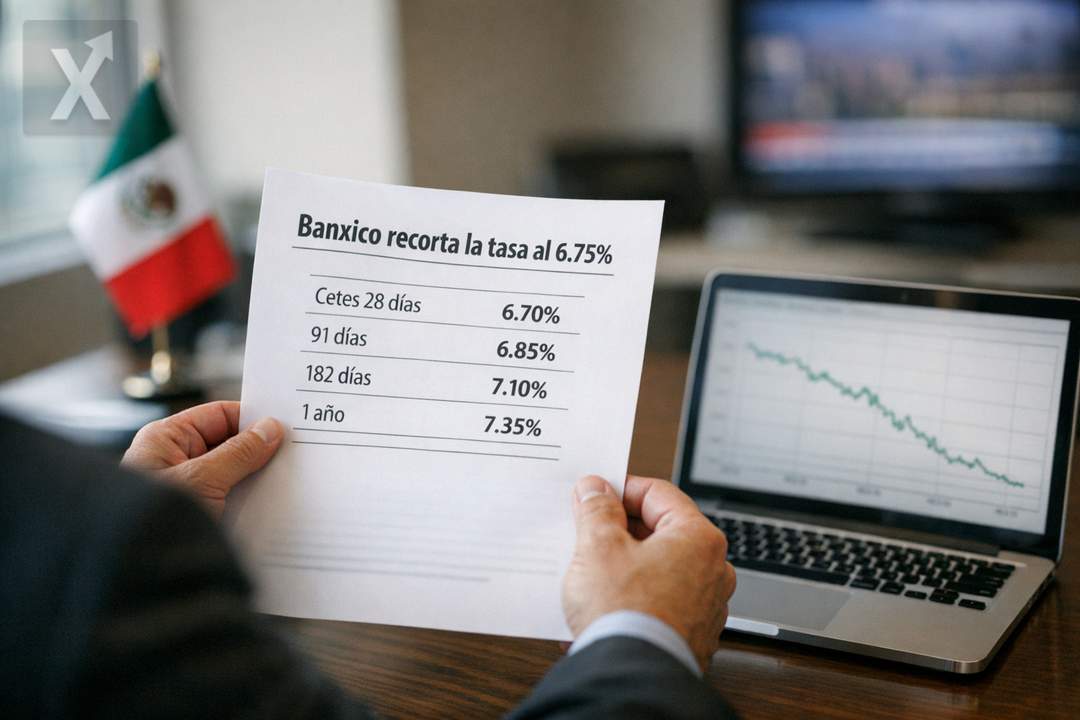
Banxico’s cut pushes Cetes yields lower and points to less restrictive financial conditions, even as inflation remains above target.
The latest cut to the Bank of Mexico (Banxico) policy rate once again reset the floor for Mexico’s local debt market: yields on Treasury Certificates (Cetes)—often viewed as the short-term “thermometer” for money—posted broad declines across key maturities. The decision comes at a time when annual inflation is hovering around 4.63%, still above the permanent target of 3% +/- one percentage point, forcing a delicate balance between supporting economic activity and keeping expectations anchored.
Banxico cut its interbank rate by 25 basis points to 6.75%, its lowest level since March 2022. In doing so, the central bank reinforces the message that the tightening cycle is over and that, if disinflation continues, borrowing costs could keep trending down gradually. However, the monetary authority has also emphasized that the international backdrop—including the risk of an escalation in the Middle East conflict and its impact on energy prices and supply chains—could reignite price pressures.
Markets reacted quickly. After several weeks of stability, 28-day Cetes fell to 6.64%. At 91 days, the yield came in at 6.82%. In the belly of the curve, the 182-day security was placed at 7.15% and the one-year at 7.44%. The slope of the curve still suggests investors demand a premium for longer maturities, although rates no longer reflect the peaks seen during the period of monetary tightening.
For retail savers, the news has two takeaways. On one hand, interest income on very low-risk instruments tends to moderate as the rate-cut cycle advances. On the other, as long as yields remain above inflation, Cetes continue to offer a positive real rate—particularly valuable in an environment where consumption remains a pillar of growth and households are looking for ways to protect purchasing power.
What it means for savers: real returns, maturities, and competition for deposits
The appeal of Cetes depends less on the “headline number” and more on the real return—that is, what’s left after subtracting inflation. With annual inflation near 4.63%, a 28-day Cete at 6.64% implies, roughly, a real gain of about 2 percentage points. That edge can change as prices and the policy-rate path shift, so investors should periodically review whether their strategy still fits their time horizon and risk tolerance.
Choosing a term also matters. Cetes are issued in different maturities—such as 28, 91, 182, and 364 days—and, in general, longer terms offer a higher yield, but at the cost of tying up cash for longer. In a declining-rate cycle, locking in yields for more months can make sense for those seeking certainty; by contrast, staying short allows quicker reinvestment if inflation re-accelerates or if the central bank shifts its tone and pauses further cuts.
Another factor to watch is competition for household savings. In Mexico, household money is spread across government instruments, bank time deposits, and long-term vehicles such as Siefores (retirement funds). When short-term rates fall, investors tend to compare alternatives and fees more actively, which can drive a gradual reallocation toward options with longer horizons or different risk exposure—especially if the economy keeps momentum and the search for yield intensifies.
At the macro level, a Banxico rate cut typically filters through with a lag into the cost of financing for businesses and households—from payroll and personal loans to credit cards, mortgages, and working-capital lines. While transmission is neither immediate nor uniform, a less restrictive environment can help support investment and consumption in a year when Mexico’s performance also depends on business confidence, remittance inflows, and the trajectory of manufactured exports.
Looking ahead, the debate will center on the pace and depth of further cuts. With inflation down from its peaks but not yet fully converging to target, the central bank may choose a cautious path, mindful of external shocks (energy, the exchange rate, logistics) and domestic pressures (services, wages, demand). In that context, Cetes will remain a key benchmark: their yield not only sets the return for conservative saving, it also signals expectations for monetary policy and broader financial conditions.
In short, Banxico’s cut to 6.75% confirms the shift toward a less restrictive monetary stance and is already showing up in lower Cetes yields; still, as long as inflation stays above target, the easing process will likely be gradual and sensitive to global risks.