Mexico sharpens its stance ahead of the USMCA review: rules of origin, regional supply chains, and “economic security”
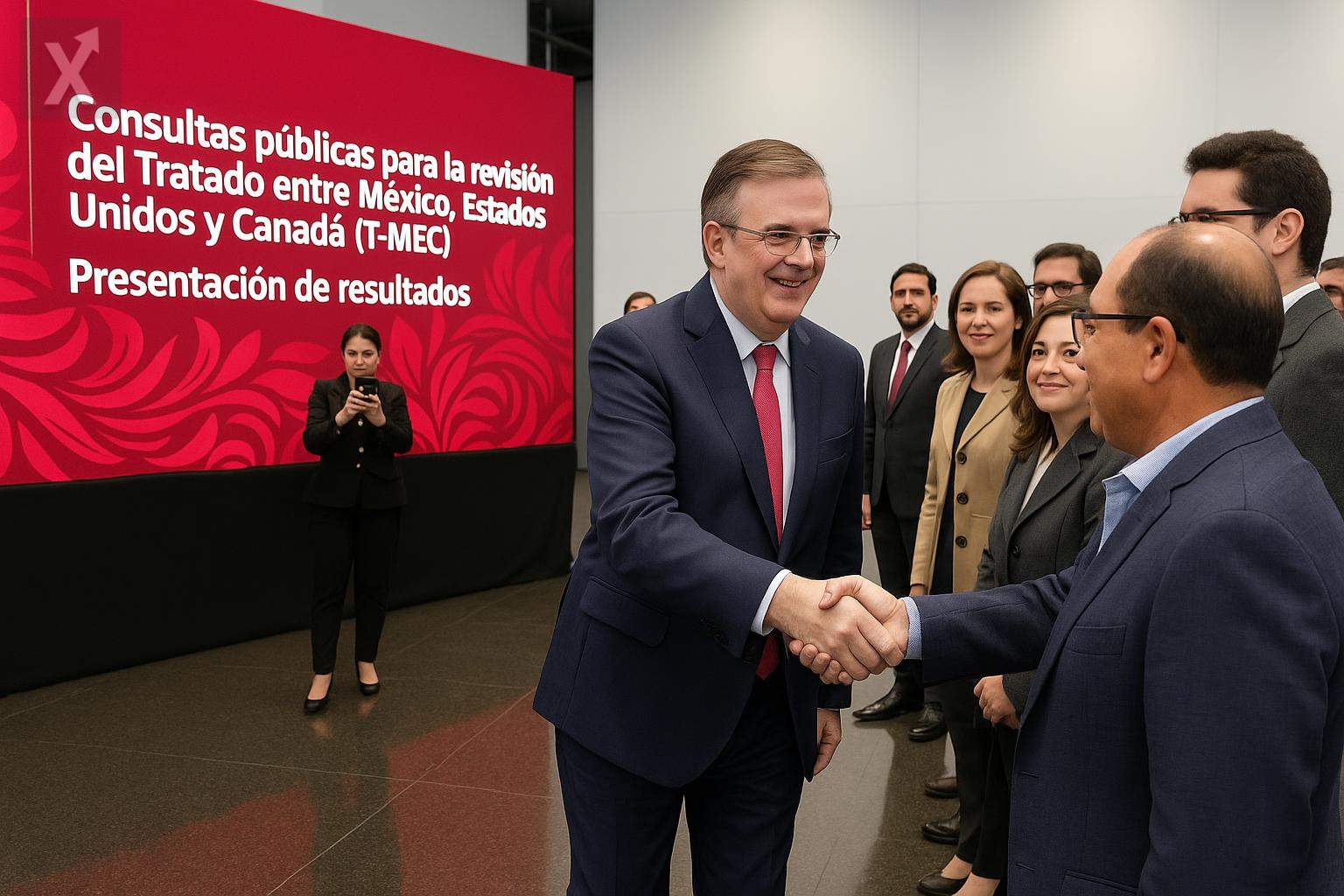
Mexico aims to reach the USMCA review with a unified agenda to strengthen production integration and reduce risks in key supply chains.
Mexico is preparing to face the upcoming review of the United States–Mexico–Canada Agreement (USMCA) with a more cohesive position than usual: an agenda built after months of consultations with companies, business chambers, unions, farm organizations, academia, and state governments. The goal, according to the Ministry of Economy, is to come to the table with “one voice” and clear priorities: modernize rules of origin without breaking existing supply chains, bring more production back to North America, and boost economic resilience in a more volatile global environment.
Taking stock of the consultations, Mexico’s trade and production dependence on its main partner remains the structural fact: most Mexican exports go to the United States, and a significant share of exported value includes U.S.-made inputs. That level of interdependence helps explain why—beyond political rhetoric—the agreement has become the central framework for manufacturing investment, nearshoring, and formal employment in industrial corridors across the country’s north, the Bajío region, and the center.
Marcelo Ebrard, Mexico’s economy minister, has emphasized that the findings show broad support for the agreement: a large share of participants believe the deal has been positive and should remain in place. That consensus contrasts with the atmosphere a year ago, when public debate focused on the agreement’s continuity and on specific trade disputes. Today, the emphasis is shifting toward how to protect the region’s competitiveness against Asia and how to prevent new measures—tariffs, sector-specific restrictions, or divergent interpretations—from injecting uncertainty for companies.
Against that backdrop, the Mexican government is putting together an agenda with three pillars: reduce external dependencies for strategic inputs, review rules of origin to favor regional content, and address “economic security,” understood as continuity of supply and lower vulnerability to geopolitical shocks. Technical talks, according to foreign-trade officials, are expected to start in Washington in mid-March, with the aim of arriving at the scheduled review dates with tangible progress.
Rules of origin: balancing integration and industrial pressure
The rules-of-origin debate is, in practice, the core of any adjustment to the USMCA: it determines which products qualify for tariff preferences and under what regional-content conditions. For Mexico, the challenge is twofold. On the one hand, it wants more stages of production to take place in North America—especially in sectors where Asia dominates intermediate components. On the other hand, it wants to avoid abrupt changes that would raise costs or disrupt supply chains that currently operate with tight inventories and high specialization. In industries such as autos, electronics, and medical devices, small changes in traceability, certification, or required percentages can reshape investment decisions. In a context where Mexico is competing for nearshoring-related capital, clearer and more predictable implementation often matters as much as the final percentage agreed.
Another item gaining prominence is substituting extra-regional imports in strategic products. Officials have noted that North America remains highly dependent on external inputs for pharmaceuticals and key industrial components. The economic logic is straightforward: a logistics disruption, a geopolitical conflict, or export controls in third countries can translate into shortages, higher prices, and temporary shutdowns. Under that framework, strengthening regional suppliers is not only an industrial policy bet, but also a stability mechanism for sensitive sectors.
The argument is backed by hard numbers: the region’s trade deficit with Asian economies is large and, in the government’s view, shifting even part of that production to North America would create room for new plants, deeper supplier networks, and higher regional content. For Mexico, this aligns with both an opportunity and a challenge: the opportunity is to leverage its export platform, its network of trade agreements, and its manufacturing workforce; the challenge is to resolve bottlenecks—available energy at competitive prices, water, border logistics, security along freight corridors, and regulatory certainty—that shape whether projects move forward.
Domestically, the consultations also highlighted uneven integration into the USMCA. The north concentrates much of the export manufacturing tied to the border and to automotive and electronics supply chains; the Bajío and central Mexico add industrial and agribusiness strength; while the southeast shows less participation in higher-value chains. This gap is not only geographic: it also shows up in differences in formal employment, wages, infrastructure, and investment attraction. In practice, a production “regionalization” strategy could deepen disparities if it is not paired with logistics investment, workforce training, and local supplier development.
Beyond rules of origin, the private sector is also interested in improving the treaty’s day-to-day operation: standards alignment, customs digitization and facilitation, shorter border-crossing times, and clearer labor mechanisms, which have been a source of tensions and dispute panels in recent years. Mexico is seeking a balanced application that protects labor rights without turning procedures into a source of uncertainty for exporters, especially in labor-intensive industries.
The macro environment also shapes the negotiation. Mexico enters this review with an economy that has shown resilience thanks to exports and remittances, but with moderate growth and structural pressures tied to public investment, infrastructure, and security. The path of interest rates and exchange-rate stability have served as an anchor for business planning, although external demand and the U.S. industrial cycle continue to set the pace for Mexican manufacturing.
Looking ahead, the USMCA review is shaping up less as a rewrite of the agreement and more as a test of confidence: if the partners can adjust rules without destabilizing supply chains—and if incentives to produce within the region are strengthened—Mexico could reinforce its role as an export platform. If, instead, contradictory measures or prolonged litigation proliferate, the main cost would be uncertainty—precisely as global competition for industrial investment intensifies.
In short, the Mexican government is betting on an agenda that combines practical production goals with regional ambition: strengthen North American content, safeguard strategic supplies, and keep rules clear. The outcome will depend on the ability to align industrial objectives with operational feasibility—and to translate integration rhetoric into concrete improvements in infrastructure, customs processes, and investment certainty.