The EU’s Trade “Bazooka” and the New Tariff Chessboard: Warning Signs for a Trade-Exposed Mexican Economy

Rising trade tensions between the United States and Europe have put a rarely used but high-impact tool back at the center of the debate: the European Union’s (EU) “anti-coercion instrument,” designed to respond when a third country pressures the bloc through threats or measures that affect trade or investment. The issue has gained traction after fresh calls from the European Parliament and political leaders to consider triggering it in response to tariff threats coming out of Washington, amid a geopolitical dispute over Greenland.
The logic of the instrument is straightforward: if the EU determines there is “economic coercion”—that is, pressure intended to sway sovereign decisions by member states—it can respond with restrictions on imports or exports, measures targeting services, and limits on access by companies from the country in question to European tenders and public procurement. In practical terms, it’s a structured retaliation capability for a market of roughly 450 million consumers, giving the bloc considerable negotiating leverage against major trading partners.
The possibility that Brussels turns to that “bazooka option” sets up a scenario that, while playing out far from Mexico, carries indirect implications for the Mexican economy given its deep integration with the United States and the global trading system’s sensitivity to bouts of uncertainty. When disputes among major powers intensify, volatility typically rises in financial markets, supply chains get reassessed, and logistics costs adjust—effects that ultimately spill over to exporting countries like Mexico, especially in sectors such as autos and auto parts, electronics, machinery, and agribusiness.
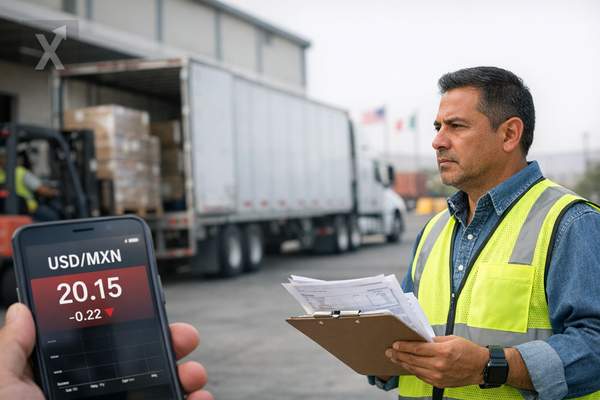
For Mexico, the most visible impact usually comes through two channels. The first is financial: episodes of trade friction tend to boost safe-haven assets and shift rate expectations, which can pressure the peso–dollar exchange rate and borrowing costs. In recent years, the peso has shown resilience supported by relatively high interest rates, inflows into local instruments, and remittances, but it remains a currency that’s sensitive to global risk appetite. The second channel is real economic activity: if tensions raise costs or reduce demand in the United States or Europe, Mexican exports can take a hit—especially at a time when Mexico’s economy depends heavily on export-oriented manufacturing performance.
The EU’s anti-coercion instrument also targets an area where the United States is often strong: services, particularly digital services. In other discussions, the EU has suggested that any retaliation menu could include major tech platforms, since the United States tends to run a services surplus with Europe. Those kinds of measures can lead to adjustments for global companies that also operate in Mexico—from digital advertising to cloud computing—and, in extreme cases, to changes in pricing or commercial terms that end up being passed through to Mexican businesses, especially SMEs that rely on imported tech tools or tools billed in dollars.
As for how it works, the European “bazooka” is not instantaneous. Triggering it requires formal steps: the European Commission must investigate, and then member states must approve measures by qualified majorities. Even so, the mere announcement of an investigation often functions as a political signal and as leverage in negotiations. For markets like Mexico’s, the takeaway is that international trade rules are becoming more instrumental and politicized: tariffs, controls, retaliation lists, and public-procurement restrictions have shifted from being exceptional measures to recurring tools of foreign and economic policy.
This environment also coincides with a period in which Mexico faces its own trade and investment challenges and opportunities. On one hand, supply-chain relocation (“nearshoring”) has kept Mexico on the radar as a manufacturing hub for North America, supported by the USMCA and logistical proximity to the United States. On the other hand, the country is dealing with domestic bottlenecks—infrastructure, energy availability, security, and water constraints in industrial regions—that can limit its ability to capture additional investment. If global trade fragments further, Mexico could benefit in certain segments through supplier substitution, but it could also suffer from weaker external momentum or from stricter rules of origin and industrial policies in major economies.
In broader perspective, Europe’s debate over its anti-coercion instrument confirms a larger trend: the global economy is increasingly shaped by geopolitical decisions and by governments’ willingness to use trade as leverage. For Mexico—highly open and tightly linked to the United States—the message is twofold: it makes sense to strengthen domestic competitiveness to capitalize on supply-chain reconfigurations, but also to diversify risks—markets, critical inputs, and logistics routes—in a world where trade shocks can arrive with little warning.
Final note: although the European mechanism has not yet been activated and its timeline is lengthy, its very existence—and the debate over using it—reflects a tougher international trade environment. For Mexico, the most likely main effect would not be direct, but rather through financial volatility, supply-chain adjustments, and cost changes for companies integrated into global markets, reinforcing the importance of macroeconomic stability and policies that raise productivity.