Nacional Monte de Piedad, Six Months on Strike: The Social and Economic Cost of an Ownerless Institution
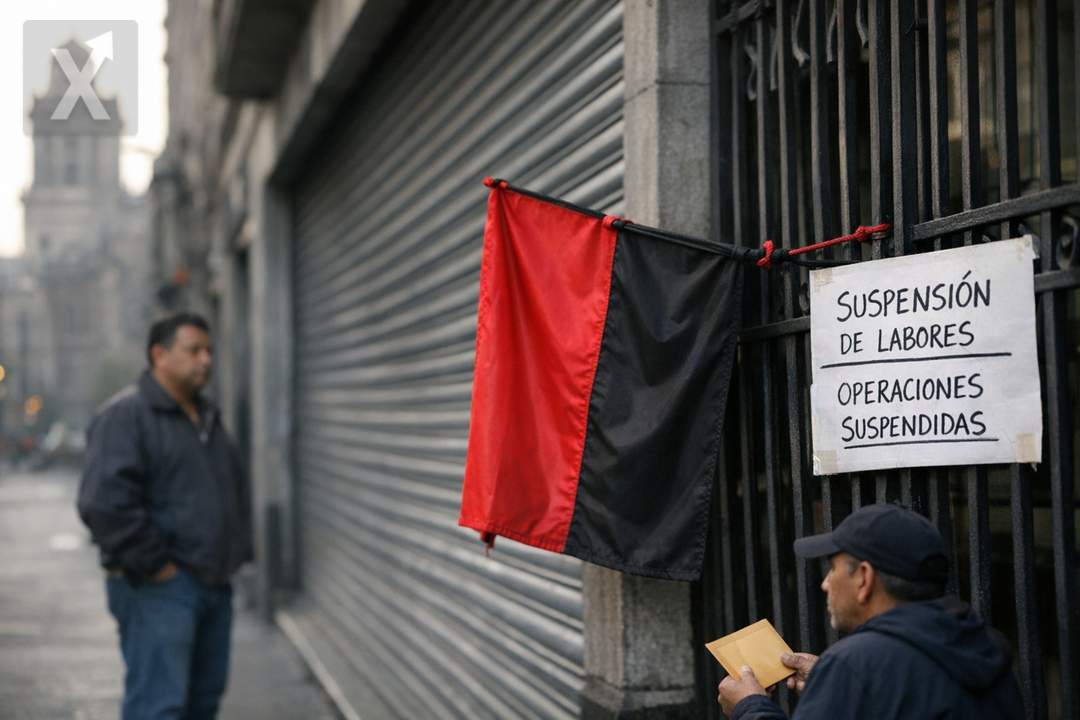
The prolonged strike at Nacional Monte de Piedad has kept more than 300 branches closed and left thousands of families without access to pawn-based credit.
With nearly two and a half centuries of operations, Nacional Monte de Piedad holds a unique place in Mexico’s financial system: it’s not a bank, it’s not a conventional pawnshop, and it doesn’t have an “owner” in the corporate sense. Its legal status as a Private Assistance Institution (Institución de Asistencia Privada, or IAP), in place since 1922, makes it a hybrid player—straddling a niche financial activity (pawn lending) and a social mission sustained by its own endowment and by the surplus generated from its operations.
That structure, however, has not insulated it from the labor tensions that have now brought the institution to a halt. Since October 1, 2025, around 2,000 employees have been on strike for more than six months, with branches closed nationwide. The work stoppage has become a highly visible case given the number of affected customers, the volume of frozen transactions, and the paradox of a nonprofit organization caught in a dispute that, in practice, limits its ability to provide assistance.
The question of “who’s in charge” at Monte de Piedad helps explain part of the clash: because there are no shareholders, leadership rests with a Board of Trustees—the highest governing body—responsible for setting policy and ensuring the institution’s continuity. On the labor front, the union alleges collective bargaining agreement violations, attempts to force liquidation, and wrongful terminations; management, for its part, has argued that operational adjustments are necessary amid rising costs and shifts in demand. Federal labor authorities have urged the parties to return to the table, but negotiations remain deadlocked.
In February 2026, a federal judge ruled the strike “nonexistent,” finding that the union failed to meet certain legal requirements. That decision was appealed, and the matter remains under review by a Collegiate Court, which has kept the shutdown effectively in place. The legal outcome is pivotal: if the ruling is upheld, reopening could happen quickly; if it’s overturned, the conflict would have to be routed back through negotiations with workers, with the risk that closures drag on.
Meanwhile, the institution says pawned items remain secured in vaults and that renewal or repayment deadlines are paused during the strike. Even so, for thousands of customers the impact is immediate: they can’t renew, pay off, or retrieve items, and they also can’t access the cash flow they typically get by pawning a piece of jewelry, a tool, or an electronic device.
Pawn Credit at a Time of Pressure on Household Income
The prolonged shutdown is unfolding at a time when Mexico’s economy combines resilience with significant micro-level pressure. Even with a labor market that has posted job creation in recent years, and consumption supported in large part by remittances and services, many families face a high cost of living, more expensive debt payments, and uneven access to formal credit. In that context, pawning serves as a liquidity “release valve”: it’s fast, has limited requirements, and doesn’t hinge on a traditional credit history. With a player as large as Monte de Piedad staying closed, some of that demand is pushed toward private pawnshops and other lenders, where terms, fees, and practices can vary widely.
Pawn credit is also sensitive to the economic cycle: during periods of tighter finances, demand for asset-backed loans tends to rise; at the same time, the risk grows that customers won’t be able to reclaim items if they lose income. The strike adds another distortion: it blocks renewals and redemptions, which can disrupt families’ day-to-day management of their assets—from jewelry to work tools—and forces households to seek cash through other channels, including payroll advances, higher-cost personal loans, or distress sales.
For Monte de Piedad itself, the stoppage also carries implications for operational sustainability. Its model depends on interest and fees from pawn lending and other services to generate surpluses, which are then directed to social investment and partnerships with civil society organizations. With branches closed, operations stall, revenue collapses, and the room to fund social projects narrows. In other words, the labor conflict goes beyond the employer–union relationship and becomes an institutional continuity issue.
From a regulatory and market perspective, the case also puts the spotlight back on the role of IAPs that engage in financial activity and the importance of internal governance. While it doesn’t compete as a bank, its footprint—more than 300 branches—and the customer base it serves make it relevant to financial inclusion. The lack of a swift solution could create space for structural changes in Mexico’s pawn market: customers shifting toward private competitors, price adjustments, and even a shift in perceptions of reliability for a service that has historically been a refuge during household-level crises.
In the short term, the decisive factor will be the court ruling and the parties’ ability to agree on labor terms compatible with running the operation. In the medium term, the debate points to how to modernize processes and hours without degrading job quality—and how to sustain a social mission in an environment where operational efficiency becomes indispensable. The challenge is twofold: restart pawn-lending activity and restore the channel of social support without losing legitimacy with workers and customers.
In sum, Nacional Monte de Piedad shows that an “ownerless” institution is not immune to distributional conflicts: a prolonged strike doesn’t just shutter service windows—it also makes liquidity more expensive for vulnerable households and strains Mexico’s short-term credit ecosystem.






