More Mexicans Outside the Labor Market: Aging and Caregiving Are Straining Growth
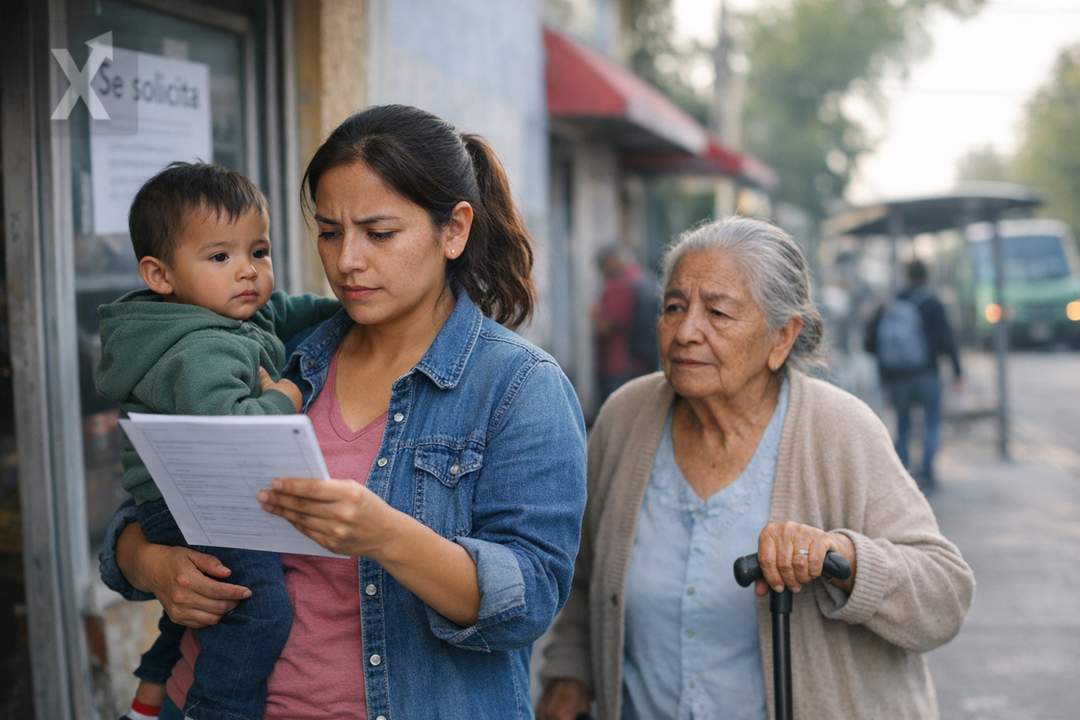
Low unemployment is coexisting with a rise in people who are neither working nor consider themselves available—driven by demographics and a caregiving burden concentrated among women.
Mexico’s unemployment rate has held near historically low levels, but that snapshot isn’t enough to explain what’s happening beneath the surface: the number of people outside the labor force is growing—and many of them also say they’re not available to work. In the first quarter of 2026, the Not Economically Active Population (PNEA) stood at about 43 million; of those, 38.1 million said they were not available for work, a block that has become increasingly central to the debate over the real performance of the labor market.
Labor survey data suggest this is not only about people who “stopped looking” for work in the classic sense—those who might reenter if an opportunity arose—but a broader group that is now farther from the labor market for reasons ranging from illness and retirement to household obligations and caregiving. Between the first quarter of 2020 and the same period in 2026, the available PNEA shrank, while the not-available PNEA grew by millions, pointing to a structural shift in how time is allocated among paid work, school, retirement, and unpaid work.
In macroeconomic terms, this reshuffling matters because labor supply is one of the core inputs to potential growth. In an economy where domestic consumption depends on labor income—and where tax collection and the sustainability of health and pension systems rest on the contributor base—lower labor force participation can become a quiet drag. At the same time, the apparent “strength” of employment can be distorted by rising informality and by the statistical stability of unemployment, which doesn’t capture those who are no longer looking and don’t consider themselves available.
By the end of the first months of 2026, analysts have also noted that job growth has been concentrated in informal segments, with weaker formal job creation. That pattern not only reduces access to social security and credit; it also limits aggregate productivity, a key factor if Mexico is to sustain expansion amid stronger industrial competition linked to nearshoring and financial conditions that, while they’ve normalized from recent peaks, remain high in real terms for households and businesses.
Demographics Are Changing the Rules of the Game for Businesses and Government
The backdrop is demographic: Mexico is moving past the “demographic dividend” that for decades provided an abundant and relatively young workforce. With lower birthrates and a gradually aging population, the availability of workers tends to decline, pushing labor-intensive sectors—such as services, retail, certain manufacturing, and construction—to compete harder for staff or reorganize processes. For public policy, the shift brings fiscal and planning challenges: greater demand for health services, increased pressure on pension systems, and the need to raise productivity to keep per-capita income growing without relying on large cohorts of young people entering the workforce each year.
In this context, investment in physical capital, digitization, and automation becomes more important. However, productivity in Mexico has historically faced obstacles such as low technology adoption among micro and small businesses, skills gaps, persistent informality, and sharp regional disparities. The demographic transition alone doesn’t determine growth, but it does make it more costly to delay reforms and investments in training, labor mobility, infrastructure, and a regulatory environment that helps more firms scale up and formalize employment.
The debate over incentives created by social programs also comes up repeatedly, though conclusions tend to be nuanced: the available evidence doesn’t support broadly attributing the rise in unavailability to a single factor. In practice, leaving the labor market usually reflects several variables at once—age, health, family responsibilities, job conditions, wages, and transportation costs—so the most useful reading is that this is a structural phenomenon that calls for comprehensive responses.
Beyond demographics, caregiving has become a central explanation for why millions—especially women—remain outside the paid labor market. Organizations such as Oxfam Mexico have documented that a meaningful share of young women classified as “neither in school nor working” are in fact doing unpaid domestic and care work. That work, while invisible on payrolls, has economic value: recent estimates put it at around a quarter of GDP, above sectors traditionally seen as growth engines, underscoring its scale and its role in the day-to-day functioning of the economy.
The unequal distribution of these tasks affects labor force participation: women—especially in prime working ages—report spending far more hours on direct care, accompaniment, and domestic work, which limits their availability for formal jobs with rigid schedules. This ties the labor issue to social and urban policy choices: access to childcare centers, early education, elder-care services, safe transportation, and compatible schedules. Without these supports, the economy may end up operating with an additional constraint: talent that doesn’t enter paid employment even when there is demand for workers in multiple industries.
The implications extend to wages and business operations. If the market faces a relative labor shortage in certain areas, costs may rise; but if the jobs being offered are mostly informal or low-quality, shortages can coexist with high turnover and low productivity. In states with stronger industrial and export momentum, pressure to find workers may increase, while in slower-growth regions, discouragement—or a lack of options compatible with family responsibilities—may deepen unavailability.
Looking ahead, Mexico’s challenge will be twofold: on the one hand, adapting to aging and a labor force that will grow more slowly; on the other, reducing the barriers that keep millions out of paid work due to the lack of an adequate care system. The potential payoff from addressing this is broad: higher labor force participation, stronger household disposable income, a larger taxpayer base, and better productivity performance—especially if formalization and training accompany the process.
In perspective, Mexico’s labor market is facing not only the challenge of creating jobs, but also of sustaining a base of available workers in a country that is aging and where caregiving absorbs time and opportunity—particularly for women. The discussion about growth and productivity, therefore, increasingly runs through care policy, formalization, and demographic adaptation.