Finance Ministry Adjusts IEPS Fuel Stimulus: Less Support for Diesel, More for Regular, Premium Left Without a Subsidy
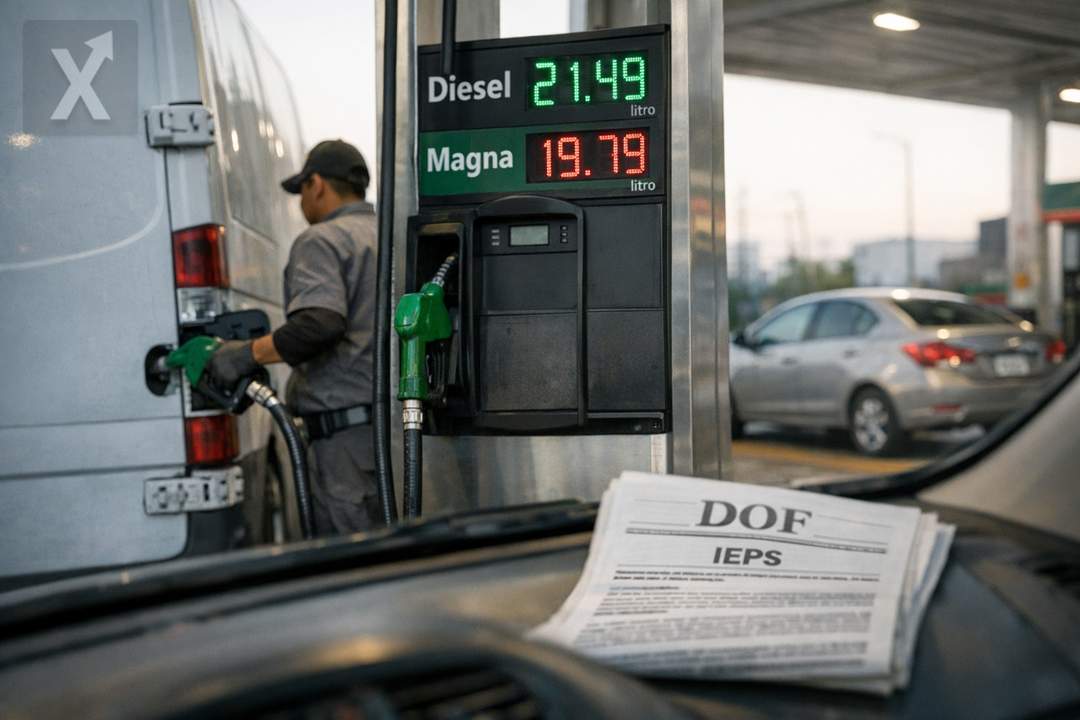
The changes to the tax stimulus aim to cushion pressure on fuel prices and limit spillovers to inflation and logistics costs.
Mexico’s Ministry of Finance and Public Credit (SHCP) once again tweaked the levers on the tax stimulus tied to the Special Tax on Production and Services (IEPS) applied to motor fuels for the week of April 25 through May 1, as international volatility continues to filter into domestic transportation and distribution costs.
For diesel—an essential input for freight trucking and a large share of passenger transport—Finance cut the stimulus: the per-liter discount will be 2.44 pesos, equivalent to 33.22%. As a result, the effective IEPS amount reflected in the final price will be 4.92 pesos per liter. The cut contrasts with the prior week’s higher support, when the stimulus was 3.18 pesos (43.17%).
For regular gasoline (Magna), the stimulus increased. SHCP will apply a discount of 1.05 pesos per liter (15.68%), bringing the effective IEPS charge to 5.65 pesos. The upward adjustment versus the previous week—when support was 0.78 pesos—keeps in place the strategy of smoothing consumer price swings, particularly for the most widely used fuel in the domestic market.
Premium gasoline, meanwhile, will remain without a tax stimulus for a second consecutive week. This means the IEPS will be charged in full at 5.66 pesos per liter—an approach typically used when authorities want to target support toward fuels with a bigger impact on the consumer basket or on production logistics.
As usual, Finance publishes these stimulus levels every Friday in the Official Gazette of the Federation (DOF) and calibrates them based on international benchmarks and fuel-market dynamics in the United States, since Mexico relies heavily on imports of gasoline and other refined products. That dependence means moves in external prices and the exchange rate can pass through quickly to the local market—even with cushioning mechanisms in place.
Economic Impact: Inflation, Logistics, and Public Finances
The IEPS stimulus works like a temporary “cushion”: when international prices rise, the government trims part of the tax to moderate the hit to the pump price; when pressures ease or fiscal room tightens, the stimulus is reduced. In Mexico, diesel has a broad, economy-wide impact because it affects freight costs, the distribution of food and goods, and services tied to supply chains; as a result, its subsidy is often viewed as a tool to rein in second-round inflationary pressures. However, this mechanism also carries a fiscal cost: every peso of stimulus means less tax revenue, forcing policymakers to balance price containment with budget discipline—especially in an environment where spending on social programs, infrastructure, and debt service is competing for resources.
Another factor is the “administered” component and voluntary agreements with gas stations designed to prevent abrupt price spikes, particularly for diesel. While these strategies can help anchor expectations and provide short-term certainty for carriers and consumers, their effectiveness depends on international price gaps not widening persistently. If the external shock drags on, the adjustment typically gets passed along gradually to consumers or puts additional pressure on the fiscal balance.
Looking ahead, the stimulus levels could keep shifting week to week as global crude and refined-product prices move and seasonal demand changes. For logistics-intensive businesses, the message is caution: even with support, energy costs may remain high and volatile, often prompting hedging strategies, renegotiation of rates, and route-efficiency measures. For households, the impact will show up more as relative price stability than as meaningful price declines, since the stimulus acts as a buffer—not a permanent replacement for the international price level.
Overall, Finance’s adjustment reinforces a policy of fine-tuning the IEPS: more support for regular gasoline, a partial cut to diesel, and Premium left without a subsidy—aimed at containing inflationary impacts while keeping an eye on the fiscal cost of maintaining prolonged stimulus measures.






