Mexico solidifies its USMCA edge: exports more to the U.S. despite higher tariffs, while Canada feels the impact of energy and volatility

In a year marked by trade tensions and tariff threats out of Washington, Mexico managed to hold— and even expand—its footprint in the U.S. market. From January to November 2025, U.S. imports from Mexico totaled $492.513 billion, a 6% year-over-year increase, according to the U.S. Department of Commerce. By contrast, purchases from Canada fell 7% to $351.186 billion. The figure matters because Mexico’s performance came despite facing a higher effective tariff rate than Canada’s for several months of the year.
The gap isn’t explained by trade policy alone, but by productive structure. Estimates from the Penn-Wharton Budget Model show that, between March and October, Mexico bore an approximate effective tariff rate of 3.8% to 4.7%, versus 1.8% to 3.7% for Canada. The effective rate—unlike the headline tariff—captures what the importer actually ends up paying and therefore provides a truer read on the impact on prices, margins, and purchasing decisions.
Under tariff pressure tied to migration and fentanyl, triggered via emergency powers (IEEPA), both USMCA partners sped up their “shielding” strategy by increasing compliance with rules of origin and other treaty provisions. The jump was striking: Mexico went from around 45% compliance in early 2025 to roughly 90% by October, while Canada followed a similar path from the mid-30s. In practice, this means reconfiguring supplier networks, improving traceability of regional content, and making documentation adjustments that, while costly, reduce exposure to discretionary measures.
The engine that tilted the balance in Mexico’s favor was the composition of its exports. Although the automotive segment showed signs of slowing—sensitive given its weight in manufacturing employment and the deep integration of auto parts—Mexico made up for it with a rebound in goods tied to advanced technologies, an area where the country has gained ground thanks to growth in electronics, electrical equipment, precision devices, and assemblies linked to North American supply chains. In parallel, Canada faced a headwind: its heavy exposure to oil and commodities made it more vulnerable to the decline in global crude prices in 2025, a factor that likely weighed more than tariffs in the pullback of its energy sales.
The outcome fits a broader trend: Mexico has solidified its position as one of the United States’ top trading partners, driven by nearshoring, geographic proximity, relatively competitive labor costs, and a manufacturing ecosystem anchored in clusters in the Bajío, the northern border region, and the central-west corridor. Still, progress isn’t automatic. Bottlenecks remain—logistics infrastructure, energy availability, red tape, security, and water in certain industrial hubs—that can limit the pace of new investment, especially in electricity-intensive sectors such as advanced auto parts, data centers, and electronics manufacturing.
Politics also played a role. While Mexico prioritized low-profile negotiations and technical cooperation with Washington, Canada went through episodes of greater friction. That contrast matters because, in a high-uncertainty environment, operational continuity carries real weight: for exporting firms, the cost of an interruption (customs inspections, holds, or a rule change) is often higher than the cost of a marginal tariff. That’s why regulatory stability—or at least predictability—becomes a competitive asset.
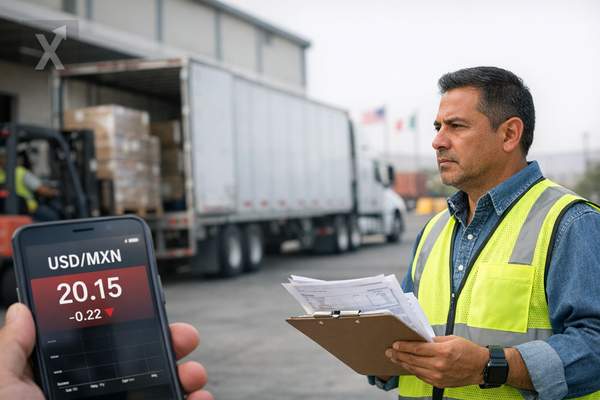
On the macro front, export performance came amid a firm currency. The peso’s appreciation in 2025—supported by high real interest rates, relative fiscal discipline, and inflows tied to remittances and investment—tends to make exports more expensive in USD terms. Even so, demand held up, suggesting that in several segments Mexico is competing more on supply-chain integration, delivery times, and proximity than on pure price. That said, a strong peso does compress margins, especially for mid-sized suppliers with less ability to hedge currency risk.
Looking ahead, the main risk is that U.S. trade policy swings back toward sector-specific actions—autos, steel, aluminum, semiconductors, or even food—or toward criteria that aren’t strictly commercial. For Mexico, that reinforces the need to deepen USMCA compliance, raise regional content where it’s cost-effective, and improve customs and logistics infrastructure to reduce border-crossing costs. At the same time, the opportunity is to capture more higher value-added links: design, engineering, testing, certifications, and manufacturing-related services—not just assembly.
By the end of 2025, foreign trade data show elevated Mexican exports that remain highly concentrated in the U.S. market, keeping the economy exposed to the U.S. industrial cycle and to its policy decisions. Diversification toward other markets is moving forward, but it is still limited relative to the scale of the North American relationship. In that context, the challenge for 2026 will be to sustain competitiveness through investment in energy, human capital, and logistics security, while managing external volatility without losing appeal for long-term projects.
Overall, the data suggest Mexico turned tariff pressure into an incentive to “anchor” itself more firmly to the USMCA and gain ground in more complex manufacturing segments, while Canada felt the strain of a profile more exposed to energy and international prices. Mexico’s performance is favorable, but it depends on maintaining certainty, improving domestic conditions, and anticipating a U.S. trade agenda that will likely remain fluid.