Valentine’s Day Becomes a Key Gauge of Domestic Consumption in Mexico
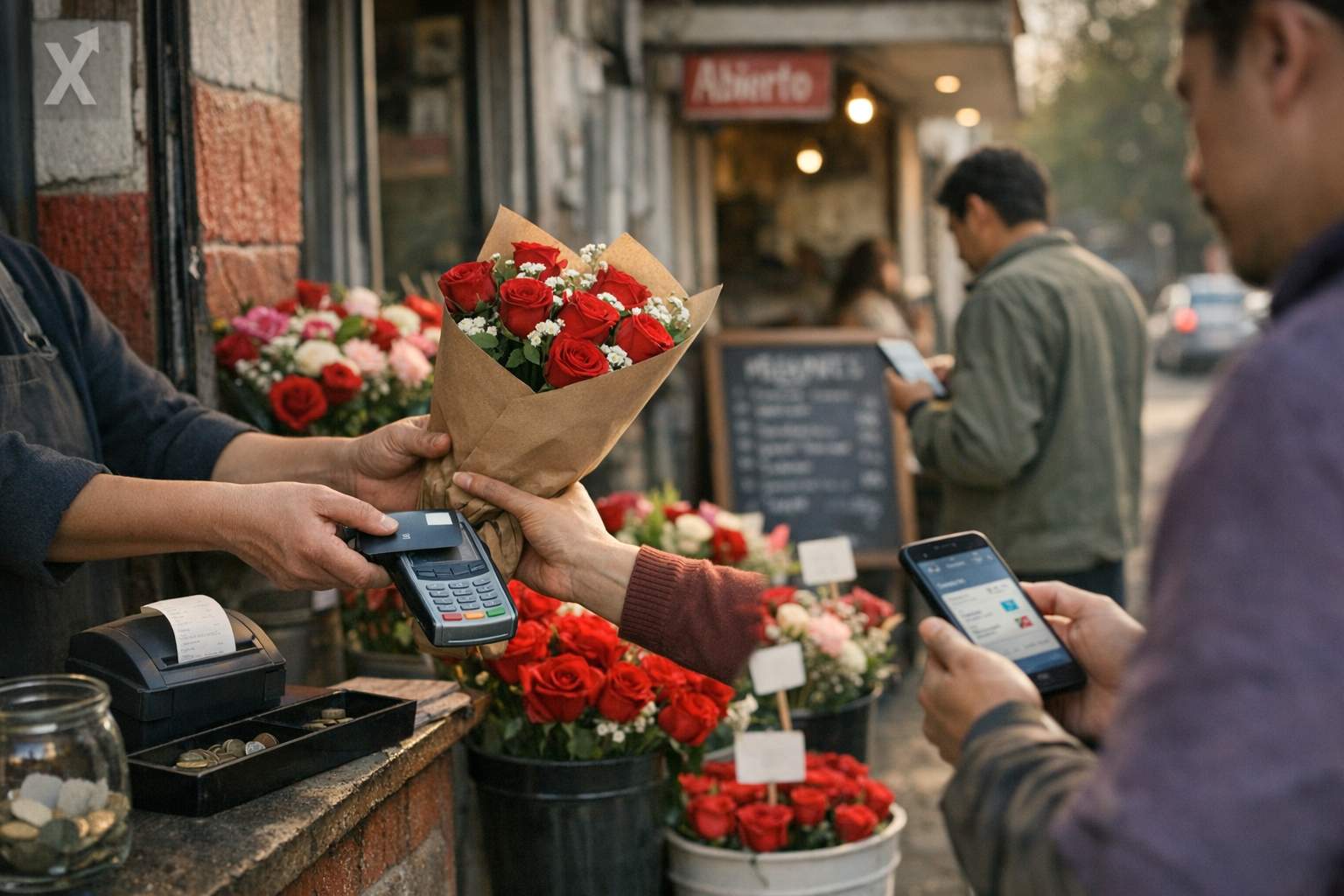
Spending tied to February 14 is rising and points to consumption that favors experiences, though it remains shaped by prices and disposable income.
Love and Friendship Day has stopped being a purely commercial date and has become one of the year’s first major “early read” on domestic consumption. For this February 14, the retail, services, and tourism sectors estimate an economic spillover of 36.2 billion pesos, 11.4% more than in 2025, according to projections from the Confederation of National Chambers of Commerce, Services and Tourism (Concanaco Servytur). That figure extends an upward trend: 25.0 billion pesos in 2023, 28.0 billion in 2024, and 32.5 billion in 2025.
The increase reflects a mix of factors: cumulative inflation in frequently purchased categories, wage adjustments across several sectors, greater formalization of payments among small businesses, and, above all, a growing preference for “giving time” through dinners out, outings, and overnight stays. Unlike campaigns such as El Buen Fin, Valentine’s Day spending depends more on immediate purchases of in-person services and less on installment financing, so it tends to boost liquidity quickly for thousands of micro and small businesses.
Concanaco estimates the economic impact is spread across roughly 4.8 million business establishments linked to retail, services, and tourism. That breadth explains why the date matters not only for large chains, but also for florists, bakeries, perfumeries, coffee shops, gift stores, and especially restaurants, where the day translates into high table turnover and an average check that runs above normal.
Average spending per person is around 1,100 pesos, with wide variation—ranging from about 550 pesos to nearly 1,650—dispersion that reflects a segmented market. In households under greater cost-of-living pressure, the celebration tends to focus on lower-cost gestures or “at-home” experiences; in other segments, diners prioritize restaurant meals, weekend getaways, and purchases at department stores.
In this context, restaurants once again serve as the main barometer. The National Chamber of the Restaurant and Seasoned Food Industry (Canirac) is projecting a sales increase of 10% to 18%. Still, the sector itself has stressed that growth has a clear ceiling: physical capacity. When February 14 falls on a weekend—already a busy period—the constraint is the number of tables, seatings, and available staff, rather than any “extraordinary” expansion driven by prices.
Prices, Wages, and the Weight of Services Consumption
Valentine’s Day performance is playing out in an economy where consumption has remained resilient, though with signs of price sensitivity. Inflation has cooled from prior years’ peaks, but that hasn’t removed pressure on household budgets: dining out, imported products or items with dollar-linked inputs, and certain services have kept rising, pushing consumers to compare more, book in advance, or swap traditional gifts for more affordable options. At the same time, increases to the minimum wage and to collective bargaining contracts have lifted income for some groups, supporting a portion of discretionary spending, particularly on experiences.
For businesses, February 14 serves as an operational stress test: fast-moving inventory (flowers, chocolates, cakes), logistics coordination, temporary staffing, and pricing strategies. For food and beverage businesses, the key is maximizing occupancy without eroding service quality, since online reputation can affect future sales. In urban tourism, the impact is more uneven: some hotels benefit from short getaways, while others see only a marginal effect if they compete with beach destinations or local events.
Beyond the anecdotal, Valentine’s Day spending helps read broader trends: the shift of spending toward services, the importance of local economies, and the circulation of cash and electronic payments among small merchants. It also helps anticipate the tone of the first quarter: if consumers are willing to spend on experiences, that tends to support labor-intensive activities, even if the boost is seasonal and concentrated in just a few days.
Looking ahead, the challenge for the sector will be sustaining margins in an environment where costs—rent, energy, inputs, and payroll—remain elevated, and where consumers have become more selective. If inflation continues to moderate and employment stays steady, dates like February 14 can keep providing oxygen to neighborhood businesses; if there are price shocks or weaker confidence, spending could shift back toward low-cost celebrations.
In short, February 14 now functions as a practical indicator of the domestic market’s pulse: it shows who can spend, which categories capture that spending, and how quickly money moves through the day-to-day economy—especially in services and small- and mid-sized commerce.






